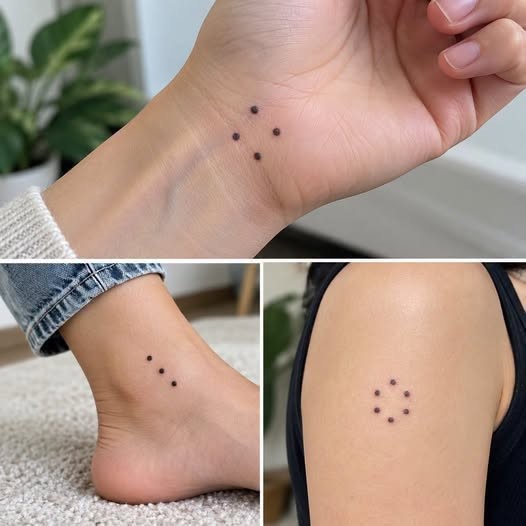
A three-dot tattoo is one of the most recognizable minimalist tattoo designs, but its meaning is far from universal. Three small dots may be placed on a hand, wrist, face, ankle, or another part of the body, often arranged in a triangle. Because the design is simple, it has been adopted by people from many backgrounds for many different reasons.
Online discussions sometimes claim that a three-dot tattoo always identifies someone as a gang member or signals danger. That conclusion is inaccurate and can unfairly stigmatize people. Like many symbols, tattoos can carry different meanings depending on a person’s culture, experiences, community, beliefs, and intention. A design alone cannot reliably reveal someone’s history, character, or behavior.
Understanding the context behind a tattoo matters. For one person, three dots may honor children or family members. For another, they may represent a spiritual belief, a period of personal growth, or an appreciation for clean, understated design. In some specific historical or criminal-justice contexts, similar markings have been associated with the phrase mi vida loca, or “my crazy life.” Even then, the tattoo by itself is not proof of gang involvement or criminal activity.
Why Three-Dot Tattoos Have More Than One Meaning
Tattoos are personal forms of expression. Their meanings are often created by the wearer rather than dictated by a fixed rule. A single image can take on different significance across countries, religions, social groups, and generations. This is especially true of simple symbols, such as dots, lines, stars, initials, or numbers.
Three-dot tattoos are visually flexible. They can be arranged in a triangular pattern, a straight line, or incorporated into a larger design. Their small size can make them appealing to people who want a discreet tattoo, while their numerical symbolism offers many possible interpretations.
It is therefore important to avoid treating tattoo imagery as a shortcut for assessing another person. Law-enforcement and academic discussions of gang identifiers generally emphasize that symbols must be evaluated within a broader context. Clothing, neighborhood, associations, social-media activity, behavior, and verified intelligence may all be considered in professional investigations, but none of these factors should be treated as conclusive in isolation. For members of the public, assumptions based on appearance can reinforce stereotypes and lead to unnecessary fear.
Mi Vida Loca: A Well-Known Cultural Association
One of the best-known interpretations of three dots is the Spanish phrase mi vida loca, commonly translated as “my crazy life.” The design is sometimes described in relation to Chicano and Mexican-American tattoo traditions. In this context, it may refer broadly to a difficult life, resilience through hardship, an unconventional path, or a personal connection to a particular street-influenced style of tattooing.
The phrase has also appeared in reporting and law-enforcement references about certain gang-related tattoo practices. However, that association needs to be handled carefully. Not every person who uses the phrase, appreciates Chicano art, speaks Spanish, or has three dots is connected to a gang. Cultural symbols can spread through music, film, fashion, tattoo culture, and social media, often becoming detached from their earlier or more localized associations.
Experts and civil-rights advocates have long cautioned against broad visual profiling. A tattoo can be old, commemorative, artistic, inherited from a past identity, or unrelated to any organization. It may also be chosen without knowledge of every possible interpretation. Assigning a criminal identity to someone based solely on a small tattoo is neither fair nor reliable.
Three Dots as a Family, Friendship, or Life Symbol
For many people, the number three is the central meaning. Three dots can represent three children, three siblings, three close friends, or three people whose relationship is especially meaningful. The tattoo may serve as a quiet reminder of loved ones, especially when it is placed somewhere the wearer sees often, such as the wrist or hand.
Others use three dots to mark important moments in time. A common interpretation is the connection between the past, present, and future. This can represent reflection on past experiences, attention to the present, and hope for what lies ahead. The same concept may appeal to someone who has overcome a difficult period or who wants a simple daily reminder of personal change.
Three dots can also stand for beginnings, challenges, and growth. Because the image is open to interpretation, it works well for people who prefer a tattoo with private meaning. A person does not have to explain the story behind it to anyone else, and its understated nature can make it feel especially personal.
Religious and Spiritual Interpretations
In Christian settings, three dots may be used to symbolize the Holy Trinity: the Father, the Son, and the Holy Spirit. This meaning is not exclusive to tattoos; the number three has longstanding significance in Christian theology and religious art. A person choosing this design may see it as an expression of faith, prayer, or spiritual guidance.
Outside Christianity, people may use three dots to represent mind, body, and spirit. Others associate the image with balance, unity, or the idea that different parts of life are interconnected. These interpretations are personal rather than universally standardized, but they reflect the broad role that the number three has played in philosophy, storytelling, and spiritual traditions.
Anyone considering a religious tattoo may wish to reflect on their own beliefs and speak with a trusted faith leader if they want guidance. Meanings can vary within religious communities, and a design that is deeply meaningful to one person may carry little significance to another.
Minimalist Tattoos and Personal Expression
Not every tattoo needs a complex explanation. Minimalist tattooing has become widely popular because small designs can be elegant, versatile, and easy to personalize. Three dots fit this style well. They are simple enough to be subtle but can still communicate an idea, memory, or aesthetic preference.
Some people choose three dots because they like geometric balance. Others may pair the dots with a quotation, a date, an initial, or a larger piece of artwork. The meaning may evolve over time as the wearer connects the tattoo to new experiences. This is one reason outside observers should be cautious about making assumptions: a tattoo’s most important meaning usually belongs to the person who wears it.
There is also a practical point to consider. Tattoos can fade, be covered up, or be removed, but they are generally intended to be long-lasting. People considering a three-dot tattoo may want to research possible cultural associations in their area, think carefully about placement, and choose a licensed studio that follows appropriate hygiene and safety practices.
Can a Three-Dot Tattoo Identify Gang Membership?
No. A three-dot tattoo cannot, on its own, identify gang membership. While the design has been documented in some gang-related contexts, it is also used extensively by people with no connection to gangs. There is no single tattoo that can accurately establish a person’s affiliations, intentions, or risk to others without substantial corroborating evidence.
This distinction is important because visual assumptions can have serious social consequences. People with tattoos may face bias in employment, education, housing, travel, and everyday interactions. Misidentifying someone because of a tattoo can cause embarrassment, exclusion, or discrimination. It can also obscure the reality that tattoos are now common across many professions, age groups, and communities.
Public-safety decisions should be based on conduct and credible information, not on stereotypes about appearance. If someone feels unsafe because of specific threatening behavior, they should prioritize their immediate well-being and contact appropriate local services when necessary. But the mere presence of a tattoo, including three dots, is not a reason to fear someone or make a report.
The Importance of Cultural Context
Cultural context is essential when discussing tattoo symbols. Chicano tattooing, for example, has a rich visual history shaped by family, faith, neighborhood identity, art, and experiences of Mexican-American communities. Reducing an entire artistic tradition to criminality overlooks that complexity and can perpetuate harmful stereotypes.
Similarly, Spanish-language phrases and imagery do not belong to one social group. They may reflect language, heritage, music, literature, family, or personal identity. When a symbol has appeared in both cultural expression and criminal subcultures, careful language is especially important. A responsible explanation recognizes historical associations without implying that everyone who uses a symbol shares the same background or beliefs.
Internationally, tattoo meanings also change from place to place. A symbol understood one way in the United States may have a completely different meaning in Europe, Latin America, Asia, or elsewhere. Social media has further accelerated the movement of tattoo trends across borders, making fixed interpretations even less dependable.
How to Approach Tattoo Meanings Responsibly
If you are curious about someone’s tattoo, the most respectful approach is simple: do not assume. If the setting is appropriate and the person seems comfortable, a polite question may offer a better answer than an internet search. Many people are happy to share the personal story behind their tattoos, while others may prefer to keep that story private.
For people considering a three-dot tattoo, research can be useful. Look at its possible cultural, spiritual, and historical meanings, but remember that you can define your own intention. A qualified tattoo artist may also offer advice about design, placement, skin care, and studio safety. Health authorities recommend choosing professional tattoo establishments that use sterile equipment and follow local regulations to reduce the risk of infection and other complications.
Ultimately, three dots are not a universal code. They may represent mi vida loca, three loved ones, the Holy Trinity, personal resilience, a life philosophy, or simply a preference for minimalist art. The same design can carry a different story for every wearer.
Conclusion: A Small Tattoo Does Not Define a Person
A three-dot tattoo can have historical and cultural associations, including links to the phrase mi vida loca in certain contexts. Yet it can also symbolize family, faith, friendship, personal milestones, or nothing more than an appreciation for simple design. Treating it as automatic evidence of gang membership is misleading.
The most accurate way to understand tattoos is to recognize their individual context. People should be judged by their actions and character, not by a small symbol on their skin. For many wearers, three little dots are not a warning sign at all. They are a private tribute, a spiritual reminder, or a meaningful part of a personal story.
Sources
- National Institute of Justice: Gang Membership and Gang-Related Violence
- Centers for Disease Control and Prevention: Tattooing and Public Health Considerations
- Federal Bureau of Investigation: Gangs
- American Civil Liberties Union: Concerns About Gang Databases and Misidentification
- Encyclopaedia Britannica: The Trinity in Christianity
Disclaimer: This content is intended for entertainment purposes only and is not based on real events.