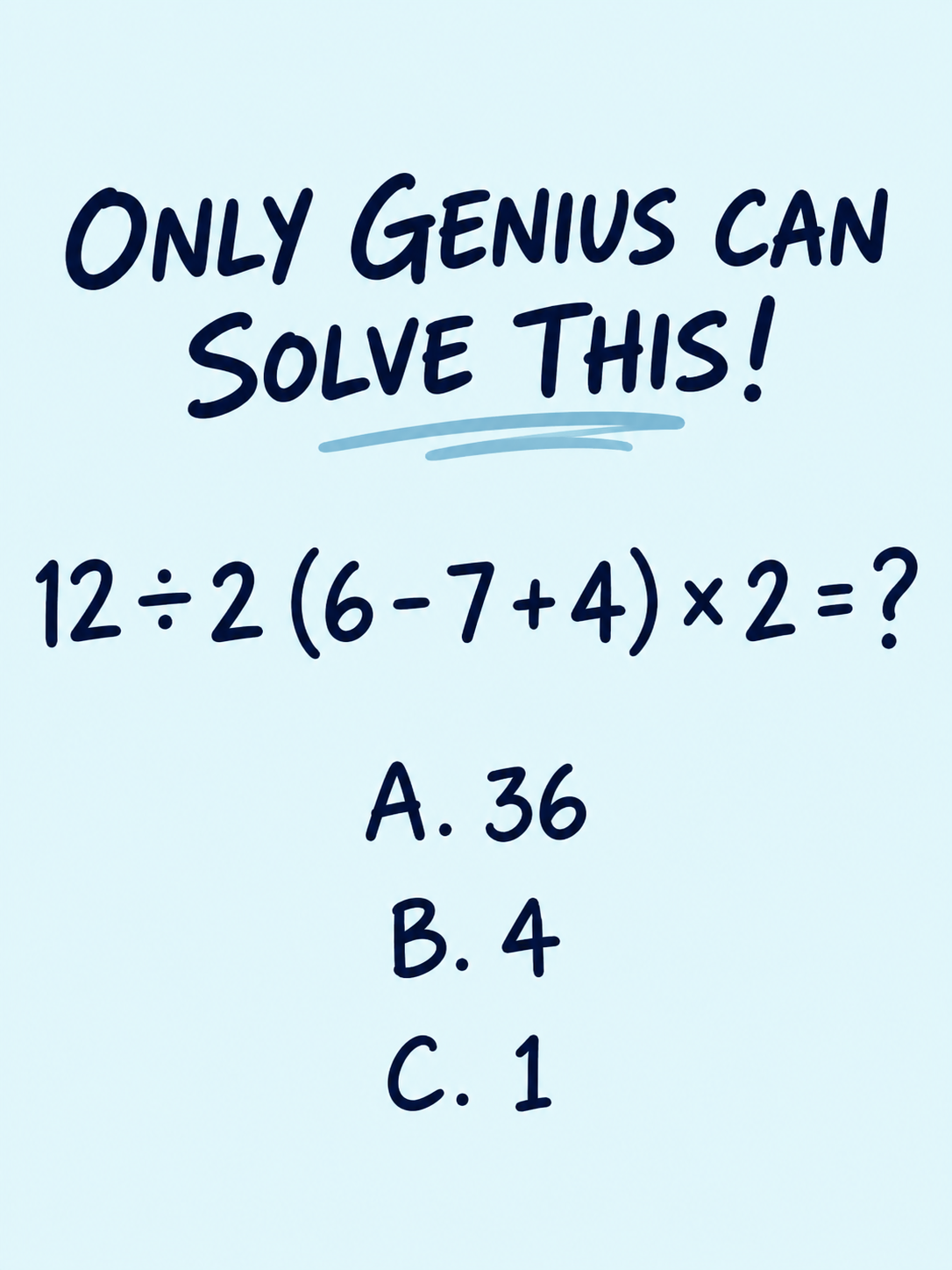
At first glance, this looks like a simple math problem that should take only a few seconds.
Introduction: Why Simple Math Problems Can Confuse
Mathematics is often considered a precise language, yet even simple expressions can provoke heated debate and confusion when written in certain ways. A prime example is the order of operations puzzle that appears straightforward at first, but a small twist in notation can challenge even seasoned math enthusiasts. This article explores one such math puzzle, clarifies how to approach it using standard conventions, and explains why ambiguity in notation plays such a key role in the variety of answers people give.
The Math Puzzle Statement
Presented as a multiple-choice question, the puzzle asks readers to solve the following mathematical expression:
At first glance, many students and even adults feel confident that solving it will take just a few seconds. However, a closer look reveals the possibility for misunderstanding.
The Importance of Order of Operations (PEMDAS/BODMAS)
The core of the confusion in many math puzzles lies in the order of operations. In mathematics, the order of operations is a standard set of rules that specifies the sequence in which calculations should be performed to arrive at a correct answer. This is often remembered by students as PEMDAS (Parentheses, Exponents, Multiplication and Division, Addition and Subtraction) or BODMAS (Brackets, Orders, Division and Multiplication, Addition and Subtraction). These acronyms help learners remember:
- First, simplify inside Parentheses or Brackets.
- Next, evaluate Exponents or Orders (powers and roots).
- Then, perform Multiplication and Division from left to right.
- Finally, perform Addition and Subtraction from left to right.
Despite these guidelines, ambiguity in the notation can override expectations and produce different results based on how the problem is read and interpreted.
Step-by-Step Solution Using Standard Order of Operations
To approach the problem correctly, it’s crucial to work step-by-step and resist the temptation to jump ahead. Let us dissect the expression as per the usual conventions.
First, we focus on the part within the parentheses:
6 − 7 + 4
Here, subtraction and addition are on the same hierarchical level, so we process from left to right:
- 6 − 7 = −1
- −1 + 4 = 3
Now, the expression is reduced to:
12 ÷ 2(3) × 2
Deciphering Multiplication and Division
This is the stage where confusion typically arises. What does 2(3) mean in this context? According to conventional math notation, 2(3) indicates multiplication: 2 × 3. However, the expression does not insert extra brackets or clarify whether 2 × 3 forms a single unit in the denominator. According to the general rules, multiplication and division are performed from left to right.
Following this methodology:
- First, we evaluate 12 ÷ 2, which yields 6.
- Next, we multiply by 3: 6 × 3 = 18.
- Finally, we look at the final multiplication by 2: 18 × 2 = 36.
Thus, applying the left-to-right rule for multiplication and division, the answer becomes 36. This corresponds to choice A in the original puzzle.
The Alternative Interpretation: Why Some People Get 4
While the standard solution gives 36, a significant number of people arrive at the answer 4. This alternative stems from a different reading of the mathematical expression: treating 2(3) as a single number in the denominator. Thus, the reader interprets the problem as follows:
12 ÷ [2(3)] × 2
Which simplifies to:
- First, 2 × 3 = 6
- Then, 12 ÷ 6 = 2
- Finally, 2 × 2 = 4
Without explicit grouping brackets in the original expression, this interpretation is less supported by standard order-of-operations rules but is still a plausible source of error. This ambiguity reflects a classical problem in mathematics education — notation matters.
Mathematical Notation: The Root of Debate
The key lesson from this puzzle is not just the arithmetic, but how a slight ambiguity in notation leads to wide disagreement. Mathematical writing aims to be unambiguous, but real-world examples such as this demonstrate why clear notation is crucial. To eliminate confusion, extra brackets should be used whenever groupings are not immediately obvious. If the intention was to have 2(3) as part of the denominator, the expression should have been written as:
12 ÷ [2(6 − 7 + 4)] × 2
Here, it is abundantly clear that the product 2 × (6 − 7 + 4) is grouped in the denominator, and nearly everyone would agree on the calculation process and answer.
Historical and Educational Perspective
Puzzles like this have appeared in standardized tests, viral posts on social media, and even in professional mathematical literature as cautionary examples. Mathematics educators frequently warn students about the importance of parentheses and clear notation, emphasizing that when in doubt, seek clarification or rewrite the expression for clarity.
According to educational experts, such as those referenced by the BBC and Reuters, ambiguity in problem phrasing is among the most common sources of error for students and even teachers. Instructors suggest that every step in a calculation should be carefully verified and, when possible, ambiguous expressions should be avoided altogether.
The Global Conversation: Viral Puzzles and Societal Reactions
These types of math puzzles frequently go viral online, sparking widespread conversation and debate across social media platforms. Forums such as Reddit and Twitter often feature heated discussions in which users defend their reasoning, sometimes pointing to regional differences in math education or even differences in calculator algorithms.
Internationally, most mathematics curricula now teach a version of the PEMDAS/BODMAS rules. Still, the way multiplication is written adjacent to parentheses can vary by country, increasing the likelihood of misinterpretation. Famous examples have even led schools to clarify their policies on mathematics notation and calculator use.
Best Practices in Mathematics: Clarity and Precision
Mathematicians and educators universally agree on the importance of clear communication. The use of explicit brackets, careful attention to the order of operations, and a step-by-step approach to problem solving are hallmarks of mathematical accuracy. In ambiguous cases, rewriting the problem with additional brackets or asking for clarification can help ensure correct results.
Calculators, spreadsheets, and computer algebra systems generally follow the established left-to-right conventions for multiplication and division. However, some older calculators may give different answers due to variations in how they parse ambiguous input — another reminder to double-check settings and standard practices.
Conclusion: Lessons from an Ambiguous Math Puzzle
The puzzle under discussion demonstrates that even experienced math students and adults can be tripped up by notation. The essential lesson is to move carefully through each stage of the calculation, always mindful of brackets, grouping, and the left-to-right precedence of operations where applicable. While the answer of 36 matches standard conventions, the answer of 4 reflects understandable confusion produced by ambiguity in mathematical notation.
Ultimately, math puzzles such as this highlight the necessity for clear, unambiguous communication, both in the classroom and in written problem statements. They also reinforce the basic skills of detailed, stepwise reasoning — skills valuable in every area of life and learning.
In summary: For the expression as originally written, following the order of operations and left-to-right calculations, the answer is 36.
Sources
- BBC News – Education
- Reuters
- The Guardian – Education
- Mathematical Association of America
- NRICH – University of Cambridge
Disclaimer: This content is intended for entertainment purposes only and is not based on real events.