Get ready to flex your mental mathematical muscle!
Mental math is not just about performing arithmetic quickly—it is a celebration of logic, pattern recognition, and fundamental mathematical principles. Today’s challenge exemplifies these qualities, requiring you to engage with an intriguing geometric puzzle where sharp observation and the application of simple rules allow you to reach the answer without ever putting pen to paper.
Introduction: The Essence of Mental Math Challenges
Brain teasers rooted in geometry have remained a staple in both educational settings and in recreational mathematics for centuries. These exercises promote spatial reasoning, logical deduction, and an intuitive grasp of mathematical laws. Instead of complex calculations, the core of today’s problem lies in visual analysis and stepwise reasoning using basic geometry.
The Problem Statement: An Intersection of Lines and Angles
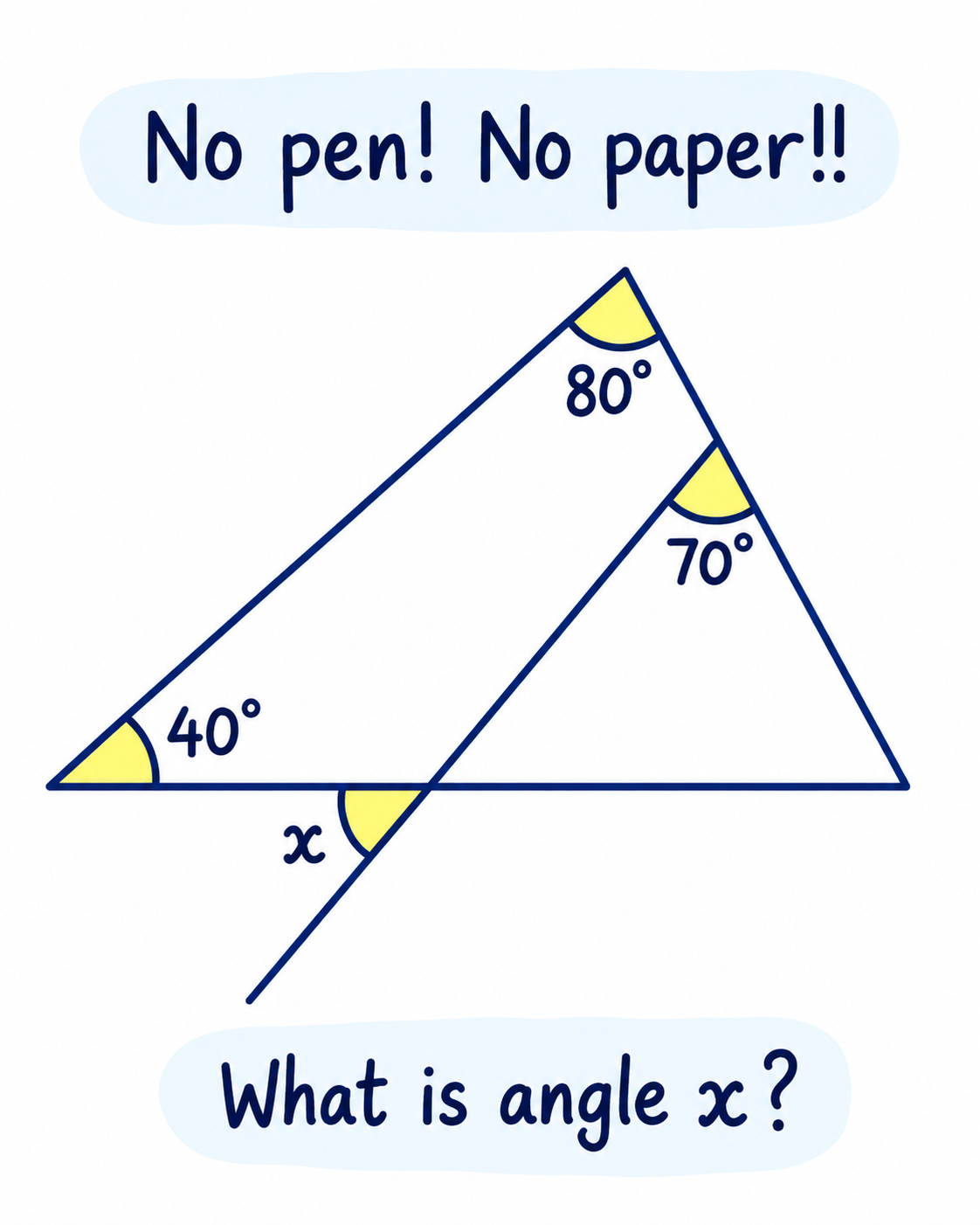
Observe the following image as you embark on this challenge:

What stands before you is a network of intersecting lines forming nested triangles. Some of the angles are marked with their measurements—40 degrees, 80 degrees, and 70 degrees—while a critical angle, labelled as X, awaits your solution. The instructions are clear: “No pen! No paper!” Thus, all reasoning must be performed mentally, making keen observation and logical deduction your most reliable tools.
Step 1: Focusing on the Largest Triangle
Start by examining the largest triangle in the figure, often called the outermost triangle. Geometry is generous in its rules, and one of the most fundamental laws is that the sum of the three interior angles in any triangle is always 180 degrees.
In this particular triangle, two of the angles have been provided: 40 degrees and 80 degrees. Your first task is to find the measure of the third angle, located at the base, right-side corner. The calculation is simple:
- Sum of angles in a triangle = 180 degrees
- Add known angles: 40 + 80 = 120 degrees
- Subtract from total: 180 – 120 = 60 degrees
This gives us the value of the unknown angle in the largest triangle: 60 degrees.
Step 2: Analyzing the Smaller, Nested Triangle
With the value of the shared angle established, you can shift your focus to the smaller triangle created by the intersecting lines within the overall figure. This inner triangle notably contains a 70-degree angle at its apex.
Importantly, this inner triangle shares one of its angles—the base, right-side corner—with the large triangle. As just determined, that angle measures 60 degrees.
Now, in this smaller triangle, two angles are already known:
- The top angle: 70 degrees
- The bottom right base angle (shared with the outer triangle): 60 degrees
To find the measure of the third angle (let’s call it Angle Y, located at the bottom left corner), apply the angle sum property once again:
- Sum of smaller triangle’s angles = 180 degrees
- Known angles: 70 + 60 = 130 degrees
- Subtract to find unknown: 180 – 130 = 50 degrees
Thus, the bottom left corner of the small triangle is 50 degrees.
Step 3: The Property of Vertically Opposite Angles
Now, consider Geometry’s invisible guiding hand: the principle of vertically opposite angles. When two straight lines intersect, the non-adjacent angles created at the intersection are always equal.
In your geometric problem, Angle X is formed at an intersection directly opposite the 50-degree angle just identified in the small triangle. These are, therefore, vertically opposite angles.
By this fundamental property:
- If one of the vertically opposite angles is 50 degrees, then its opposite (Angle X) must also be 50 degrees.
This solution comes from observing the structure and application of deeply rooted principles in geometry, all performed mentally as the challenge demands.
In-Depth: The Mathematical Principles Involved
Let’s take a closer look at the reasoning used and why it always holds true, no matter how complex the figure may appear:
- Triangle Angle Sum Theorem: All triangles, regardless of size or proportion, have interior angles that sum to 180 degrees. This rule emerges from Euclidean geometry and forms the backbone of countless geometric proofs and calculations.
- Vertically Opposite Angles: The intersection of two straight lines always forms two pairs of opposite angles. Each pair is congruent—equally measured—as a direct consequence of the way lines cross. This property is essential in complex diagrams, permitting quick identification of matching angles.
The beauty of such problems lies in layering simple ideas in a visually challenging context. They show that consistent application of fundamental geometric rules can unravel even complicated arrangements.
Educational Significance and Applications
Problems like these are more than just puzzles—they help reinforce critical thinking and visualization skills in mathematics education. Educators frequently use such challenges to:
- Promote logical deduction and critical reasoning
- Enhance students’ understanding of geometric properties
- Encourage solving problems step-by-step and avoiding careless errors
- Instill confidence in tackling visually complex diagrams through simple rules
Furthermore, success in these problems can boost self-confidence and deepen appreciation for the logical structure of mathematics itself.
Broader Context: Geometry in Daily Life and Other Fields
Mastery of geometry is valuable far beyond classroom walls. The ability to interpret complex visual information, deduce relationships, and apply structured rules is essential in:
- Engineering and architectural planning
- Computer graphics and animation
- Medical imaging (identifying structures in scans and models)
- Astronomy and space navigation
- Everyday tasks like home design and navigation
Recognizing that the same rules apply universally gives students and enthusiasts motivation to engage with even the simplest-seeming geometric puzzles.
Expert Commentary: Why Visual Logic Exercises Matter
Experts in mathematical education underscore the importance of mental logic challenges. According to the National Council of Teachers of Mathematics (NCTM) and reports from education-focused organizations, spatial reasoning skills are closely linked to future success in STEM disciplines.
Problem-solving that avoids mechanical calculation, instead focusing on reasoning, cultivates flexible thinking. Educational psychology researchers argue that logic-based tasks help learners build a robust understanding, transferable across mathematical topics and practical scenarios.
Societal and Global Engagement with Math Puzzles
The popularity of such puzzles is international. Many newspapers, online forums, and educational websites regularly publish geometry or logic brain teasers, encouraging diverse audiences to practice mental math. Participation in these activities contributes to lifelong learning and cognitive health, with researchers from the Alzheimer’s Association and the World Health Organization highlighting the value of regular mental challenges for long-term brain function.
Competitions, clubs, and public math festivals often feature similar problems, uniting people around the world in their enjoyment of pure reasoning and friendly challenge.
Step-by-Step Recap: How We Solved for Angle X
- Identified known angles in the largest triangle (40°, 80°), used the angle sum rule to calculate the missing angle (60°).
- Applied the same logic to the smaller, nested triangle (with angles 70° and 60°) to determine the third angle (50°).
- Recognized that Angle X and this 50-degree angle are vertically opposite, making Angle X equal to 50 degrees.
This consistent method demonstrates the utility of mental geometry and strengthens understanding for learners at every level.
Final Answer to the Challenge
Angle X is 50 degrees.
By approaching the problem with logic, geometric rules, and careful observation, the answer emerges without need for calculation tools or written notes—just the power of the human mind engaging with the structure of mathematics.
Post Views: 352
Sources
- BBC Future – The Benefits of Brainteasers
- NRICH: The NRICH Project, University of Cambridge (Geometry Resources)
- National Council of Teachers of Mathematics (NCTM) – Geometry Education Standards
- World Health Organization – Promoting Brain Health
- The Guardian – Why Maths is a Brain Booster
Disclaimer: This content is intended for entertainment purposes only and is not based on real events.