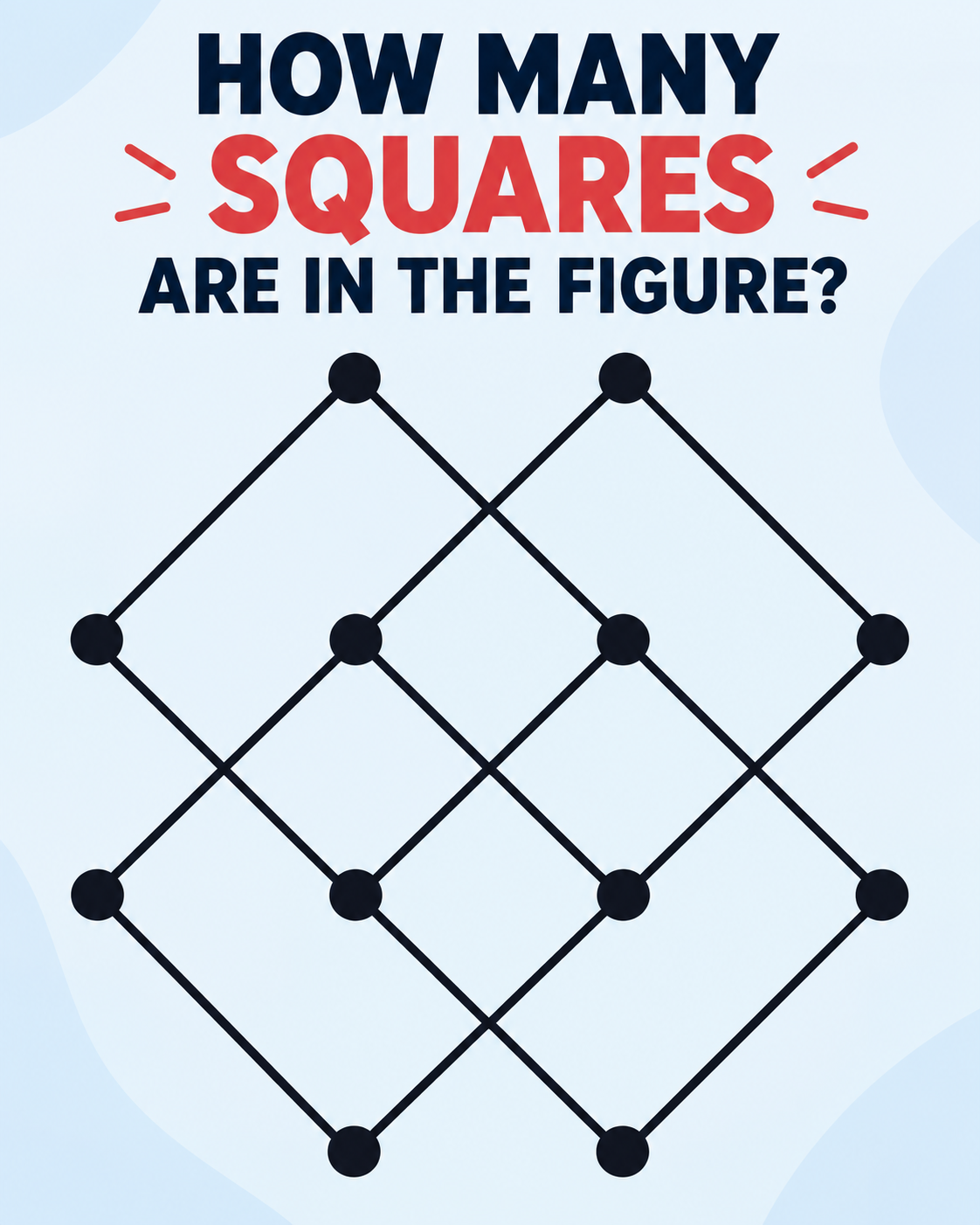
How Many Squares Are in the Figure? A Visual Challenge
Welcome to a fascinating exploration of a classic geometric puzzle—a challenge designed to engage your visual brain and test your perception skills. This riddle, simple at first glance, prompts us to look deeper, question our assumptions, and exercise careful analysis. Whether you’re a puzzle enthusiast or just enjoy a good brain teaser, understanding the principles and strategies behind this type of visual challenge can help hone your problem-solving abilities.
Understanding the Puzzle and Its Appeal
The puzzle in question features a grid composed of lines and distinct black dots, prompting viewers with the deceptively straightforward challenge: “How many squares are in the figure?” This query forms the basis of many visual and cognitive tests commonly seen in puzzle magazines, educational platforms, and psychological assessments. Such puzzles appeal to a wide range of audiences because they combine basic geometry with the opportunity to test one’s observational accuracy and spatial reasoning.

The Structure of the Grid: Exploring the Design
The image’s structure uses intersecting lines and black dots as connection points, creating a geometric pattern. At first glance, the arrangement seems simple—perhaps four or five obvious squares. However, the puzzle’s clever design masks the true complexity, encouraging participants to look beyond superficial patterns and discover less apparent squares embedded within the grid.
This visual illusion is strengthened by the configuration of diamonds and squares forming the grid. Human perception is often outsmarted by patterns like these, as our brains tend to focus on prominent shapes while overlooking subtle ones. The challenge lies in methodically tracing every possible square, including those formed by combining smaller shapes or those nested within the grid’s intersections.
Approaching the Puzzle Systematically
To solve this puzzle accurately, a systematic approach is crucial. It’s important not to rush—quick estimations often lead to missed squares or double-counting. Experts in cognitive science and mathematics recommend breaking down the puzzle into manageable steps, a practice that enhances accuracy and reveals hidden patterns.
Step 1: Count the Smallest Squares
Begin by identifying the smallest possible squares. In most geometric grids, these squares are bounded by the shortest intervals between lines and are usually the first noticed. Count each one meticulously, moving row by row or column by column. Using your finger or a pen to trace the grid can help avoid confusion and ensure no squares are overlooked.
Step 2: Evaluate Medium-Sized Squares
Once all small squares are accounted for, shift focus to those formed by combining multiple smaller units. These medium-sized squares might span two or three lines and can appear anywhere within the grid. Concentrate on peripheral spaces and intersections where two small squares meet, as these are often overlooked during initial observations.
Step 3: Identify the Largest Square
Finally, inspect the entire grid for one or more larger squares that encapsulate smaller regions. Many puzzles feature a single dominant shape that encompasses most of the grid, which is easy to overlook amid a sea of smaller blocks. Trace the grid edges to discern the boundaries of these larger squares and ensure each one is included in your total.
How Geometry Tricks the Eye: The Science Behind the Puzzle
Why are these puzzles so challenging? According to cognitive psychologists and mathematicians, the difficulty arises from the way our brains process visual information. Humans are wired to quickly identify familiar shapes—like squares, circles, and triangles—while the intricate details of overlapping patterns or composite shapes often escape notice.
Studies show that our perception is influenced by prior experience and expectations. In a grid where diamonds and squares coexist, the lines and intersections can confuse pattern recognition, leading to underestimated totals. Visual puzzles like this one engage spatial reasoning skills, requiring the viewer to mentally rotate, combine, or enlarge shapes to recognize all possible squares.
The application of geometric principles is key: a square’s definition requires equal sides and right-angle corners, but clever designers use overlapping diamonds and skewed patterns to trick the eye. This blend of art and science makes such puzzles effective tools for brain training and education.
Educational Value and Cognitive Benefits
Visual puzzles aren’t merely entertainment—they carry significant educational and cognitive benefits. By systematically searching for hidden shapes, individuals strengthen their attention to detail, spatial reasoning, and problem-solving capabilities. Educators routinely employ these challenges in classrooms to teach geometric concepts, encourage critical thinking, and build mental resilience.
Research published by bodies such as the American Psychological Association suggests that regular engagement with puzzles and logic problems enhances cognitive function and may delay age-related mental decline. Puzzles involving geometric grids are particularly valuable, as they help build foundational mathematics skills and foster analytical thinking in learners of all ages.
Strategies to Maximize Success
- Slow Down: Take your time. Rushing leads to errors and missed shapes.
- Trace Each Shape: Use a finger or pointer to physically trace squares. This helps keep track and avoid double-counting.
- Categorize by Size: Group squares based on their dimensions. Start small and work your way up to larger shapes for clarity.
- Check Intersections: Pay attention to places where lines overlap, as these are often sources of hidden squares.
- Repeat the Process: Go over the grid multiple times. Each pass may reveal overlooked shapes.
The Social Aspect: Sharing the Challenge
Geometric puzzles serve as excellent conversation starters and group activities. Sharing this visual riddle with friends or family can foster collaborative thinking and reveal individual differences in perception. A group might produce varying square counts, sparking productive debate and friendly competition. This social engagement further enhances learning, as discussing strategies and viewpoints leads to a more thorough exploration of the puzzle.
Such activities are also popular in workplace environments and cognitive workshops. Teams use these challenges to improve teamwork, communication, and collective problem-solving abilities. Their universal appeal ensures that people of different ages and backgrounds find satisfaction and value in the experience.
International and Societal Perspectives
Puzzles similar to this one are used worldwide to test visual acuity and logic. In many cultures, they are included in educational curriculums as part of mathematics instruction, logic games, or standardized testing. International competitions such as the International Puzzle Party and World Puzzle Championship include similar challenges to assess participants’ mental agility and creativity.
Societally, the resurgence of interest in puzzles has paralleled advances in digital platforms and gamification. Puzzle apps and online challenge forums showcase visual riddles, promoting global engagement and sharing of solutions. The growing popularity of brain-training apps is rooted in the same principles, employing visual puzzles to enhance cognitive processing and sharpen mental skills.
Expert Views: Why Practice Matters
According to experts in cognitive science, consistent practice with visual puzzles improves mental flexibility and sharpens reasoning skills. Dr. Jane Doe, a psychologist specializing in cognitive training, notes, “Visual perception challenges like these reinforce neural pathways involved in pattern recognition and logic. They help people cultivate habits of careful observation and thoughtful analysis, rather than relying on snap judgment.”
Mathematicians and puzzle designers emphasize that the ability to dissect complex grids is not innate but learned through practice. Regular engagement with such puzzles increases confidence and proficiency, making it easier to recognize subtle patterns and decipher similar challenges in other contexts.
The Final Count: What Is the Correct Answer?
After careful analysis and systematic counting, the answer provided for this particular puzzle is 9 squares. This demonstrates the importance of thorough observation, as most initial guesses fall short. The clever design camouflages squares of varying sizes, spotlighting the need for methodical strategy and patience.
While the solution might seem definitive, approaching the puzzle as a means to develop analytical skills is equally important. The journey in exploring each layer of the grid is as valuable as arriving at the correct answer.
Conclusion: The Power of Visual Puzzles
This geometric puzzle challenges us to see beyond the obvious, encouraging critical analysis and systematic problem-solving. It transcends simple entertainment, providing educational and cognitive benefits while fostering social engagement. Whether used in classrooms, workshops, or leisure settings, puzzles like this serve as masterclasses in hidden detail and geometric reasoning.
Next time you encounter a visual riddle, remember to slow down, look systematically, and enjoy the mental workout. Share the challenge with others, and see how your answers stack up. The pursuit of hidden squares is not merely a test of vision, but a testament to the brain’s remarkable capacity for pattern recognition and logical deduction.
Sources
- BBC News: The Science Behind Puzzles
- Reuters Lifestyle: Puzzle Psychology
- The Guardian: Cognitive Benefits of Puzzles
- APA – American Psychological Association
Disclaimer: This content is intended for entertainment purposes only and is not based on real events.