An ordinary airplane meal turned into an unexpected internet debate when travel creator Risky Regg confronted a fellow passenger about the way he was eating.
What began as a small moment of irritation quickly became a much bigger conversation about airplane etiquette, personal boundaries, social manners, and the responsibilities that come with recording strangers in public.
The video reportedly attracted millions of views, with viewers divided over a surprisingly simple question: Was Risky Regg right to say something, or did his response go too far?
The Airplane Moment That Went Viral
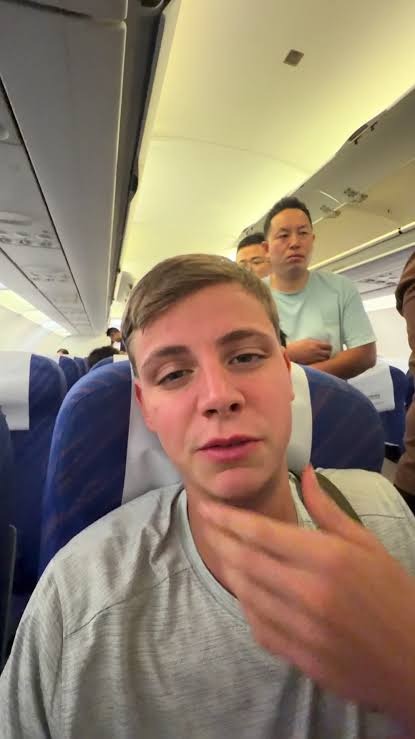
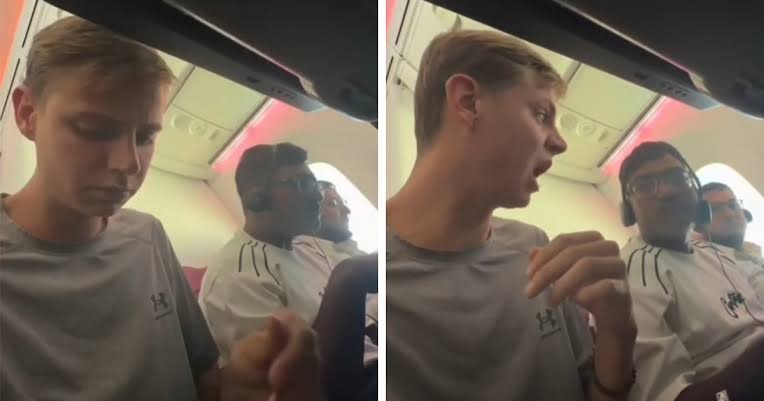
British travel creator Risky Regg, who has built a substantial audience across TikTok and Instagram, reportedly filmed the interaction while traveling on a flight believed to have been connected with Nepal.
During the meal service, he noticed the passenger beside him eating with his mouth open.
Rather than quietly ignoring the behavior, Risky Regg decided to address it directly.
“Excuse me?” he asked before requesting that the passenger eat with his mouth closed.
He then mimicked the chewing behavior before asking the man how old he was.
The other passenger’s response was reportedly difficult to hear in the recording.
Eventually, Risky Regg appeared to abandon the conversation, put in his earbuds, and return his attention to his own meal.
For most passengers, the incident might have ended there.
Instead, the recording became a viral social media discussion.
Why Open Mouth Chewing Bothers So Many People

There is nothing unusual about people having strong reactions to eating sounds.
For some individuals, sounds such as chewing, slurping, or repeated tapping can be particularly distracting. In everyday social settings, eating with one’s mouth closed is also widely regarded as a basic matter of table etiquette.
That makes the annoyance understandable.
An airplane, however, creates a different environment.
Passengers are seated unusually close together, often for several hours at a time. There may be limited opportunities to move to another seat, and ordinary sounds can become much more noticeable inside the relatively confined cabin.
A behavior that might barely register in a restaurant can therefore become much more irritating during a long flight.
This may help explain why the video resonated with so many viewers.
People recognized the situation immediately, even if they disagreed about how it should have been handled.
Viewers Were Quickly Divided
Once the video spread online, reactions reportedly fell into two broad camps.
Some viewers supported Risky Regg.
They argued that noisy eating can be extremely unpleasant, particularly when someone is sitting directly beside you for an extended period.
Others believed that his approach was unnecessarily confrontational.
For those viewers, the issue was no longer the passenger’s eating habits. Instead, it became a question of courtesy.
There is an important distinction between privately being annoyed by someone’s behavior and publicly confronting that person.
One can dislike something without necessarily believing that the person deserves to be corrected.
That difference became central to the debate.
Was the Passenger Breaking a Social Rule?
Eating with your mouth closed is widely considered conventional table etiquette in many cultures.
But etiquette is not universal.
Different families, countries, and communities can have different expectations surrounding meals. Even within the same culture, individuals may have very different habits.
That means calling someone’s behavior “bad manners” can sometimes be more complicated than it first appears.
The passenger may simply have been unaware of how noticeable his eating was.
He may have had a personal habit that he had never considered particularly problematic.
Or he may simply have been eating normally from his own perspective.
None of those possibilities necessarily makes the behavior pleasant for someone sitting beside him.
But they do demonstrate why a little patience can sometimes be useful in public spaces.
The Bigger Question: How Should You Handle Annoying Passengers?
Air travel regularly places strangers in situations they would never voluntarily choose.
You might sit beside someone who talks constantly.
Another passenger might recline their seat.
Someone may listen to music loudly.
A child might become restless.
A passenger might eat in a way you find unpleasant.
These moments can test anyone’s patience.
The challenge is deciding which annoyances are worth addressing and which are better handled by simply adjusting your own environment.
In Risky Regg’s case, putting in earbuds ultimately provided a simple solution.
It may not have eliminated the irritation completely, but it allowed him to focus on his own experience rather than continuing the disagreement.
Sometimes disengagement is the most practical form of conflict resolution.
The Privacy Question Changed the Conversation
Perhaps the most significant criticism directed at the video concerned something other than chewing.
Several viewers reportedly objected to the decision to record another passenger and publish the interaction online.
This raises an increasingly important question in the social media era.
Just because someone is physically near you does not necessarily mean they expect to become part of your online content.
Modern smartphones make recording remarkably easy.
A person can capture a stranger’s behavior within seconds and potentially expose it to millions of viewers.
That creates an imbalance that did not exist in the same way before social media became part of everyday life.
The person being filmed may have no meaningful opportunity to explain their side before thousands of strangers form an opinion.
Viral Content Changes Ordinary Interactions
Social media has changed how people experience everyday disagreements.
In the past, an awkward encounter on a plane would probably have remained a private memory.
Today, the same moment can become content.
A disagreement that lasts less than a minute can generate comments, reactions, reposts, memes, and international discussion.
That can make seemingly insignificant interactions feel much larger than they actually are.
For content creators, this creates a difficult balance.
Audiences want authenticity and spontaneous moments.
At the same time, people appearing in those moments still have personal boundaries.
The popularity of a video does not necessarily answer the ethical question of whether filming and publishing the interaction was appropriate.
Risky Regg Has Faced Other Online Debate
The airplane incident also attracted additional attention because Risky Regg had previously faced criticism over other social media content.
Earlier in the year, he reportedly attracted backlash over a video involving a Chinese woman in Xi’an.
The video’s title referred to “Winning Over a Chinese Girlfriend,” while previous comments attributed to the creator suggested that he believed he could meet and pursue a Chinese woman within a very short period.
Some viewers criticized the framing as disrespectful toward women and Chinese culture.
According to reports, the woman involved defended the friendship and said she had voluntarily chosen to spend time with him.
The contrasting reactions demonstrate how quickly online audiences can interpret the same content differently.
One viewer may see humor and spontaneity.
Another may see insensitivity.
Why Intent and Impact Can Be Different
One of the most useful lessons from internet controversies is the difference between intention and impact.
A creator may intend to make a funny video.
The audience may find it entertaining.
But the person featured in the video may experience the situation very differently.
This does not automatically mean that the creator acted maliciously.
It simply means that public content can have consequences beyond what the person making it initially intended.
The same principle applies to the passenger.
He may not have intended to annoy anyone.
Yet his eating habits clearly bothered the person sitting next to him.
Both sides can therefore be considered without assuming that one person was entirely right and the other entirely wrong.
Could There Have Been a Better Approach?
There are several ways Risky Regg could have handled the situation.
He could have ignored the behavior and continued eating.
He could have politely asked whether the passenger could chew more quietly.
He could have spoken to cabin crew if the situation became genuinely disruptive.
Or he could have simply put on his earbuds, as he eventually did.
The most effective approach would depend on the circumstances.
If a behavior is merely annoying, ignoring it may be easiest.
If it genuinely interferes with your comfort, a respectful request may be reasonable.
The important factor is often tone.
A polite request communicates a personal boundary without necessarily humiliating the other person.
Airplane Etiquette Is About Mutual Consideration
Good airplane etiquette ultimately comes down to consideration.
Passengers share a limited space with dozens or hundreds of strangers.
That means everyone makes small compromises.
Keeping personal belongings within your space, using headphones appropriately, being mindful of strong smells, respecting seat boundaries, and maintaining reasonable volume are all examples of behaviors that make shared travel easier.
Eating with your mouth closed is another widely recognized courtesy.
But consideration works in both directions.
Passengers also need to recognize that strangers will not always behave exactly as they would.
Some differences are worth accepting.
Others may justify a polite conversation.
Learning the difference is part of traveling well.
Why This Simple Video Became So Popular
The enormous response to the video may have less to do with Risky Regg himself than with how relatable the situation is.
Almost everyone has experienced a small public annoyance.
Perhaps someone was talking loudly in a quiet place.
Maybe another person was playing audio without headphones.
Perhaps someone was standing too close in a crowded line.
These experiences are universal.
The interesting part is what we choose to do next.
Do we confront the person?
Ignore the behavior?
Move away?
Ask politely?
Or turn the experience into a story for millions of people online?
That final option is what makes the modern situation particularly different.
The Internet Loves a Debate About Manners
Social media platforms thrive on situations that encourage people to choose sides.
A short video can create an immediate question with no obvious answer.
Was he justified?
Was he rude?
Was the passenger inconsiderate?
Was recording him worse?
Should people simply mind their own business?
Each question invites another opinion.
And because everyone has their own experiences with public etiquette, viewers naturally bring their personal standards into the discussion.
That helps explain why something as mundane as chewing could generate such a strong reaction.
Final Thoughts
The Risky Regg airplane video may seem like a trivial disagreement, but it raises surprisingly meaningful questions about modern social behavior.
Basic manners matter.
So does patience.
And in an age when almost every uncomfortable moment can be recorded and shared, privacy and consideration deserve attention too.
Perhaps the most useful lesson is simple: not every irritation requires confrontation.
Sometimes a polite request is enough.
Sometimes the best solution is to put on your headphones and move on.
And sometimes, before turning a stranger’s awkward moment into viral content, it is worth asking whether the entertainment value is worth the potential embarrassment for the person being filmed.
The internet may continue debating who was right, but the situation ultimately reflects something much more universal. Living alongside other people requires patience, compromise, and an understanding that our personal standards are not always shared by everyone around us.
Sources
TikTok: Original video and public reactions associated with Risky Regg’s airplane encounter.
Newsner: Background reporting on the viral video and the creator’s previous online controversies.
Bored Panda: Reporting and compilation of public reactions to the airplane incident.
General aviation etiquette guidance: Considerations surrounding passenger behavior, shared cabin space, and respectful interaction during air travel.