Editor’s note: The names, locations, events, prices, and dialogue in this narrative have not been independently verified. This rewritten version presents the original as a work of fiction while incorporating factual context about timber valuation, hardwood grading, and responsible forest management.
A Story About Timber, Trust, and What a Log Is Worth
In rural forest communities, a standing tree can represent much more than lumber. It may carry family history, years of careful stewardship, and the hope that a landowner will receive a fair return when the time comes to harvest it. That is the foundation of Pallet, a fictional narrative about an elderly landowner, a load of black cherry logs, and a painful dispute over how those logs should be valued.
The story begins at a small Pennsylvania sawmill. Arvid, an older farmer, has cut black cherry trees from the hillside behind his barn. The trees have been part of his family’s land for decades, and the proceeds are intended to help pay for his wife Ingrid’s dental care. Arvid’s son Pete hauls the logs to a mill operated by Lyle, a relative and longtime friend of the family.
Instead of receiving a price consistent with what the family believes is high-quality cherry, Arvid is handed a check for $600. Each of the twenty-two logs has been marked “Pallet,” a low-value designation associated with lumber used for shipping platforms, industrial packing, and other utilitarian purposes.
The moment is significant not because a single word on a ticket changes the physical wood, but because log grading can greatly influence a seller’s payment. In the story, “pallet” becomes a symbol of lost trust. It is also a reminder that timber sales often involve technical judgments that landowners may find difficult to evaluate without independent information.
Why Black Cherry Lumber Can Be Valuable
Black cherry, scientifically known as Prunus serotina, is an important hardwood species in parts of the eastern United States. It is particularly associated with the Allegheny Plateau region of Pennsylvania, New York, and West Virginia, where favorable soils and careful forest management can produce tall, relatively straight trees with desirable wood characteristics.
Cherry lumber is valued for its warm reddish-brown color, fine texture, and workability. Freshly sawn cherry may appear lighter or pinkish, then darken over time when exposed to light and air. It has historically been used for furniture, cabinetry, millwork, paneling, and decorative interior applications. However, not every cherry tree produces premium lumber. Value depends on numerous factors, including diameter, straightness, defects, visible knots, internal decay, metal contamination, log length, and current market demand.
A log’s outward appearance can offer useful clues, but it cannot reveal everything inside. That uncertainty is central to the fictional conflict in Pallet. When the family seeks a second opinion, another mill saws the logs in front of them. The boards reveal clean grain and wide sections of usable lumber, changing the emotional meaning of the harvest for Arvid and his family.
In real timber markets, sawmills and buyers use established grading systems, scaling methods, and yield estimates to determine what they can pay. Yet actual value can still vary considerably between buyers because each operation has different equipment, customers, costs, and end markets.
Understanding Log Grades and Timber Scale
Logs are commonly sorted according to expected lumber yield and quality. Higher-grade hardwood logs generally have fewer visible defects, larger clear faces, adequate length and diameter, and shapes that allow a mill to recover more clear boards. Lower-grade logs may be crooked, excessively knotty, decayed, split, damaged, or otherwise unsuitable for higher-value lumber.
“Pallet grade” is often used informally in the forest-products industry to describe material with limited potential for appearance-grade products. But terminology is not always uniform. A seller should ask buyers what grade system they use, how they estimate volume, and how the price will be calculated.
Board-foot volume is another important part of the equation. A board foot represents a piece of wood measuring 12 inches by 12 inches by 1 inch thick, although log scale rules estimate how much lumber could be recovered from a round log rather than measuring finished boards directly. Different log rules, including the Doyle, International 1/4-inch, and Scribner scales, can produce different volume estimates for the same logs.
That does not automatically mean that one buyer is acting improperly. It does mean sellers should understand which scale is being used and compare offers on a consistent basis. A stated price per thousand board feet is meaningful only when the scaling method, grade assumptions, hauling costs, and deductions are clearly explained.
The Importance of Independent Timber Advice
The conflict in Pallet reflects a real concern for many family forest owners: how can a landowner know whether an offer is fair? A single buyer’s estimate may be reasonable, but it should not be the only information considered when a valuable hardwood stand is being sold.
Forestry agencies and university extension services commonly recommend that landowners consult a qualified professional forester before conducting a timber sale. A consulting forester can inventory the trees, estimate volume, identify species and quality, prepare a management plan, solicit competitive bids, and help oversee harvesting. This may be especially important when a sale includes high-value species such as black cherry, walnut, white oak, or hard maple.
Competitive bidding can improve transparency. Instead of accepting an unsolicited offer, a landowner may choose to have several qualified buyers bid on a defined timber sale. Written contracts can also clarify boundaries, payment terms, road use, insurance, environmental protections, harvesting methods, and responsibility for repairing damage.
Not every woodland owner needs the same approach. Small harvests, storm-damaged trees, and firewood sales may be handled differently from a large commercial timber sale. Still, the basic principle remains valuable: ask questions, document agreements, and seek advice before signing away the right to harvest trees that took generations to grow.
A Family’s Response to an Unfair Offer
In the fictional story, Pete does not argue at the first mill. Instead, he reloads the logs and takes them home. The family then contacts Levi, an independent sawmill operator who agrees to inspect and saw the logs openly.
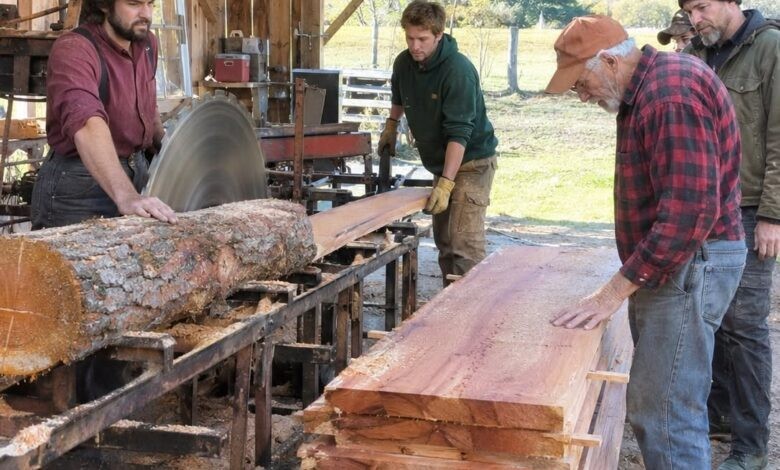
The public sawing of the logs becomes the story’s turning point. As the boards emerge, Arvid sees the quality that had been hidden beneath the bark: wide cherry boards with largely clear faces and rich color. Levi measures the lumber and offers a payment based on the material’s demonstrated grade and the market available to his mill.
For Arvid, the sale is not only about receiving enough money for Ingrid’s treatment. It restores his confidence that the trees planted and tended by his family had genuine worth. He keeps boards from one special tree, said to have been planted by his father when Arvid was born. Later, those boards become a piano bench for Ingrid, linking the harvested forest to the family’s home and traditions.
The narrative’s emotional force comes from this balance between practical need and personal memory. Timber can be an asset, but forests are also places where families hunt, work, remember relatives, and pass knowledge to younger generations. A responsible sale recognizes both realities.
Forest Stewardship Beyond a Single Harvest
One of the strongest themes in Pallet is renewal. After the harvest, Arvid plants twenty-two black cherry seedlings, one for each log removed from the hillside. He asks his grandson Mason to plant the final seedling beside the stump of the tree planted by an earlier generation.
Replanting is not always the only or best regeneration method for hardwood forests. In many eastern woodlands, natural regeneration from seeds, sprouts, and nearby mature trees can play a major role. But successful regeneration depends on site conditions, sunlight, competing vegetation, deer browsing pressure, and long-term management. Protective tree shelters or wire cages may help young seedlings survive where browsing is common.
Professional foresters can help landowners determine whether planting, natural regeneration, selective cutting, thinning, or another approach is appropriate. Sustainable forest management is not simply about removing trees or planting replacements. It involves planning for forest health, wildlife habitat, soil protection, water quality, invasive species control, and future stand composition.
In the story, the seedlings represent a promise that the family’s relationship with the land will continue. The grandson’s interest in forestry offers another form of renewal: knowledge passed forward so that future decisions about trees, lumber, and land are made with greater confidence.
Accountability and Second Chances
The final portion of the narrative focuses on Lyle, the mill operator whose grading decision triggered the dispute. He eventually admits that financial pressure and fear of losing the business led him to underpay multiple sellers. The story does not present hardship as an excuse. Instead, it treats accountability as a necessary step toward repair.
That message has broad relevance beyond forestry. Economic stress can affect individuals and small businesses, especially in industries exposed to changing markets, equipment costs, transportation expenses, and shifts in demand. Yet transparent pricing and honest communication remain essential in any business relationship, particularly where one party has specialized knowledge that the other may not possess.
In Pallet, Lyle begins to make amends by acknowledging the harm, repaying people where possible, and learning to grade logs honestly under the guidance of another sawyer. The conclusion is not a guarantee that every loss can be fixed. Rather, it suggests that a person’s reputation is rebuilt through consistent actions, not explanations alone.
What Landowners Can Learn From Pallet
Although this is a fictional story, its central lessons align with widely available forestry guidance. Landowners considering a timber sale should identify their goals before accepting an offer. Some may prioritize income; others may focus on wildlife, forest health, recreation, legacy planning, or a combination of these objectives.
- Consult a qualified professional forester before selling valuable timber.
- Request written estimates and understand the log scale or measurement system used.
- Seek multiple bids when practical, especially for high-value hardwoods.
- Use a written timber-sale contract with clear payment and harvesting terms.
- Ask how trees will be selected and how roads, streams, soil, and remaining trees will be protected.
- Keep records of inspections, offers, contracts, scale tickets, and payments.
- Plan for regeneration and the long-term condition of the forest after harvest.
The simple phrase repeated throughout the story is that wood reveals itself when it is opened. In real life, a landowner may not need to mill logs personally to protect their interests. But they do need enough independent information to understand what they are selling and whether the terms reflect a fair, informed transaction.
Sources
- Penn State Extension: Timber Sale Contract Considerations
- Penn State Extension: Selling Timber—What the Landowner Needs to Know
- USDA Forest Service: Private Land and Forest Management Resources
- USDA Forest Service: Treesearch Research Publications
- Pennsylvania Department of Conservation and Natural Resources: Managing Your Woods
Disclaimer: This content is intended for entertainment purposes only and is not based on real events.