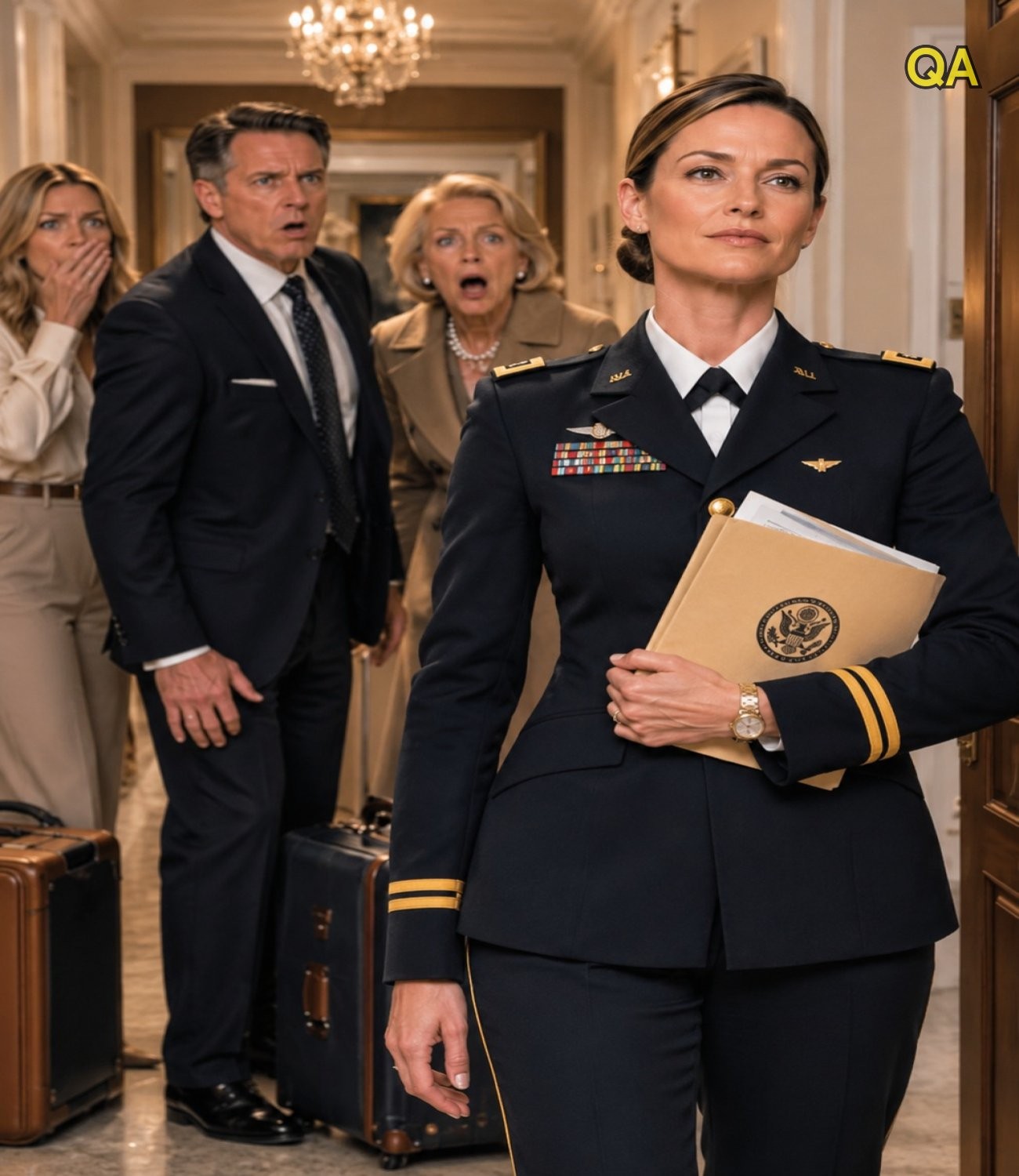
My husband, Wesley Miller, delivered those words while standing beside the dinner table I had prepared to celebrate the biggest promotion of my military career.
He loosened his tie, glanced at the candles, and pushed his jacket across the back of a chair.
“My mother and Gwen are moving in tomorrow,” he continued. “You’ll be taking care of them.”
I stared at him, waiting for the smile that would tell me this was some terrible joke.
It never came.
“You heard me,” he said. “That’s what a wife is actually supposed to do.”
My name is Andrea Miller. I was thirty-six years old, and I had spent fifteen years serving in the United States Army.
That afternoon, I had received a promotion into a senior leadership position after years of deployments, demanding assignments, and sacrifices I rarely discussed at home.
I had imagined telling Wesley over dinner. I had imagined him standing, embracing me, and saying he was proud.
Instead, he sat down and began explaining why my career would have to become less important.
His mother, Beulah, had financial problems. His sister, Gwen, was recently divorced. Both needed somewhere to live.
Wesley had already promised them our apartment without asking me.
“They’ll need the bedrooms arranged,” he said. “And Mom has dietary restrictions, so you’ll have to plan meals.”
I kept my hands beneath the table.
“You’ll handle the laundry and cleaning,” he added. “And no accepting temporary assignments that leave them stranded.”
“Stranded?” I repeated.
“Without someone managing the household.”
I looked at the untouched plate in front of him.
“What about my responsibilities?”
He laughed.
“Your soldiers can survive without you.”
For several seconds, I said nothing. Then I quietly began clearing the dishes.
“What time are you leaving tomorrow?” I asked.
Wesley smiled as though he had won.
“Early. I’m driving to Olympia to get them.”
Before sunrise, he loaded his overnight bag into the car and left to collect Beulah and Gwen.
I watched his taillights disappear before making my first phone call.
It was to my attorney.
The second call went to our landlord. I was the primary tenant, and my military salary had covered nearly every rental payment for three years.
My third call went to a professional moving company experienced in military transfers.
By late afternoon, Wesley’s furniture, suits, golf clubs, and personal possessions had been carefully packed, labeled, and placed outside our apartment.
Working with the landlord’s written authorization, I arranged for the locks to be changed.
On the entrance table, I placed a blue folder containing our lease, rental records, bank statements, and a handwritten message.
“What is not addressed with respect will be addressed through action.”
At precisely 8:20 that evening, the elevator opened.
Beulah’s complaining voice reached me first. Gwen’s laughter followed.
Then Wesley inserted his key into the lock.
It wouldn’t turn.
He tried again, harder.
The doorbell rang three times.
When I opened the door, Wesley stopped moving.
His mother and sister stared at the packed suitcases lining the hallway. The locksmith stood nearby, quietly gathering his tools.
Wesley’s face drained of color.
“What the hell have you done?” he shouted.
I met his eyes without raising my voice.
“Nothing,” I replied. “Except return each of you to the place where you belong.”
For one remarkable second, nobody spoke.
Then Beulah Miller pushed past her son and pointed directly at me.
“You ungrateful little woman.”
Her voice echoed through the hallway.
“You’ve embarrassed my family.”
I stood inside the doorway, one hand resting against the frame.
Behind me, the apartment was nearly empty.
The dining table remained, along with two chairs and several items I had purchased before marrying Wesley.
Everything else had been documented, separated, and accounted for.
That distinction mattered.
It would matter considerably more in the days ahead.
“Where are my things?” Wesley demanded.
I gestured toward the labeled boxes.
“Your possessions are right there.”
“You can’t put my belongings in a hallway.”
“They’re being held for collection by the moving company. The building manager approved a temporary loading arrangement.”
Wesley glanced toward the elevator.
A uniformed building employee stood beside a flatbed cart.
He had witnessed the movers inventorying the possessions that afternoon.
The man looked uncomfortable but said nothing.
Wesley turned back toward me.
“You’re out of your mind.”
I felt the familiar tightening in my stomach.
There had been years when those words would have sent me scrambling for an apology.
That evening, I remained still.
“I’m not discussing our marriage in the hallway.”
Beulah made a furious sound.
“Oh, now she’s too important to speak to us.”
Gwen folded her arms.
She was thirty-two, blonde, and dressed in a cream-colored sweater that looked expensive enough to contradict her brother’s financial descriptions.
“Wesley said you agreed,” she announced.
I looked at her.
“He told you that?”
“Of course.”
“He never asked me.”
For the first time, Gwen glanced uncertainly at her brother.
Wesley stepped forward.
“Move.”
I didn’t.
“Wesley, please don’t.”
He gave a short laugh.
“That’s my apartment.”
“Your name is included in the rental agreement,” I replied. “That doesn’t give you authority to bring additional residents without discussing it.”
Beulah shook her head.
“She talks like a lawyer now.”
I thought of the attorney’s careful warnings that afternoon.
Changing a lock did not erase another resident’s legal rights.
A primary tenant could not simply declare a spouse homeless.
My attorney had explained that clearly.
That was why I had prepared documents, requested the landlord’s involvement, and arranged an immediate lawful process rather than pretending one evening could settle everything.
I had also been told to avoid physical confrontation.
If Wesley demanded access, I was to contact the building manager and let the legal process determine the next step.
Wesley pulled his phone from his pocket.
“I’m calling the police.”
“You can.”
His thumb stopped over the screen.
Something about my answer disturbed him.
“You think they won’t make you let me inside?”
“I think they’ll look at the documents and tell us how to proceed.”
The hallway became quiet again.
Then Beulah pointed at my uniform.
“You’ve let that Army job turn you into a monster.”
I looked down at the gold insignia on my shoulders.
That uniform had carried me through fifteen years.
It had been soaked by rain during field exercises and stained by dust during deployments.
It had accompanied me to military hospitals and memorial services.
And now my husband’s mother stood in front of me, treating it like evidence of a character defect.
“My job didn’t make this decision,” I answered.
“Then what did?”
“Your son’s decision to speak for me.”
Wesley reached toward the doorframe.
I stepped back, not to surrender the doorway, but to keep distance between us.
“I’m not fighting with you.”
“You already started a fight.”
“No. I finally stopped pretending there wasn’t one.”
His expression changed.
For years, Wesley had known exactly how to end an argument.
He raised his voice until I lowered mine.
He threatened to sleep elsewhere until I apologized.
He reminded me that marriages required compromise, always meaning compromise from me.
That routine was no longer working.
He looked past my shoulder into the apartment.
“Where’s the television?”
“In storage.”
“The sectional?”
“In storage.”
“My desk?”
“Packed with your office equipment.”
His eyes narrowed.
“What about the safe?”
My pulse quickened.
It was the first question that had frightened me all day.
Not because I had touched the safe.
Because I hadn’t.
“The safe is exactly where you left it.”
Wesley stared.
Then he looked toward Beulah.
It was a brief movement.
Almost nothing.
But after fifteen years of watching soldiers communicate under pressure, I knew when a glance carried meaning.
Beulah’s mouth tightened.
Gwen appeared not to notice.
“I’m freezing,” Gwen complained. “Can somebody explain where we’re supposed to sleep?”
“Not here,” I replied.
She gave a disbelieving laugh.
“You can’t seriously expect us to find a hotel.”
“You weren’t invited by the person responsible for sharing this home.”
Wesley stepped closer again.
“You’re going to regret this.”
I had heard him make that promise before.
Usually, it meant a week of silence.
Sometimes, it meant humiliating me in front of friends.
Once, after I missed his company’s holiday dinner because of a military emergency, it meant telling everyone I cared more about strangers than my husband.
That evening, I recognized something different.
He wasn’t embarrassed.
He was frightened.
And he was frightened before he had even seen the documents.
“Take the folder,” I said.
He glanced toward the entrance table.
“What’s that?”
“The records you never wanted to discuss.”
“I’m not playing your games.”
“Then speak with my attorney.”
He stopped.
“Attorney?”
“Yes.”
Beulah leaned forward.
“What kind of wife hires a lawyer against her husband?”
“The kind who needs to understand her options.”
Wesley snatched the folder from the table.
He flipped through several pages without reading them.
“Bank statements?”
“Records of our financial contributions.”
“Are you seriously counting rent payments now?”
“Someone should.”
His jaw tightened.
I watched him turn another page.
A printed copy of the lease lay near the back.
The primary tenant section contained my name.
Andrea Marie Miller.
Wesley had signed beneath me three years earlier.
At the time, he had joked that the landlord trusted military officers more than sales executives.
I had laughed.
Now I wondered how many important things I had disguised with laughter.
Wesley reached the handwritten note.
He read it twice.
Then he looked up.
“You think this makes you powerful?”
“No.”
“Then what’s the point?”
“I’m finished accepting disrespect as the price of peace.”
Gwen shifted beside the luggage.
“Wesley, you said she was fine with everything.”
He didn’t answer.
“Wesley?”
“Stay out of it.”
Gwen’s expression hardened.
“You brought me here.”
“Then let me handle it.”
Beulah seized the folder.
She examined the lease through narrow eyes.
“Your name is on this too,” she told Wesley.
“Mom, give it back.”
“So why is she acting like she owns everything?”
I answered before he could.
“Because I’ve spent years paying for a household while being told I contribute nothing.”
Wesley turned sharply.
“That’s a lie.”
“Then we can review the statements.”
He slapped the folder shut.
The sound made Gwen flinch.
I didn’t.
“I’m calling the landlord,” Wesley declared.
“Please do.”
He pressed the number.
We waited.
When someone answered, Wesley stepped away and lowered his voice.
I couldn’t hear everything.
Only fragments.
“My wife.”
“Changed the locks.”
“Unacceptable.”
Then silence.
His shoulders stiffened.
“Yes, I’m aware of the lease.”
Another pause.
“No, I don’t agree to that.”
He ended the call.
Beulah looked hopeful.
“Well?”
Wesley stared at the floor.
“The landlord says we need to discuss access through the property office.”
I nodded.
“That matches what I was told.”
He glared at me.
“You planned this.”
“Yes.”
The simple answer seemed to bother him more than any insult could have.
A moment later, the elevator opened again.
The building manager stepped into the hallway.
His name was Peter Lang.
He was a quiet man in his fifties who had managed the property since before we moved in.
He held a clipboard and a ring of keys.
“Mr. Miller,” Peter said, “we should speak downstairs.”
Wesley pointed toward me.
“Tell her she can’t do this.”
Peter glanced at the open door.
“The access dispute needs to be handled correctly. I’m not making a legal determination in the hallway.”
“Then let me inside.”
Peter hesitated.
“We can arrange temporary access while the attorneys work through occupancy rights.”
I looked at him.
“I understand.”
Wesley appeared disappointed.
He had expected an audience to declare him victorious.
Instead, everyone wanted procedures.
Paperwork.
Boundaries.
The things he had spent years mocking when they came from me.
I stepped farther into the apartment.
“I’m willing to follow the process.”
Wesley looked suddenly triumphant.
“See?”
“But Beulah and Gwen are not approved residents.”
Peter nodded.
“Any additional occupants require a formal request.”
Gwen threw up her hands.
“This is ridiculous.”
Beulah began speaking loudly about family loyalty.
Peter waited without responding.
Then he addressed Wesley again.
“Let’s discuss your immediate belongings and access downstairs.”
Wesley looked at me one final time.
“You’re destroying our marriage.”
I felt something painful move through my chest.
Not surprise.
Not anger.
Grief.
For the woman who had believed endurance was the same thing as love.
“No,” I said. “I’m asking you to take responsibility for what you’ve already done.”
He turned away.
Beulah followed, still complaining.
Gwen remained for one moment.
She looked at the blue folder.
Then at my uniform.
“You really didn’t know we were coming?”
“No.”
Her face changed.
“Wesley told us you suggested it.”
I held her gaze.
“He lied.”
She swallowed.
Then the elevator doors closed around them.
I stood alone in the hallway.
The apartment behind me smelled faintly of furniture polish and cardboard.
There were pale rectangles on the walls where our photographs had hung.
My wedding portrait had left the largest mark.
I closed the door gently.
Then I sat on the floor and cried.
Not because I regretted what I had done.
Because I finally understood how long I had waited.
At 6:10 the following morning, my phone rang.
I had slept less than three hours.
The apartment was quiet except for the refrigerator humming in the kitchen.
My attorney’s name appeared on the screen.
“Good morning, Andrea,” Lauren Hayes said.
She had a calm voice and a remarkable ability to make frightening information sound manageable.
“Did Wesley contact you?”
“Not yet.”
“He contacted the landlord.”
“I know.”
Lauren paused.
“Before anything else, I need you to understand that his occupancy rights require formal resolution.”
“I understand.”
“The property manager has agreed to help coordinate temporary access.”
“That’s fine.”
“Good. We need to make sure your boundaries are legally sustainable.”
I rubbed my forehead.
“Did I make a mistake?”
“You made an important decision under pressure. Now we handle its consequences carefully.”
That was Lauren.
She never confused encouragement with pretending complications didn’t exist.
“We’ll discuss separation, temporary living arrangements, and the property inventory,” she continued.
I glanced toward the empty hallway.
“And the safe?”
There was a pause.
“What about it?”
“Wesley asked about it almost immediately.”
“Did you open it?”
“No.”
“Don’t. If the contents concern jointly held property or financial records, we’ll address them through appropriate legal channels.”
I looked toward the bedroom.
The safe was mounted inside Wesley’s closet.
He had purchased it two years earlier.
He said it held investment paperwork, insurance information, and business contracts.
He had never offered me access.
At the time, I hadn’t questioned it.
Every marriage deserved a measure of privacy.
But privacy and secrecy weren’t the same thing.
Something in Wesley’s reaction suggested he understood that difference better than I did.
Lauren gave me a list of documents to preserve.
Tax returns.
Bank statements.
Rental records.
Insurance policies.
Retirement account information.
Any communications about Beulah and Gwen’s proposed move.
Then she asked a question I hadn’t expected.
“Has Wesley ever asked you to sign financial documents without explaining them?”
I thought carefully.
“He handled our taxes.”
“That wasn’t my question.”
I stared at the wall.
“There were forms.”
“What kind?”
“Mostly things he said were routine.”
“Did you keep copies?”
“I don’t know.”
Lauren’s voice became firmer.
“Don’t speculate. Just gather what you have.”
I promised I would.
After the call, I made coffee and opened my laptop.
My military promotion certificate stood on the counter beside a vase of flowers.
I had bought the flowers myself.
They were white tulips.
Wesley had never noticed them.
I moved the certificate beside the laptop.
For a moment, I considered putting it away.
Then I left it where it was.
At eight, I drove to my installation.
The commute passed through damp Washington streets under a gray morning sky.
Traffic moved slowly near the highway entrance.
I listened to the radio without hearing a word.
My new assignment involved coordinating operational readiness across several units.
It was a responsibility I had worked toward for years.
I should have been reviewing personnel reports.
Instead, I was thinking about a blue folder.
And a safe.
And the way my husband had glanced at his mother.
My new supervisor, Colonel Rebecca Shaw, was waiting when I arrived.
She stood outside the conference room with a tablet beneath her arm.
Rebecca was forty-eight, direct, and known for expecting people to solve problems before explaining why problems existed.
“Major Miller.”
I came to attention.
“Ma’am.”
She smiled.
“At ease. Congratulations again.”
“Thank you, Colonel.”
“Ready for your first briefing?”
“Yes, ma’am.”
She studied my face.
Then she lowered the tablet.
“That’s the official answer.”
I managed a small smile.
“It’s still the answer.”
Rebecca didn’t press.
“Good. Conference room in ten.”
I spent the next hour discussing equipment readiness, training schedules, and deployment planning.
Every question had a defined purpose.
Every decision had consequences.
Nobody asked whether I was too ambitious.
Nobody suggested my accomplishments were embarrassing.
When the briefing ended, Rebecca asked me to remain.
I waited until the others left.
“Something at home?” she asked.
I hesitated.
Military service had taught me to separate personal problems from professional responsibilities.
But it had also taught me that pretending a problem didn’t exist could make it worse.
“My husband and I are separating.”
Rebecca nodded once.
“Do you need time for legal appointments?”
“Possibly.”
“Coordinate with the office. We’ll manage the schedule.”
I looked at her.
“That simple?”
“Your work still matters. So does handling your personal life responsibly.”
The words struck harder than I expected.
Rebecca set down her tablet.
“I’m not asking for details. I’m asking whether you need resources.”
I considered telling her everything.
The dinner.
The insult.
The suitcases.
The locked door.
Instead, I said, “I have an attorney.”
“Good.”
She waited.
“Anything else?”
“No, ma’am.”
She nodded.
“Then welcome to your new position, Major.”
I walked out carrying a folder of operational reports.
For the first time since Wesley’s announcement, I felt the ground beneath me become steady.
At lunchtime, I received a message from an unfamiliar number.
This is Gwen. Can we talk?
I stared at the screen.
Then I replied.
About what?
Her answer came immediately.
What Wesley told us.
I considered ignoring her.
Gwen had never been particularly kind to me.
At family dinners, she enjoyed making jokes about my military schedule.
She called me “Sergeant Serious” even after I became an officer.
Sometimes she laughed about how I probably ordered Wesley to make his bed.
I usually smiled to avoid making gatherings uncomfortable.
Now I wondered whether the jokes had ever been harmless.
I’m at work, I wrote. You can send a message.
Three dots appeared.
Disappeared.
Returned.
He said you had already agreed to let us stay for six months.
I read the message twice.
Six months.
Wesley had told me indefinitely.
I never agreed to any arrangement, I replied.
A minute passed.
Then Gwen sent another message.
He said you were taking leave to help Mom.
I felt my jaw tighten.
That’s false.
He said your promotion wasn’t final.
I looked at the certificate on my desk.
The polished frame reflected the overhead lights.
It is final.
Another long pause.
Then Gwen wrote something that made me sit up.
Then why did he ask Mom to bring her financial papers?
I stared.
What financial papers?
Gwen didn’t answer immediately.
My phone rang instead.
Her name appeared.
I stepped into an empty office.
“Hello?”
Gwen spoke quietly.
“I’m not trying to get involved in your marriage.”
“You’re already involved.”
“I know.”
She sounded different from the woman who had laughed outside my door.
Uneasy.
Almost embarrassed.
“Wesley said Mom needed to sign some things after we moved in.”
“What things?”
“I don’t know.”
“Did he explain?”
“No.”
I heard traffic in the background.
She was probably outside the hotel.
“Gwen, why are you telling me this?”
“Because he told us you suggested everything.”
I waited.
“And when you said you didn’t know, he acted like you were lying.”
“That doesn’t surprise me.”
“It surprised me.”
For a moment, neither of us spoke.
Then Gwen lowered her voice.
“He was really angry last night.”
“I noticed.”
“No. After we left.”
My fingers tightened around the phone.
“What happened?”
“He kept asking Mom whether she had brought the blue envelope.”
A cold sensation moved through my stomach.
“What blue envelope?”
“I don’t know. She said it was in her purse.”
“Did you see it?”
“No.”
Gwen hesitated.
“Then Wesley said they needed to get into the apartment before you found something.”
I closed my eyes.
“What exactly did he say?”
“He said, ‘If she starts looking through things, we’re finished.’”
The office seemed suddenly too quiet.
“Are you certain?”
“Yes.”
I opened my eyes.
“Thank you for telling me.”
Gwen gave a humorless laugh.
“Don’t thank me yet.”
“Why?”
“Because I think Mom knows what he’s talking about.”
The call ended a minute later.
I remained beside the desk, holding my phone.
Wesley had been worried about the safe.
Beulah had carried an envelope.
And someone had been afraid I would discover something.
The clues were small.
But they pointed in the same direction.
For fifteen years, I had learned that patterns mattered more than isolated incidents.
I opened my laptop.
Then I began reviewing our financial history.
The first irregularity appeared in an account I hadn’t checked closely in months.
It was a joint savings account.
We had opened it after our wedding.
At first, both of us contributed.
Over time, Wesley began transferring his paycheck into a personal account while my military earnings covered household expenses.
He described the arrangement as temporary.
Then it became normal.
I scrolled through the transactions.
There were withdrawals I recognized.
Insurance.
Utilities.
Car repairs.
And others I didn’t.
Three thousand dollars.
Four thousand five hundred.
Two thousand eight hundred.
Each had been transferred to an account ending in the same four digits.
I didn’t recognize the account.
I searched older records.
The transfers began eighteen months earlier.
Around the time Wesley had told me his sales commissions were temporarily delayed.
I opened a spreadsheet.
One by one, I entered the amounts.
The total grew.
Then grew again.
By the time I finished, I was staring at a number that made my hands cold.
More than forty-two thousand dollars.
I checked the dates.
Several withdrawals occurred while I was away for military training.
One happened during a deployment.
Another occurred three days after I had sent Wesley money to cover an unexpected medical expense for his mother.
I remembered the phone call.
Beulah had supposedly needed help paying a specialist.
Wesley sounded frightened.
I wired the money without hesitation.
Now I couldn’t find any corresponding payment to a medical provider.
I leaned back.
My first impulse was to call Wesley.
I imagined demanding explanations.
I imagined his familiar response.
You’re overreacting.
You don’t understand finances.
Why are you going through my things?
Instead, I called Lauren.
She answered after two rings.
“I found something.”
“Tell me.”
I described the transfers.
She asked me to send the records securely.
Then she asked whether the account had required both signatures for withdrawals.
“No.”
“Were the transfers authorized under the bank’s account rules?”
“I think so.”
“Then we need to distinguish permitted access from possible misuse or deception.”
I stared at the spreadsheet.
“Can I recover the money?”
“Possibly, depending on the facts. But don’t assume every transfer creates a legal claim.”
I swallowed.
“There are more than forty thousand dollars.”
“I understand.”
Lauren paused.
“Do you know where the money went?”
“No.”
“Then finding that out is our next step.”
I told her about Gwen’s phone call.
The blue envelope.
The safe.
Wesley’s warning.
Lauren became quiet.
Finally, she said, “Preserve those messages. Don’t confront him about the account yet.”
“Why not?”
“Because we need documentation before allegations.”
I looked at the clock.
Nearly two.
I had a meeting in twenty minutes.
My mind was full of questions.
But Lauren was right.
I couldn’t build a conclusion from fear.
I had spent too many years reviewing incomplete intelligence reports to forget that.
“There’s one more thing,” she said.
“What?”
“I’d like you to request your credit reports.”
My stomach tightened.
“Why?”
“Because unexplained financial activity sometimes involves obligations the other spouse doesn’t know about.”
I looked toward the hallway.
A soldier walked past carrying a stack of files.
Ordinary life continued around me.
“I’ll do it tonight,” I said.
“Do it somewhere private.”
Wesley called at 5:43.
I was sitting in my car outside the installation.
For several seconds, I watched his name illuminate the screen.
Then I answered.
“Andrea.”
His voice sounded exhausted.
“Hello, Wesley.”
“We need to talk.”
“I agree.”
“Not through lawyers.”
“I won’t discuss legal matters without advice.”
He exhaled sharply.
“Can you stop acting like this is some military operation?”
“No.”
The silence that followed was almost satisfying.
Not because I enjoyed hurting him.
Because I had finally answered honestly.
“Mom is devastated,” he said.
“I’m sorry she’s upset.”
“You humiliated her.”
“She arrived expecting to take over a home without my consent.”
“She’s family.”
“So am I.”
He didn’t respond.
I continued.
“And family should have been enough reason to ask me first.”
“Why are you making everything so difficult?”
I looked through the windshield.
Rain began collecting against the glass.
“Because you made a decision that would affect my career, my privacy, and my home.”
“I was helping my mother.”
“You were offering my time.”
“That’s what married people do.”
“No. Married people discuss sacrifices before volunteering someone else to make them.”
Wesley let out a frustrated breath.
“Can we meet tomorrow?”
“About what?”
“Everything.”
I hesitated.
“Lauren can arrange a meeting.”
“Your lawyer again.”
“Yes.”
His voice sharpened.
“You’re really going to throw away twelve years?”
We had been married for twelve years.
I remembered our wedding.
Wesley had looked at me beneath a white canopy in Tacoma.
He had promised that my service would never make him feel second.
I had believed him.
“I didn’t throw away our marriage,” I said.
“Then come home and talk.”
“I am home.”
He was silent.
The words settled between us.
After several seconds, he said, “You always have to win.”
I closed my eyes.
“No, Wesley. I spent years trying not to lose you.”
My voice remained steady.
“And somewhere along the way, I lost myself.”
He ended the call.
I sat inside the car until the rain became heavy.
Then I drove home.
The apartment felt different after dark.
Without Wesley’s television playing in the living room, I could hear the rain against the windows.
I placed my keys on the counter.
For years, I had entered this apartment expecting to adjust myself around another person’s mood.
If Wesley was angry, I became quieter.
If he was tired, I postponed conversations.
If he was embarrassed by my accomplishments, I described them as routine.
Now the silence belonged to nobody.
I warmed leftover soup and sat at the kitchen table.
Then I opened the credit report website.
The process took only minutes.
When the results appeared, I scanned the accounts.
My mortgage history from before the marriage.
Two credit cards.
An auto loan we had paid off.
And then something unfamiliar.
A personal loan.
Opened fourteen months earlier.
The balance exceeded sixty thousand dollars.
I stared at the screen.
The lender’s name meant nothing to me.
But the account was listed in my report.
I clicked the details.
A co-borrower appeared.
Wesley Miller.
My heart began beating faster.
I opened another section.
The original loan amount was seventy-five thousand dollars.
I had no memory of applying.
No memory of signing anything.
No memory of discussing such a loan.
I checked the date.
I was at a field training exercise when the account opened.
I remembered that week clearly.
Heavy rain.
A communications failure.
Three nights of interrupted sleep.
And one brief phone call with Wesley.
He had asked me to check my email and approve some routine household paperwork.
I remembered telling him I was exhausted.
He said it would take seconds.
I had opened a message on my phone.
There had been a verification code.
I read it aloud.
My hands began shaking.
I looked at the account again.
Then at my wedding ring.
For years, I had believed that trust meant never questioning the person beside me.
Now I understood how easily trust could become an opening.
I called Lauren.
She answered immediately.
“Andrea?”
“I found a loan.”
“How much?”
“Seventy-five thousand originally.”
A pause.
“Do you recognize it?”
“No.”
“Did you sign the application?”
“I don’t remember signing anything.”
“Then don’t assume the documents are valid.”
I took a breath.
“What do I do?”
“Preserve the report. Contact the lender’s fraud department. Request copies of the application and authorization records.”
“Tonight?”
“You can start the process tonight.”
I looked at the rain.
“Could Wesley have done this?”
“We need evidence before deciding who did what.”
I nodded, though she couldn’t see me.
“There was a verification code.”
“What code?”
I told her about the training exercise.
She asked me to write down every detail I remembered.
The approximate date.
The email.
The phone call.
Whether I had ever seen the actual loan agreement.
I answered as carefully as I could.
When I finished, Lauren said something that would stay with me.
“Someone can have your trust without having your informed consent.”
I stared at the wall.
There was still a pale rectangle where our wedding portrait had hung.
“I think I’ve been afraid to look,” I whispered.
“Then we’ll look carefully.”
The next morning, the lender confirmed that the account existed.
They could not explain everything over the phone.
An investigation would be required.
They provided a case number and instructions for disputing the account.
I wrote everything down.
Then I requested the original application and electronic authorization records.
The representative told me the review could take time.
I thanked her.
After the call, I sat quietly.
I didn’t feel victorious.
I felt exposed.
My name was attached to a debt I hadn’t knowingly accepted.
My husband had dismissed my career while apparently relying on the financial identity that career supported.
And I had no idea how far the problem extended.
At ten, Lauren called.
“I’d like you to come to my office this afternoon.”
“Did something happen?”
“Wesley’s attorney contacted me.”
I straightened.
“He has an attorney?”
“Yes.”
“What does he want?”
“He’s requesting access to the apartment and claiming financial contributions to the household.”
I looked at the bank statements.
“Contributions?”
“We’ll review the evidence.”
“Is he threatening me?”
“His attorney has raised concerns about the lock change and possession of his property.”
I closed my eyes.
“Does he have a case?”
“He may have enforceable occupancy rights. That’s why we’re arranging lawful access and temporary agreements.”
I nodded slowly.
“Okay.”
“Andrea?”
“Yes?”
“Do not treat this as a contest of who can make the other person suffer.”
I opened my eyes.
“I’m not trying to hurt him.”
“Good. Then keep your focus on protecting yourself and resolving the actual disputes.”
After the call, I looked at the blue folder.
It had begun as a statement.
Now it was becoming evidence.
I added the loan report.
Then the transfer spreadsheet.
Then screenshots of Gwen’s messages.
I placed everything in a larger binder.
On its cover, I wrote one word.
Records.
For fifteen years, I had been trained to document decisions.
At home, I had mistaken documentation for distrust.
That mistake was ending.
Lauren’s office occupied the third floor of a brick building near downtown Tacoma.
The waiting area smelled faintly of coffee and fresh paper.
A receptionist directed me into a conference room.
Lauren entered carrying a legal pad.
She was in her early forties, with dark hair pulled into a neat bun.
She wore no jewelry except a wedding ring.
“Thank you for coming.”
I placed my binder on the table.
She looked at its thickness.
“You’ve been busy.”
“I couldn’t sleep.”
She didn’t smile.
Instead, she opened the binder.
For nearly an hour, we reviewed the records.
The rental agreement.
My income.
Wesley’s deposits.
The disputed transfers.
The personal loan.
Gwen’s messages.
Lauren asked questions that forced me to distinguish what I knew from what I suspected.
That distinction was painful.
I knew money had left the joint account.
I didn’t know why.
I knew a loan appeared under my name.
I didn’t know whether my signature had been forged.
I knew Wesley had hidden information from me.
I didn’t yet know the full extent.
By the end of the meeting, Lauren had written several pages of notes.
Then she leaned back.
“There are two separate issues.”
I waited.
“Your marriage and living arrangements are one issue.”
“And the money?”
“Potentially another.”
She tapped the credit report.
“If these authorization records show deception, the consequences could extend beyond divorce proceedings.”
I looked down.
“I don’t want revenge.”
“That’s good.”
“I just want to understand what happened.”
“Then we proceed methodically.”
She explained the next steps.
A formal separation process.
A temporary occupancy arrangement.
Preservation of financial records.
Requests for loan documents.
Potential investigation of disputed transactions.
I listened carefully.
Then I asked the question that had been following me since the hallway confrontation.
“Was I wrong to put his things outside?”
Lauren considered her answer.
“You had legitimate reasons to establish boundaries. But unilateral removal and changed locks can create legal problems.”
I lowered my eyes.
“So I was wrong.”
“You acted under emotional pressure. What matters now is correcting any procedural issues rather than defending every decision.”
I nodded.
“We’ll arrange access and document property handling,” she continued.
“I understand.”
She studied me.
“Andrea, protecting yourself doesn’t require pretending you never make mistakes.”
The words surprised me.
At work, mistakes could have serious consequences.
I had learned to acknowledge them quickly.
At home, Wesley treated every admission as proof that he was right about everything.
Lauren seemed to understand the difference.
I left her office with a plan.
Not certainty.
A plan.
That was enough for the moment.
Wesley arrived for the scheduled property meeting two days later.
Peter Lang supervised access to the apartment.
Lauren had arranged for a neutral inventory company to document the remaining possessions.
Wesley entered carrying a cardboard box.
He looked tired.
His hair was uncombed, and his shirt hung loosely beneath his jacket.
For a moment, I saw the man I had married.
Then he looked at the living room.
“Unbelievable.”
I stood near the kitchen.
“Your personal items are available for collection.”
He walked toward his office area.
When he reached the bedroom, he stopped.
The safe remained mounted inside the closet.
He turned toward me.
“Did you touch it?”
“No.”
“Did anyone else?”
“Not that I know of.”
He seemed relieved.
Then he caught himself.
“Good.”
Peter entered carrying a clipboard.
“We’ve documented the furniture and boxes.”
Wesley barely listened.
He crouched beside the safe.
I watched him enter a combination.
The lock clicked.
He opened the door.
Inside were several folders, a small velvet box, and a stack of documents.
He reached immediately for a gray envelope.
Then froze.
I saw his shoulders tighten.
He moved the other folders.
Checked beneath them.
Opened a side compartment.
His movements became faster.
“Something wrong?” I asked.
He looked over his shoulder.
“No.”
But his voice had changed.
He closed the safe without removing anything.
Then stood.
“Where’s my blue folder?”
I frowned.
“What blue folder?”
“The one from my office.”
“I didn’t open your files.”
“You packed everything.”
“The moving company inventoried the boxes.”
He stepped closer.
“Did you take it?”
“No.”
His eyes searched my face.
Then he looked toward Peter.
“Did your people go through my documents?”
Peter shook his head.
“We didn’t inspect the contents of personal folders.”
Wesley rubbed his forehead.
For several seconds, he seemed to forget we were standing there.
Then his phone rang.
He glanced at the screen.
Beulah.
He declined the call.
It rang again.
He declined it again.
“Wesley,” I said quietly.
He looked up.
“What?”
“Is there something you need to tell me?”
His expression closed immediately.
“No.”
“Something about our finances?”
“Don’t start.”
“I found a loan.”
He became motionless.
I hadn’t intended to say it.
Lauren had advised waiting for documentation.
But the words were out.
Wesley’s face changed so quickly that I knew I had touched something real.
“What loan?”
“The one opened in my name fourteen months ago.”
He looked toward Peter.
“Can we have some privacy?”
Peter glanced at me.
I shook my head.
“No. We can discuss it with our attorneys.”
Wesley’s jaw tightened.
“You’re making a mistake.”
“Then explain it to Lauren.”
He stared at me.
I could almost see him searching for the version of me who would apologize for asking.
She wasn’t there.
Finally, he picked up his box.
“This conversation is over.”
He walked toward the door.
Then stopped.
Without turning around, he said, “You have no idea what you’ve started.”
I looked at the open closet.
At the safe.
At the empty space where he had expected a blue folder.
“Maybe not,” I answered.
“But I’m going to find out.”
He left without another word.
That evening, I received a call from Gwen.
Her voice was trembling.
“Andrea, I need to tell you something.”
I sat down.
“What happened?”
“Mom and Wesley are fighting.”
“About what?”
“Money.”
My heart sank.
“Gwen, I don’t want you caught between us.”
“I’m already caught.”
I waited.
She took a shaky breath.
“Wesley keeps saying Mom has to find the documents.”
“What documents?”
“The ones she brought from Olympia.”
I thought of the blue envelope.
“Has she found them?”
“I don’t know.”
Gwen lowered her voice.
“But I heard them arguing about a signature.”
I gripped the phone.
“Whose signature?”
She hesitated.
Then she whispered, “Yours.”
A silence opened between us.
I looked toward the binder on my kitchen table.
The credit report lay inside.
The disputed loan.
The unexplained transfers.
The safe.
All of it suddenly seemed connected.
“Gwen,” I said carefully, “I need you to tell me exactly what you heard.”
Before she could answer, a man’s voice sounded in the background.
Wesley.
“Who are you talking to?”
Gwen stopped breathing.
The phone shifted.
Then the call ended.
I stared at the screen.
A moment later, a message appeared.
He knows.
I stood slowly.
Outside, rain struck the windows.
My military promotion certificate remained on the kitchen counter.
Beside it sat the blue folder.
For years, Wesley had insisted that my rank meant nothing.
Now I was beginning to understand how much he had depended on everything my career provided.
And for the first time, I suspected his attempt to bring Beulah and Gwen into my home had never been only about giving them somewhere to sleep.
Click Chapter 2 below to find out what happens next.