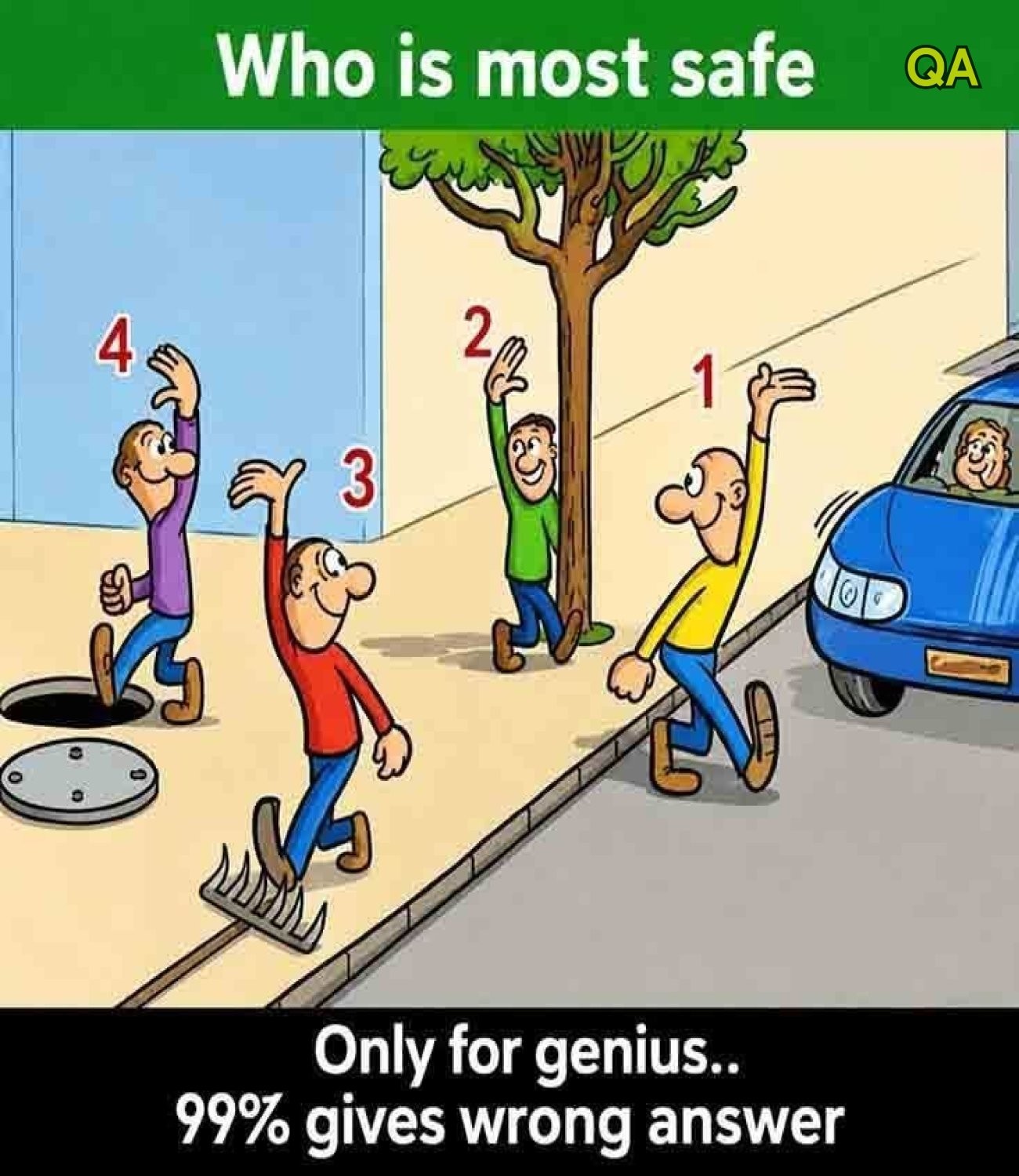
At first glance, this visual puzzle appears simple: four cartoon people are shown near different everyday hazards, and the question asks which one is safest. Yet the puzzle encourages a useful kind of thinking. To answer it fairly, viewers need to identify the risks that are actually visible, compare their immediacy, and avoid adding details that the illustration does not provide.
The intended answer is Person 2. While the other people are positioned close to clear hazards—moving traffic, a rake on the ground, and an uncovered manhole—Person 2 is standing beside a tree with no obvious immediate danger shown. The puzzle is not a formal safety assessment, and real-world conditions can always change. Still, it offers a helpful introduction to observation, hazard recognition, and evidence-based decision-making.
Understanding the Safest Person Visual Puzzle
The illustration presents four people in separate situations:
- Person 1 is walking near a moving car.
- Person 2 is standing beside a tree.
- Person 3 is approaching a rake lying on the sidewalk.
- Person 4 is standing close to an open manhole.
Each scene involves a different type of potential hazard. Some dangers are associated with transport, some with objects left in a walking area, and some with unsafe infrastructure. The task is not to predict every possible event that could happen. Instead, it is to compare what the picture establishes at that moment.
That distinction matters. In real life, a tree could become dangerous during severe weather or if it has visibly damaged branches. But a tree is not automatically a hazard simply because it is present. In the puzzle, there is no evidence of wind, damage, instability, or falling branches. By contrast, the risks near the moving vehicle, rake, and open manhole are immediate and visible.
The Intended Answer: Person 2 Is the Safest
Person 2 is the safest person based on the information shown in the image. They are not immediately next to traffic, are not about to step onto an obstacle, and are not standing near an uncovered opening in the ground.
This does not mean Person 2 is guaranteed to be completely safe in every imaginable circumstance. Safety is always influenced by context, including weather, visibility, surroundings, behavior, and the condition of nearby objects. However, a puzzle should be assessed using the evidence supplied. On that basis, Person 2 has the lowest visible level of immediate exposure to harm.
Why the Other Three Situations Carry More Immediate Risk
Person 1: Walking Near Moving Traffic
Person 1 is close to a moving vehicle. Pedestrian safety depends on many factors, including the speed and direction of traffic, road design, visibility, weather, and whether the driver and pedestrian can see one another clearly. Even in a familiar area, proximity to traffic requires attention.
Public-health and road-safety agencies consistently encourage pedestrians to stay alert, use sidewalks where available, cross at designated locations, and avoid assuming that a driver has noticed them. A driver may be distracted, have limited visibility, or need additional distance to stop. In the context of this puzzle, the moving car is an obvious and immediate hazard, making Person 1 less safe than Person 2.
Person 3: Approaching a Rake on the Ground
Person 3 is about to step on a rake left in a pedestrian path. The familiar cartoon scenario of a rake handle swinging upward is exaggerated for humor, but the broader safety issue is realistic: tools and clutter left on the ground can create trip hazards and lead to falls or impacts.
Falls are a common cause of unintentional injury, particularly among older adults, though anyone can be affected by poor housekeeping or obstructed walkways. A rake can be avoided if it is noticed in time, but its presence directly in Person 3’s path means there is an immediate risk that Person 2 does not face.
The prevention lesson is straightforward. Garden tools should be stored securely after use, and paths, entrances, stairs, and corridors should be kept clear. Simple habits such as looking ahead while walking and avoiding distractions can also help people spot hazards before an accident occurs.
Person 4: Standing Near an Open Manhole
Person 4 is positioned near an uncovered manhole. This is the most serious visible hazard in the illustration because an open utility access point can create a major fall risk. The depth, lighting, surface condition, and surrounding barriers would all affect the level of danger, but an uncovered opening should be treated with caution in any public or work setting.
The appropriate response is to stay well away from the opening and report it to the relevant local authority, property owner, road-maintenance team, or emergency service if there is an urgent risk to the public. People should not lean over, enter, or attempt to inspect an unprotected opening themselves.
Because Person 4 is so close to a clearly hazardous area, they are less safe than the other people in the puzzle. The scene also illustrates why proper barriers, covers, warning signs, and maintenance are important parts of community safety.
Visible Evidence Versus Assumptions
The central lesson of this puzzle is the difference between observation and assumption. An observation is based on what can be seen. An assumption adds an interpretation or prediction that may or may not be supported by evidence.
- Observation: Person 2 is standing beside a tree, and no immediate problem with the tree is visible.
- Assumption: Person 2 must be unsafe because the tree could fall.
In everyday life, considering possible risks is often sensible. A person walking under a visibly damaged tree during a storm should take the situation seriously. However, effective judgment requires proportion. Not every theoretical possibility should be treated as equally likely or equally urgent.
This is especially important when evaluating visual puzzles, online posts, and short pieces of information. People may be tempted to search for hidden twists because many internet puzzles are designed to be surprising. But an answer should be based first on the available evidence, not on unsupported scenarios outside the frame.
How Risk Assessment Works in Everyday Life
The puzzle offers a simplified example of risk assessment. A hazard is anything with the potential to cause harm. Risk involves both the chance that harm could occur and the seriousness of the possible outcome.
Safety professionals often assess situations by considering several practical questions:
- What is the hazard? Identify the source of possible harm, such as traffic, an obstacle, poor lighting, or an unsafe opening.
- Who could be affected? Consider pedestrians, workers, children, older adults, cyclists, or other people nearby.
- How likely is an incident? Look at distance, movement, visibility, environmental conditions, and whether safeguards are in place.
- How serious could the outcome be? A minor trip and a fall into an open access point have very different potential consequences.
- What can reduce the danger? Removing an obstacle, using a barrier, improving lighting, or reporting a defect may prevent an injury.
In the image, Person 1 faces a transport-related risk, Person 3 faces a trip or impact hazard, and Person 4 faces a fall hazard. Person 2 does not have a comparable immediate danger depicted. That is why Person 2 is the logical answer.
Why Simple Visual Puzzles Can Create Debate
People often disagree about puzzles like this one, even when the intended solution is relatively clear. This does not necessarily mean that one group is careless or another is overly cautious. People notice details differently, and personal experience affects how they interpret risk.
Attention Is Selective
A moving vehicle and an open manhole are visually dramatic, so they may capture attention first. The rake may be less noticeable despite being directly in a walking path. Psychologists and safety educators often emphasize the importance of scanning an environment rather than focusing only on the most striking feature.
In ordinary settings, this can mean noticing loose cords, wet floors, uneven pavement, cluttered stairs, or poor lighting. Many preventable incidents involve everyday conditions that appear minor until someone is distracted or unable to see the hazard clearly.
Experience Shapes Perception
Someone who has witnessed a road incident may immediately focus on Person 1. A gardener who has tripped over equipment may be especially alert to Person 3. Another viewer may see Person 4’s open manhole as the most urgent concern. These reactions are understandable because previous experience helps people recognize patterns quickly.
However, personal experience should be combined with a balanced review of the facts. Good risk awareness is not about fearing every possibility; it is about noticing genuine hazards and responding appropriately.
Online Puzzles Encourage Overthinking
Many viral riddles suggest that there is a hidden answer that only a small number of people will find. Such claims can encourage viewers to distrust the obvious interpretation. In this case, the simple answer is also the best-supported answer: Person 2 has the fewest immediate hazards visible in the scene.
A single visual puzzle cannot measure intelligence, personality, caution, or problem-solving ability. People may arrive at the same answer through different reasoning, and someone who initially chooses another option may simply have noticed a different aspect of the image. The most useful question is not “What does your answer reveal about you?” but “What evidence did you use?”
Practical Everyday Safety Lessons From the Puzzle
Although the illustration is fictional, its safety themes are relevant to everyday life. Small preventive actions can reduce the likelihood of avoidable injuries.
Stay Focused Near Roads
When walking near traffic, remain aware of vehicles, cyclists, intersections, and driveways. Use crossings and sidewalks where possible, follow local traffic signals, and avoid letting a phone or headphones take attention away from the environment. Children may need additional supervision and clear road-safety guidance.
Keep Walking Areas Clear
Tools, bags, cables, toys, and other objects should not be left where people walk. At home, workplaces, schools, and public spaces, clear routes make it easier for everyone to move safely. This is particularly important in areas used by people with limited mobility or reduced vision.
Report Public Hazards
Broken pavement, missing covers, damaged railings, and unsafe openings should be reported to the organization responsible for the location. In an immediate emergency, local emergency services may be the appropriate contact. Do not place yourself at risk while trying to investigate or repair a serious hazard.
Adapt to Changing Conditions
A familiar route may become less safe due to rain, darkness, ice, construction, fallen debris, or heavy traffic. Staying observant allows people to adjust their behavior when circumstances change. This is a more practical safety habit than assuming any place is permanently risk-free.
Using Visual Puzzles to Teach Children About Safety
Visual puzzles can be a useful starting point for age-appropriate conversations with children. Adults can ask open questions rather than immediately supplying the answer: What hazards can you see? What could each person do differently? Which situation seems safest, and why?
The aim should not be to make children fearful. Instead, it is to help them build confidence in recognizing common hazards and making sensible choices. For example, children can learn to stop and look for traffic, avoid playing near roadways or openings, and tell an adult when they notice something unsafe.
These conversations work best when they are calm, practical, and connected to real settings. Pointing out a safe crossing, discussing why tools are put away, or explaining the purpose of barriers can make safety guidance easier to understand and remember.
Final Answer: Who Is the Safest Person?
The safest person in this visual puzzle is Person 2. Person 1 is near moving traffic, Person 3 is approaching a rake in the walkway, and Person 4 is standing beside an uncovered manhole. Person 2, standing near a tree with no apparent immediate danger, has the lowest visible risk.
The bigger message is about sound judgment. Look carefully at the evidence, identify the hazards that are present, compare their likelihood and possible consequences, and do not let unsupported assumptions overwhelm the facts. In a real-world situation, new information can change an assessment. But when judging the scene as shown, Person 2 is the clearest and most reasonable choice.
Sources
- Centers for Disease Control and Prevention: Pedestrian Safety
- World Health Organization: Falls
- National Highway Traffic Safety Administration: Pedestrian Safety
- Occupational Safety and Health Administration: Duty to Have Fall Protection and Falling Object Protection
- National Safety Council: Slips, Trips and Falls
Disclaimer: This content is intended for entertainment purposes only and is not based on real events.