
Viral Video: Cars Seemingly Disappear Into the Ocean on Iconic Virginia Bridge-Tunnel
In today’s digital age, video clips often dominate our feeds with everything from entertaining pet antics to awe-inspiring scientific displays. However, few internet sensations have captured as much fascination as a recent viral video showing cars apparently driving directly into the ocean, never to emerge again. Posted on X (formerly Twitter), this footage has accumulated millions of views, sparking widespread curiosity and speculation about its authenticity and what is truly transpiring in the scene.
The Viral Phenomenon: What the Footage Shows
The now-famous clip provides an aerial perspective over a broad expanse of water, where a series of vehicles appears to move along a bridge only to abruptly vanish at a specific section. Viewers are left bewildered as the cars continue on a roadway suspended above the water before seemingly slipping into an unseen abyss. No visible crash, slowdown, or detour—the vehicles simply fade from view, engrossing viewers in a seemingly impossible scenario.
The Illusion Explained: The Monitor Merrimac Memorial Bridge-Tunnel
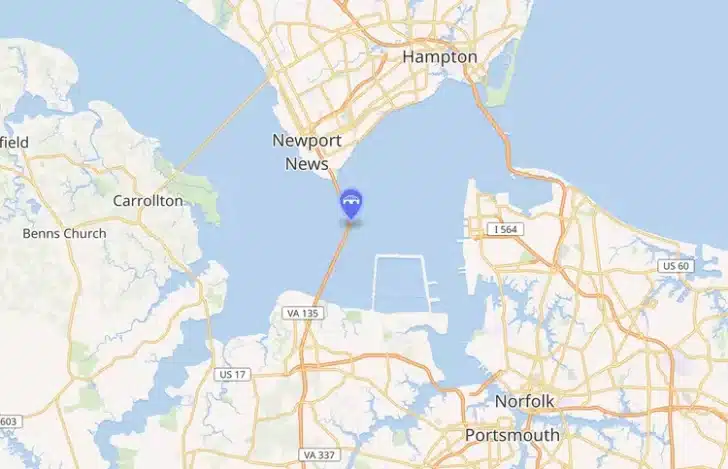
Contrary to assumptions about digital trickery or advanced AI-generated imagery, the phenomenon is completely genuine and rooted in civil engineering. The footage captures the Monitor Merrimac Memorial Bridge-Tunnel (MMMBT) in Hampton Roads, Virginia. This infrastructure is a masterclass in inventive construction, designed to address unique geographic and logistical challenges posed by a critical maritime and military corridor.
Engineering Marvel: Structure and Design of the MMMBT
Spanning 4.6 miles (7.4 kilometers), the MMMBT connects two vital cities—Newport News and Suffolk—by crossing a complex convergence of waterways, including the James, Nansemond, and Elizabeth Rivers. The illusion of cars disappearing happens at the precise transition point where the roadway descends from the bridge section into an underwater tunnel, concealed from the aerial perspective.
The Monitor Merrimac Memorial Bridge-Tunnel comprises:
- 3.2 miles of parallel twin trestle bridges, facilitating eastbound and westbound vehicle traffic on elevated roadways
- Two carefully constructed man-made islands, serving as entry and exit points for the tunnel passages
- A 4,800-foot (approximately 1,500 meters) underwater tunnel, allowing uninterrupted navigation above by large ships
Completed in April 1992 at a construction cost of nearly $400 million, the bridge-tunnel was named to commemorate the Monitor and the Merrimack (later CSS Virginia), two historic ironclad warships that fought in the landmark Battle of Hampton Roads during the American Civil War in March 1862.
Purpose and Strategic Significance
While the internet marvels at the seemingly mystical sight, the Monitor Merrimac Memorial Bridge-Tunnel was constructed for real-world necessity and regional development. The tunnel section, built beneath the riverbed, addresses the challenge of accommodating large naval vessels and heavy commercial shipping traffic—key features of the Hampton Roads maritime landscape on the East Coast.
A traditional tall bridge could have provided clearance for shipping, but it would have posed significant limitations. Operational risks include the interruption of major Navy and commercial routes, exposure to harsh weather events like hurricanes, and concerns about structural vulnerability during emergencies or potential attacks. The region’s considerable military presence, including the globally important Naval Station Norfolk, demanded a secure, adaptable, and resilient infrastructural solution.
The combined use of bridge spans, man-made islands, and an elaborate underwater tunnel allowed engineers to elegantly overcome the area’s deep waterways, fluctuating tides, and both civilian and military priorities. The design also set a precedent for similar “bridge-tunnel” structures elsewhere in the United States and beyond.
How the Disappearing-Car Illusion Works
From an overhead vantage point, viewers are unable to see the precise transition from the bridge section to the submerged tunnel. As vehicles descend onto the man-made island and enter the tunnel portal, they become obscured from view. With the path to the tunnel aligned closely with the bridge deck, cars appear to drive into open water before being suddenly enveloped by the tunnel’s structure. This split-second shift creates the optical illusion of cars vanishing—a testament to both imaginative camera angles and the ingenious nature of the MMMBT’s construction.
Public Reactions and Global Curiosity
As the video spread quickly across social media, reactions were wide-ranging and passionate. Some users, captivated and mystified, pleaded for an explanation, while others recognized the tunnel for what it is and responded with humor or educational insights. Typical comments included:
- “Wait, can someone explain?”
- “That is a tunnel. Welcome to your first day of elementary school.”
- “Open the schools,” another joked.
Yet, many expressed genuine admiration for the engineering prowess on display, highlighting the significance of infrastructure often taken for granted in daily life. Phrases like “Appreciate engineers!” echoed throughout the comments, underscoring a renewed respect for the complexities of transportation design.
Wait, can someone explain? pic.twitter.com/ioeiBGx1IC
— YabaLeftOnline (@yabaleftonline) May 22, 2025
Historical Context and Regional Impact
The history of bridge-tunnel construction in Hampton Roads extends beyond the MMMBT. The region has faced unique challenges due to its topography, maritime traffic, and weather patterns. Early crossings included ferries and basic bridges, which eventually became insufficient for growing populations and strategic demands. Prior efforts, such as the Hampton Roads Bridge-Tunnel and Chesapeake Bay Bridge-Tunnel, established a tradition of innovative civil engineering in southeastern Virginia.
The MMMBT project, managed by the Virginia Department of Transportation (VDOT), broke new ground in both engineering and funding. Through complex geotechnical studies and the use of “immersed tube tunnel” technology—where large prefabricated sections are sunk and joined under the seabed—engineers were able to design a smooth transition for both vehicles and ships. This method has since been adopted in large infrastructure works worldwide.
Economic and Transportation Benefits
Since its inauguration, the MMMBT has played a pivotal role in easing traffic congestion, promoting regional commerce, and supporting national security. It forms a critical segment of Interstate 664, part of the circumferential Hampton Roads Beltway, and facilitates the transport of goods and passengers in one of America’s key shipping hubs. The design is lauded for its resilience against tides, hurricanes, and rising sea levels.
By enabling reliable crossings regardless of maritime traffic volume, the bridge-tunnel system reduces delays and enhances the efficiency of local industries, tourist travel, and logistical operations. It stands as an essential link for both civilian commuters and military logistics.
Expert Insights: The Science and Challenges of Tunnel Construction
Experts in civil and structural engineering highlight the technical feats accomplished with the MMMBT. “Designing long-span bridges and deep tunnels beneath major waterways requires meticulous analysis of soil conditions, water pressure, and seismic activity,” notes a civil engineering professor at Virginia Tech. “Engineers must also plan for ventilation, lighting, emergency access, and ongoing maintenance.”
Internationally, similar projects have been driven by lessons learned in Hampton Roads. Key considerations often include cost, environmental impact, construction safety, and adaptability to future climate conditions.
Societal Fascination With Engineering Wonders
The public’s reaction to the viral video underscores a broader fascination with large-scale engineering achievements. From the Chunnel linking England and France, to tunnels under Hudson River in New York City, people are compelled by the innovations that allow seamless connection across—and beneath—once-impossible barriers. The Monitor Merrimac Memorial Bridge-Tunnel stands as a testament to American ingenuity and the potential of public works to capture imaginations across generations and continents.
Conclusion: Infrastructure as Everyday Magic
While social media continually surprises us with viral oddities, the story behind the video of “vanishing cars” is a celebration of human capability and the inventiveness built into our daily lives. The Monitor Merrimac Memorial Bridge-Tunnel is not just a functional piece of infrastructure—it is a symbol of foresight, resilience, and the subtle marvels that underpin modern civilization. Ultimately, this episode serves as a reminder to look beyond the surface and appreciate the unseen complexities shaping our world every day.
Sources
- BBC News – Virginia Transportation Coverage
- Reuters – Virginia Bridge-Tunnel Explained
- Virginia Department of Transportation – Project Description
- The Guardian – Hampton Roads Infrastructure
- Al Jazeera – Viral Video Analysis
Disclaimer: This content is intended for entertainment purposes only and is not based on real events.