Lady Jane Grey: The Nine Days Queen and Her Last Hours at the Tower
The Final Morning: Lady Jane Grey in the Tower
On a frigid Monday morning in February 1554, Lady Jane Grey stood at her window in the Tower of London. She was a teenager—sixteen or perhaps seventeen—wearing a black gown and witnessing the aftermath of her husband’s execution. Just seven months earlier, Jane Grey had been proclaimed Queen of England, ruling for only nine tumultuous days before her fall. The tragedy of her last morning began with the return of Lord Guildford Dudley’s body, and within an hour, Jane herself would walk across the Tower grass toward the scaffold.

Background: Royal Blood and Ambition
Jane was born in 1537, the eldest daughter of Henry Grey, Marquess of Dorset, and Lady Frances Brandon, granddaughter of Henry VII. Her lineage made her a distant heir to the throne and, in the context of Tudor England, a political pawn. The Greys were known for their ambition, and their home at Bradgate Park in Leicestershire was infamous for its lack of warmth. Royal blood brought both honor and significant danger; in 16th-century England, anyone with a claim to the throne became a piece in the power games of the nobility.
Jane’s Early Life: Education and Household Influences
At nine or ten, Jane was placed in the household of Catherine Parr, Henry VIII’s widow. Catherine was married to Thomas Seymour, uncle to the boy king Edward VI. Under Parr’s tutelage, Jane was exposed to deep religious discussions, intellectual rigor, and a household brimming with books. Catherine Parr was a pioneering religious reformer and published author. After Parr’s death in 1548 and Seymour’s downfall, Jane returned to Bradgate, but the seeds of intellectual curiosity had already taken root.
Jane’s education continued at an astonishing pace. Her tutor, John Aylmer (later Bishop of London), guided her through Latin, Greek, and Italian studies. She corresponded in Latin with continental reformers like Heinrich Bullinger and was regarded as one of England’s brightest young scholars. Visitors, such as Roger Ascham, famously found her reading Plato’s “Phaedo” in Greek, preferring intellectual pursuits over family recreation. She confided that her parents were stern and demanding, and her happiest times were spent studying with Master Aylmer.
The Political Context: Edward VI and the Protestant Succession
Jane’s cousin, Edward VI, ascended the throne at age nine in 1547. Edward was fiercely Protestant and championed religious reforms, but his youth meant that powerful courtiers effectively ruled England. By 1553, Edward fell gravely ill—likely from tuberculosis. According to Henry VIII’s will and the laws of succession, Edward’s elder half-sister Mary was next in line. Mary was a committed Catholic, and her succession threatened the Protestant reforms.
John Dudley’s Scheme: Jane as Queen
John Dudley, Duke of Northumberland, England’s de facto chief minister, faced the loss of his power and, potentially, his life if Mary became queen. To maintain his position, Northumberland sought to place a Protestant heir on the throne. Jane Grey, with royal blood, youth, and Protestant convictions, fit the criteria. Jane was married to Northumberland’s teenage son, Guildford Dudley, in May 1553. Reports suggest Jane was reluctant, pressured by her parents, though details come mostly from foreign sources.
Edward’s Devise and Jane’s Accession
In his final weeks, Edward VI drafted his “devise for the succession,” bypassing both Mary and Elizabeth, citing their illegitimacy. The revised document named Jane as the heir. Edward died on July 6, 1553. His death was kept quiet while Northumberland and the council prepared to install Jane. On July 9, Jane was told she was queen. She later described the moment as shocking and sorrowful, asserting that the crown was not her right. Despite her protests, she was installed in the Tower of London, traditionally the residence of monarchs before coronation.
Jane was proclaimed queen on July 10, but the streets of London remained subdued. Her reign began in isolation and uncertainty.
Nine Days: Mary’s Challenge and Jane’s Reign
Jane’s rule was immediately challenged by Mary, who declared her claim from East Anglia and gathered support. The majority of ordinary people, regardless of religious affiliation, saw Mary as the rightful heir. Northumberland’s efforts to rally an army failed, as his forces dissolved. On July 19, the council switched allegiance, recognizing Mary as queen. That evening, Jane’s father symbolically removed her canopy of state, ending her short reign.
Jane was imprisoned in the Tower, and Mary entered London to widespread acclaim on August 3, 1553.
Imprisonment and Hope for Mercy
Initially, it appeared Jane might survive. Mary was empathetic, recognizing Jane as an unwitting pawn. Northumberland was executed for treason, and Jane dined with visitors, expressing bewilderment at Dudley’s last-minute religious conversion. Jane’s steadfastness in faith would soon be tested more acutely.
Jane and Guildford were imprisoned separately. On November 13, 1553, they were tried and found guilty of treason, though Mary delayed the sentences. Jane’s youth and lack of agency pointed toward mercy, and for a brief period, her release seemed possible.
Events Leading to Execution: Wyatt’s Rebellion
Mary’s marriage plans with Prince Philip of Spain outraged many English subjects. Philip symbolized foreign domination and Catholic resurgence. In January 1554, Thomas Wyatt led a rebellion in Kent, briefly threatening London. Jane, locked in the Tower, had no involvement, but her father joined the uprising and was quickly captured. This sealed Jane’s fate, as her existence continued to symbolize Protestant resistance.
Religious Debate: Jane and Dean Feckenham
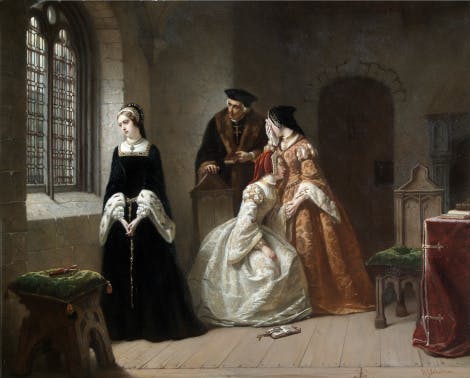
Mary sought to save Jane’s soul by sending John Feckenham, Dean of St Paul’s and a learned, compassionate priest, to persuade her to convert. Instead, Jane and Feckenham engaged in a theological debate. Jane argued for salvation by faith alone, quoted scripture, and defended the Protestant interpretation of the Eucharist. Feckenham urged trust in the church, but Jane maintained that scripture was the sole authority. Their conversation was soon circulated among Protestants, further cementing Jane’s legacy as a martyr for her beliefs.
The Last Night: Jane’s Farewell Letters and Prayers
On February 11, Jane wrote a farewell letter to her younger sister Katherine in the blank pages of a Greek New Testament, urging her to seek solace in scripture and not to grieve for her death. Jane also wrote comforting words to her imprisoned father and to Sir John Brydges, the courteous Lieutenant of the Tower. Her prayer book, filled with reflections and prayers, survives in the British Library. Tradition holds that Jane carved Latin verses onto the walls during her incarceration, but these remain uncertain.
Final Moments: Refusing a Last Meeting, Facing the Scaffold
Guildford requested to see Jane before their executions; Jane declined, suggesting it would only bring sorrow and that they would be reunited in heaven. On February 12, Guildford was executed publicly, his body returned for burial in the Chapel of St Peter ad Vincula, inside the Tower, witnessed by Jane.
Jane walked to the scaffold accompanied by Sir John Brydges and two weeping gentlewomen. Feckenham was present. The execution area was reserved for high-born prisoners, away from public gaze. Jane’s demeanor was calm and resolute.
Jane’s Last Speech and Execution
Jane addressed the small audience, admitting to unlawful actions but affirming she never sought the crown. She professed her Christian faith, repented her worldly attachments, and asked for prayers. She recited Psalm 51—”Have mercy upon me, O God”—a plea for forgiveness and renewal. She forgave her executioner, prepared herself, and laid her head on the block after being guided by an unnamed bystander. Jane’s final words echoed Christ’s: “Lord, into thy hands I commend my spirit.” She was executed swiftly and buried near her husband.
Aftermath: The Fate of Jane’s Family
Jane’s father was executed eleven days later. Her mother, Frances Brandon, was spared, returned to court, and eventually remarried. Frances died in 1559, her funeral attended by her daughters and paid by Queen Elizabeth I, Jane’s cousin.
Legacy: Martyrdom and Historical Memory
Jane Grey became emblematic of Protestant martyrdom, immortalized in John Foxe’s “Book of Martyrs.” Her letters and theological debates were republished, shaping English perceptions for centuries. Her steadfastness and innocent acceptance of fate resonated deeply among Protestants. Jane’s words, not her crown, defined her legacy.
The Dudley brothers, locked in the Beauchamp Tower, carved family emblems into the stone. Most were released by late 1554, with Robert Dudley rising to become Earl of Leicester and confidant to Elizabeth I, the same cousin who had been bypassed in Jane’s succession.
The Art and the Myth: Paul Delaroche’s Painting
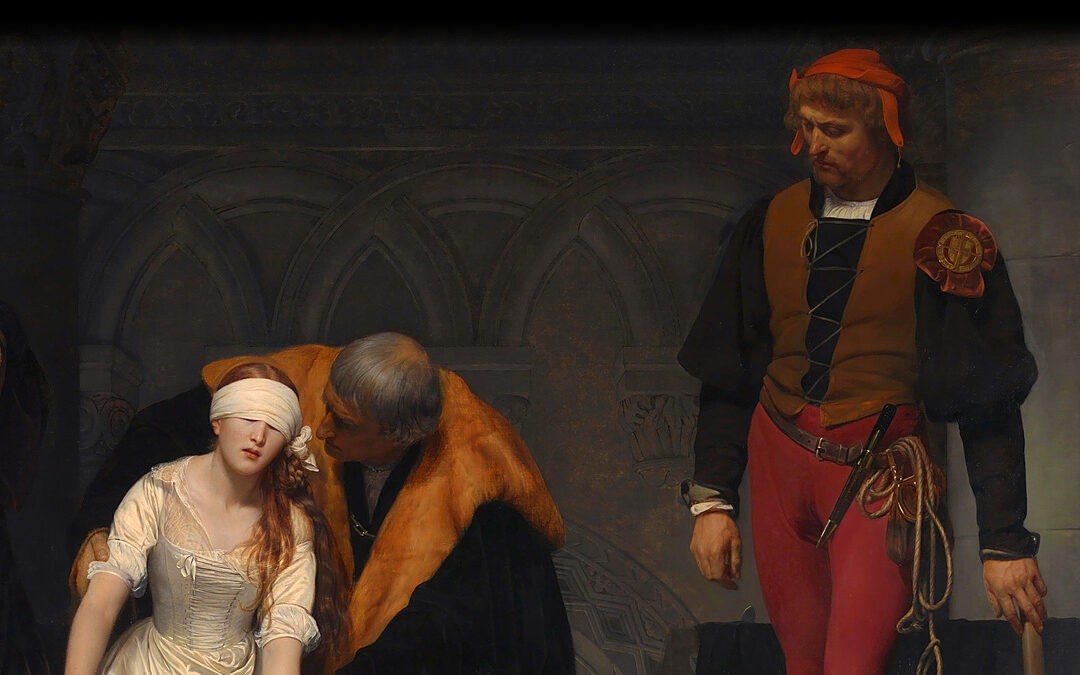
In 1833, French artist Paul Delaroche painted “The Execution of Lady Jane Grey,” shaping modern perceptions. Jane, in white satin, is depicted blindfolded and guided gently toward the block. The painting is inaccurate—Jane wore black and died outdoors—but it captures the emotional poignancy of her final moment, influencing how the world remembers her.
Enduring Words: Jane Grey’s Legacy
Jane Grey’s reign lasted nine days; she never sought the crown and relinquished it without protest. Her courage at the scaffold, her profound prayer, and her unwavering faith have outlasted centuries. The Tower held her body, but her words escaped—her farewell, her debates, and her final speech. Nearly five hundred years later, the story of Lady Jane Grey continues to be read, remembered, and studied as one of the most poignant episodes in Tudor history.
Sources
Disclaimer: This content is intended for entertainment purposes only and is not based on real events.