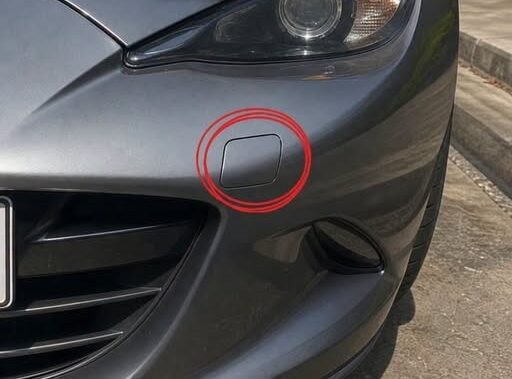
A small square, rectangular, or circular plastic panel on a car bumper can look like an insignificant part of the vehicle’s exterior design. It is often painted to match the bumper and may be easy to miss until someone points it out during a breakdown or roadside assistance call.
On many modern vehicles, this panel covers a threaded mounting point for a removable towing eye, also called a screw-in tow hook. The towing eye is usually stored with the spare tire tools, beneath the cargo-area floor, or in another location identified in the owner’s manual. When fitted correctly, it gives a recovery operator or roadside technician access to a manufacturer-designated attachment point.
However, it is important not to make assumptions based on appearance alone. Not every small panel on every bumper covers a towing-eye socket. Some vehicles have covers for headlamp-washer systems, parking sensors, radar equipment, or other design-specific components. The owner’s manual remains the most reliable way to identify a bumper panel and understand its intended purpose.
For vehicles that do have this feature, knowing its function before an emergency can save time and help prevent costly damage. The cover itself is not a tow hook, and the visible bumper is not normally the part meant to carry a pulling load. Instead, the panel is simply an access door to a connection designed for a particular removable component and a particular type of vehicle movement.

A Small Bumper Panel With a Practical Purpose
Automakers use removable bumper covers because modern vehicles are designed with smooth exterior surfaces, styling requirements, pedestrian-safety considerations, and integrated sensors. A permanently exposed metal hook would affect appearance and may be less practical for everyday driving. A discreet panel allows manufacturers to hide the towing-eye connection until it is needed.
Depending on the model, the cover may be located on the front bumper, rear bumper, or both. It is commonly shaped as a small square or rectangle, although the exact size, outline, and position differ between vehicles. Some covers include a small notch that allows them to be gently released with a suitable tool, while others are designed to be pushed or lifted from a particular edge.
The panel should be handled carefully. It is a trim piece rather than a structural component, and forcing it open can break clips, scratch paint, or damage the surrounding bumper surface. Vehicle manuals often provide specific instructions for removing and refitting it. In many cases, the cover remains attached by a small retaining strap or should be stored safely until the towing eye is removed.
The key point is simple: when the panel conceals a towing-eye socket, the plastic cover only protects and hides that opening. It is not intended to be pulled, tied around, or used as an attachment point for straps, ropes, chains, or cables.
What Is Behind the Cover?
Behind an applicable bumper cover is a threaded socket built into a reinforced part of the vehicle structure. A compatible towing eye screws into this socket. The eye is generally a heavy metal loop with a threaded shaft, designed to be tightened fully according to the manufacturer’s instructions.
Many drivers refer to this part as a “tow hook,” but “towing eye” is often a more precise term. Rather than being a permanently mounted hook, it is a removable component that creates a defined connection point when installed. The towing eye may be used by a professional recovery vehicle, in carefully controlled towing circumstances, or when a vehicle needs to be moved a short distance as permitted by the manufacturer.
Its exact permitted use varies substantially. Some manufacturers state that the screw-in eye is intended only for loading the vehicle onto a transporter, positioning it during recovery, or moving it at very low speed over a short distance. Other manuals include limited flat-towing guidance for certain models, while many vehicles specifically warn against towing with wheels on the ground. Electric vehicles, all-wheel-drive vehicles, hybrids, vehicles with automatic transmissions, and cars with electronic parking systems can have especially important restrictions.
For this reason, a threaded socket should never be interpreted as blanket permission to tow a vehicle in any manner. The part may be strong and purpose-built, but its approved use depends on the vehicle’s drivetrain, transmission, condition, angle of pull, road conditions, and the procedure described by the manufacturer.
Why the Bumper Is Not a Suitable Substitute
During an unexpected roadside problem, an exposed bumper edge may seem like an easy place to attach a rope or strap. That approach can lead to avoidable damage. Most visible bumper covers are made of plastic and are designed primarily for appearance, impact management, aerodynamic performance, and the housing of lights or sensors. They are not typically designed to serve as pulling points.
Attaching equipment to an unsuitable exterior component can crack bodywork, detach trim, damage sensor systems, bend parts behind the bumper, or create an unsafe connection. Even where a vehicle has a metal reinforcement beam behind its bumper cover, that does not mean the outer bumper assembly is an approved place to connect recovery equipment.
The towing-eye socket exists to provide a manufacturer-selected location for an appropriate attachment. It helps technicians avoid improvising around visible body panels. Still, the presence of that connection does not eliminate all risk. A tow line can become loaded unexpectedly, an improperly fitted eye can fail, and an unsuitable recovery method can cause vehicle damage or create hazards for people nearby.
Professional operators consider more than the location of a towing eye. They assess whether the vehicle can roll freely, whether the steering is unlocked, whether the wheels are damaged, whether the transmission allows the intended movement, and whether a flatbed or wheel-lift is the safer transport method. These decisions are especially important after a collision, tire failure, mechanical fault, or loss of power.
Front and Rear Tow-Eye Covers Can Have Different Roles
Some cars have a towing-eye access point at both ends, while others provide one only at the front or rear. The location can help a recovery professional determine where a connection may be made, but it does not automatically tell the driver which way the car can be towed.
For example, a rear access point may be useful for positioning a vehicle, but it does not necessarily authorize long-distance towing from the rear. Likewise, a front towing eye may be intended for loading a vehicle onto a recovery truck rather than pulling it over public roads. The vehicle’s manual, rather than the panel’s location, establishes the approved procedure.
There is also a difference between towing and recovery. Towing generally refers to transporting or pulling a vehicle in a controlled manner. Recovery may involve moving a stranded vehicle from snow, mud, a ditch, or another situation where it cannot move freely. Recovery loads can be unpredictable and significantly greater than the loads involved in gentle repositioning. A screw-in towing eye that is acceptable for controlled loading may not be approved for forceful extraction.
Manufacturers commonly warn drivers not to use towing eyes for sudden jerking, snatch-style pulls, or other high-load recovery attempts unless the vehicle documentation expressly permits a specific method. When a car is stuck or severely damaged, contacting a qualified roadside assistance provider is usually the safest option.
Finding and Installing the Correct Towing Eye
If a vehicle’s owner’s manual confirms that the bumper panel covers a towing-eye mounting point, the next step is locating the correct towing eye. It is often included in the vehicle’s tool kit, though its storage position differs by model. In some cars it may be beneath the trunk floor; in others it may be in a side compartment or with the jack equipment. Vehicles without a spare tire may still have a tool kit containing the towing eye.
Only the component specified for that vehicle should be used. Towing eyes are not necessarily interchangeable between brands, models, or model years. Thread size, length, material, and the way the eye seats against the vehicle can vary. A part that appears to fit may not engage correctly or may not provide the intended strength and alignment.
Manufacturer instructions commonly require the towing eye to be screwed in fully and tightened securely, sometimes using the supplied wheel wrench or another tool for leverage. It should not be used if the threads are visibly damaged, contaminated, or unable to engage smoothly. Cross-threading or partial engagement can compromise the connection.
After use, the towing eye should be removed and stored properly, and the bumper cover should be refitted. Leaving the eye installed during normal driving can create an unnecessary protrusion and may be inconsistent with the vehicle manufacturer’s guidance.

Why Modern Vehicles Need Vehicle-Specific Towing Guidance
Modern cars are more complex than older vehicles in ways that affect roadside transport. Automatic transmissions may require particular gear selections or restrictions on wheel movement. All-wheel-drive systems can be damaged if one axle is lifted while the other wheels remain on the ground. Electric and hybrid vehicles may have high-voltage systems, battery-protection requirements, or specific instructions after an incident. Driver-assistance sensors and low-mounted body components can also affect where recovery equipment should be placed.
Because of these differences, roadside assistance organizations and automakers frequently recommend a flatbed truck for many disabled vehicles. A flatbed keeps all wheels off the road and can reduce the risk of drivetrain damage when a vehicle cannot be safely towed with its wheels rolling. The correct method will depend on the model, the reason it is disabled, and the manufacturer’s instructions.
Drivers should also distinguish between moving a vehicle out of immediate danger and arranging proper transportation. If a car has stopped in an unsafe location, the priority is personal safety: move away from traffic where possible, use hazard warning lights if conditions allow, and seek professional assistance. Attempting an unfamiliar towing procedure at the roadside can create additional risks.
How to Prepare Before a Roadside Emergency
A few minutes of preparation can make a stressful situation more manageable. Drivers can review the owner’s manual section covering emergency towing, identify the location of the towing eye and tool kit, and check whether the vehicle has front, rear, or both access points. It is also useful to keep roadside assistance contact details available in the vehicle or on a phone.
Before any connection is used, confirm the following:
- Whether the bumper panel actually covers a towing-eye socket.
- Whether the correct towing eye for the vehicle is available and undamaged.
- How the manufacturer says the eye should be installed.
- Whether the vehicle may be moved with wheels on the ground.
- Whether the intended action is a permitted tow, controlled loading operation, or a situation requiring professional recovery.
- Whether a flatbed or other specialized transport method is recommended.
If any of these points are uncertain, the safest choice is to consult the owner’s manual, call the vehicle manufacturer’s roadside support service, or contact a qualified towing provider. The towing eye is a useful feature, but it is only one element of a safe recovery or transport plan.
The Bottom Line on the Small Square Bumper Cover
The small plastic cover on a car bumper is often more than a styling detail. On many vehicles, it conceals a threaded socket for a removable towing eye. This socket provides access to a designated connection point and can help prevent damage caused by attaching equipment to an unsuitable bumper component.
Yet the cover does not provide universal towing instructions. Not all panels have the same function, not all towing eyes are interchangeable, and not every type of pull is appropriate for a threaded towing-eye connection. The correct method depends on the specific vehicle and the circumstances.
Recognizing the panel is valuable because it helps drivers understand what roadside professionals may be looking for. The most important next step is checking the owner’s manual and following the manufacturer’s limits. Used correctly, the hidden towing-eye connection is a practical feature designed to support safe, informed vehicle handling when assistance is needed.
Sources
- National Highway Traffic Safety Administration (NHTSA) — Vehicle safety information and roadside preparedness resources.
- AAA Newsroom — Roadside safety and vehicle assistance information.
- Ford Owner Manuals — Model-specific towing and emergency vehicle movement instructions.
- Tesla Owner’s Manuals — Official guidance on transport and towing procedures for Tesla vehicles.
- BMW Owner’s Manuals — Vehicle-specific operating and towing-eye guidance.
Disclaimer: This content is intended for entertainment purposes only and is not based on real events.