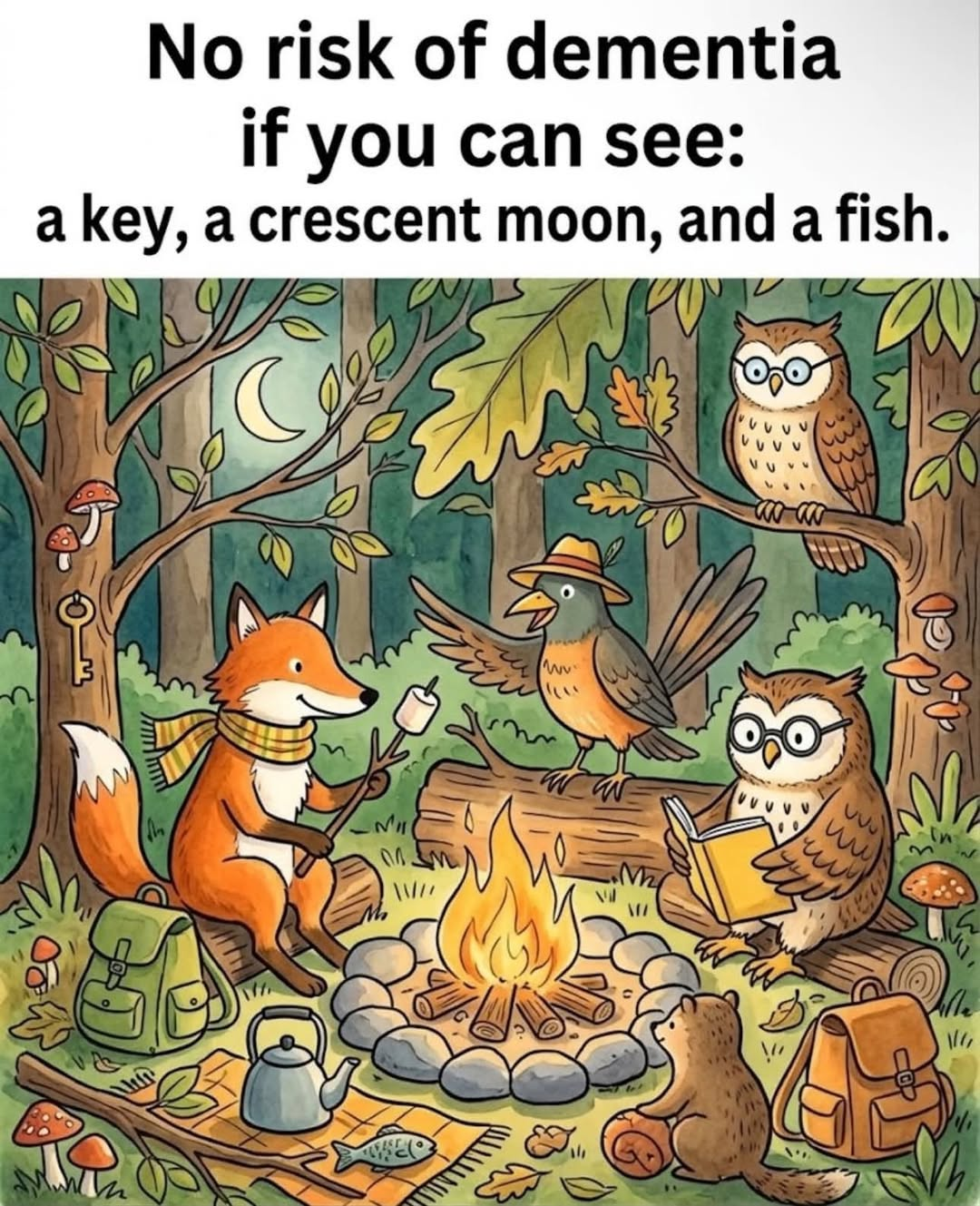
A Simple Picture That Is Harder Than It Looks
At first glance, a colorful illustration filled with animals and natural details may appear easy to understand. You might notice the main characters, recognize the setting, and move on without giving the smaller details much attention.
But hidden-object puzzles invite you to look again.
Somewhere within the illustration are three objects waiting to be discovered: a key, a crescent moon, and a fish. They may be cleverly incorporated into the surrounding shapes, making them difficult to distinguish from the rest of the picture.
The key and crescent moon may be easier for some viewers to recognize. The fish, however, is described as the more challenging object, requiring closer attention to the smaller details.
That is what makes this kind of visual challenge enjoyable. Instead of simply looking at the picture as a whole, you must examine individual areas, compare shapes, and notice details that might otherwise escape your attention.
Some people may identify all three objects quickly. Others may need several minutes to search through the illustration.
There is no need to rush. The challenge is about enjoying the process of observation rather than proving something about your intelligence or health.
Why Hidden-Object Puzzles Capture People’s Attention
Hidden-object games have been popular for generations because they turn ordinary pictures into small visual mysteries.
Unlike puzzles that require complicated instructions or specialist knowledge, these challenges are easy to understand. Players receive a simple objective: find the objects concealed within an image.
The difficulty comes from the way the objects are incorporated into the surrounding scene.
A curved branch might resemble the outline of a fish. A small section of a decorative pattern could form the shape of a key. A crescent moon might blend into the background or appear among other curved details.
The brain must separate the object being searched for from the many visual elements competing for attention.
This process involves several everyday visual skills. People use their eyes to collect information, recognize familiar shapes, compare patterns, and decide which details deserve closer examination.
The task can become more challenging when the image contains many overlapping objects, similar colors, or distracting patterns.
That is why two people looking at the same illustration may have very different experiences. One might immediately recognize the fish, while another repeatedly scans the same area without noticing it.
These differences are part of what makes visual puzzles interesting.
What Makes the Key, Moon, and Fish Difficult to Find?
Each hidden object presents a slightly different visual challenge.
A key is often recognizable because of its familiar structure: a narrow shaft, a rounded or decorative head, and small teeth at one end. However, when these features are incorporated into a complicated illustration, the outline may be difficult to distinguish.
A crescent moon has a recognizable curved shape, but it can easily blend into other curved objects. Branches, leaves, decorative lines, and shadows may create similar outlines.
The fish can be particularly challenging because its shape may be disguised by surrounding details. Depending on the illustration, the body, tail, and fins might not immediately look like a recognizable animal.
The important part is to look beyond the obvious objects.
Instead of scanning the entire picture randomly, try examining one section at a time. Look for unusual curves, small shapes, and outlines that seem slightly different from their surroundings.
You can also change your viewing strategy. Start with the larger areas, then move toward smaller details. If you repeatedly search the same area without success, take a short break and return with fresh attention.
Sometimes, stepping away from an image makes a previously overlooked shape easier to recognize.
A Fun Way to Practice Visual Attention
One reason people enjoy hidden-object puzzles is that they encourage focused observation.
When searching for a particular object, you are directing your attention toward specific visual features. You may compare outlines, examine different parts of the image, and ignore details that are unrelated to the task.
This makes the puzzle a simple exercise in visual attention.
Visual attention is the ability to focus on relevant information while filtering out distractions. It plays a role in many ordinary activities, from finding a familiar item in a crowded drawer to reading a page or locating a particular object in a busy room.
Hidden-object games provide an entertaining setting in which to practice looking carefully.
However, it is important to understand the limits of this benefit. Completing one picture puzzle does not demonstrate that someone’s overall attention, memory, or cognitive abilities are better than those of another person.
A player may be especially familiar with visual puzzles, have more time to examine the picture, or recognize the hidden shapes because of previous experience.
Someone who takes longer may simply be unfamiliar with the particular illustration or may be viewing it on a small screen.
The result of a single game should therefore be treated as entertainment, not as a meaningful measurement of general cognitive ability.
Can Picture Puzzles Help Keep the Brain Active?
Activities that challenge the mind can be an enjoyable part of everyday life.
Reading, learning a new skill, playing games, solving puzzles, and engaging in conversations all involve different kinds of mental activity. Some require memory, others involve reasoning, language, planning, or visual recognition.
Hidden-object puzzles mainly encourage people to focus on visual details and identify familiar shapes within a larger scene.
Repeated practice may help someone become more familiar with this particular type of task. For example, a person who regularly plays hidden-object games may become quicker at recognizing objects concealed within complex illustrations.
However, becoming better at a specific puzzle does not automatically mean that every aspect of cognitive ability has improved.
The Alzheimer’s Society explains that brain-training activities can improve performance on particular tasks, but strong evidence that commercial brain-training games reduce the risk of dementia is lacking.
This distinction is important because online headlines sometimes exaggerate what simple puzzles can accomplish.
A picture puzzle can be enjoyable and mentally engaging. It should not be promoted as a proven way to prevent Alzheimer’s disease or other forms of dementia.
A balanced approach to brain health involves a much broader range of everyday habits and health considerations.
Can Finding All Three Objects Tell You Anything About Dementia?
This is where the puzzle requires an important clarification.
Some online versions of hidden-object challenges have been associated with claims that people who find all the objects quickly have no risk of developing dementia.
That statement is misleading.
Dementia is not a condition that can be ruled out by completing a single visual game. Finding a hidden key, crescent moon, and fish does not establish that a person has healthy cognitive function in every area.
Likewise, struggling to find one of the objects does not mean that someone has dementia or is developing the condition.
Dementia describes a group of conditions associated with a decline in cognitive abilities that affects everyday life. Symptoms can involve memory, language, reasoning, judgment, behavior, and other functions.
The experience differs between individuals, and the symptoms may develop gradually.
A person might have difficulty with memory while retaining strong visual recognition skills. Another person may experience changes in visual processing without having difficulty with every other cognitive task.
Age, eyesight, education, familiarity with puzzles, image quality, lighting, fatigue, and distractions can all influence how someone performs in a visual challenge.
For these reasons, the time required to find three objects cannot serve as a reliable measure of dementia risk.
How Is Dementia Actually Assessed?
A proper assessment of suspected dementia involves much more than one puzzle or online test.
Healthcare professionals generally consider a person’s medical history, reported symptoms, changes in everyday functioning, and observations from family members or other people who know them well.
Depending on the situation, an assessment may include cognitive screening tests, physical examinations, blood tests, brain imaging, or more detailed neuropsychological evaluations.
Some standardized cognitive assessments include tasks involving memory, attention, language, reasoning, and visual or spatial abilities.
These tools are designed to examine specific areas of cognitive functioning under more controlled conditions.
Even formal screening tests have limitations. A screening result does not automatically establish a diagnosis. Further evaluation may be necessary to understand the cause of any difficulties and determine whether they are related to dementia or another condition.
The United States Preventive Services Task Force explains that cognitive screening instruments are not intended to independently diagnose dementia.
This is very different from an informal online puzzle that has no established diagnostic procedure, scoring system, or validated clinical interpretation.
If someone experiences persistent or worsening memory problems, difficulty managing familiar daily activities, or other concerning changes in thinking and behavior, speaking with a healthcare professional is more appropriate than relying on an internet challenge.
There is no reason to become alarmed simply because a particular hidden object is difficult to find.
Why Online Dementia Claims Should Be Treated Carefully
Health-related claims often attract attention because they connect everyday experiences with concerns people may already have.
A simple puzzle becomes more interesting when a headline suggests that completing it can reveal something important about the brain.
But an attention-grabbing headline is not the same as scientific evidence.
To determine whether a test can identify a medical condition, researchers must examine how accurately it performs, whether the results can be repeated, and whether it distinguishes people with the condition from those without it.
A valid diagnostic or screening tool requires evidence and appropriate clinical interpretation.
A hidden-object illustration does not meet those requirements simply because it involves visual recognition.
This does not mean that visual tasks have no role in medical research. Researchers have investigated visual and spatial abilities as part of cognitive assessment, including their potential relevance to Alzheimer’s disease.
A 2023 systematic review published in Dementia and Geriatric Cognitive Disorders examined research on visual and spatial perception tests in Alzheimer’s disease. It found that certain structured tests may contribute to clinical screening, although the evidence and diagnostic performance varied across different tests.
The key difference is that these are studied assessment methods, not ordinary online picture puzzles.
A game designed for entertainment cannot be treated as an equivalent medical instrument.
How to Enjoy the Puzzle Without Taking It Too Seriously
The best way to approach the key, moon, and fish challenge is to treat it as a small test of patience and observation.
Start by looking at the entire illustration. Notice the main shapes, the background, and the different objects in the scene.
Then search for the key. Look for a familiar outline with a narrow shaft and a distinctive head.
Next, look for the crescent moon. Focus on curved shapes that resemble a thin, partially illuminated moon.
Finally, search for the fish. Examine the smaller details and look for an outline that could include a body, tail, or fins.
If you cannot find everything immediately, there is no reason to feel frustrated. The image may be deliberately designed to make the objects difficult to recognize.
You can also invite friends or family members to participate. Comparing which object each person notices first can make the activity more enjoyable.
For families, these puzzles can be a simple way to spend time together, especially when children and adults enjoy different levels of challenge.
Just remember that the results are not a competition with medical meaning. The fastest person is not necessarily healthier, more intelligent, or less likely to develop a neurological condition.
The value of the activity lies in the enjoyment of looking carefully and discovering something that was hidden in plain sight.
A Small Puzzle With a Much Bigger Lesson
The hidden key, crescent moon, and fish may seem like ordinary objects, but finding them can turn a simple illustration into an entertaining challenge.
The puzzle encourages people to slow down, examine details, and look at familiar shapes from a different perspective. It can provide a pleasant mental break and an opportunity to share a little friendly competition.
At the same time, the claims sometimes attached to these challenges deserve careful attention.
Finding all three objects does not prove that someone is free from dementia. Missing the fish does not indicate that someone has a cognitive disorder. A single picture cannot measure a person’s overall brain health or predict their future medical condition.
Visual puzzles are best enjoyed for what they are: games that encourage observation and curiosity.
So take another look at the illustration, search carefully for the three hidden objects, and challenge someone else to find them too.
Whether you discover the key first, spot the crescent moon immediately, or spend the longest time searching for the fish, the most important thing is to enjoy the challenge without mistaking it for a medical test.