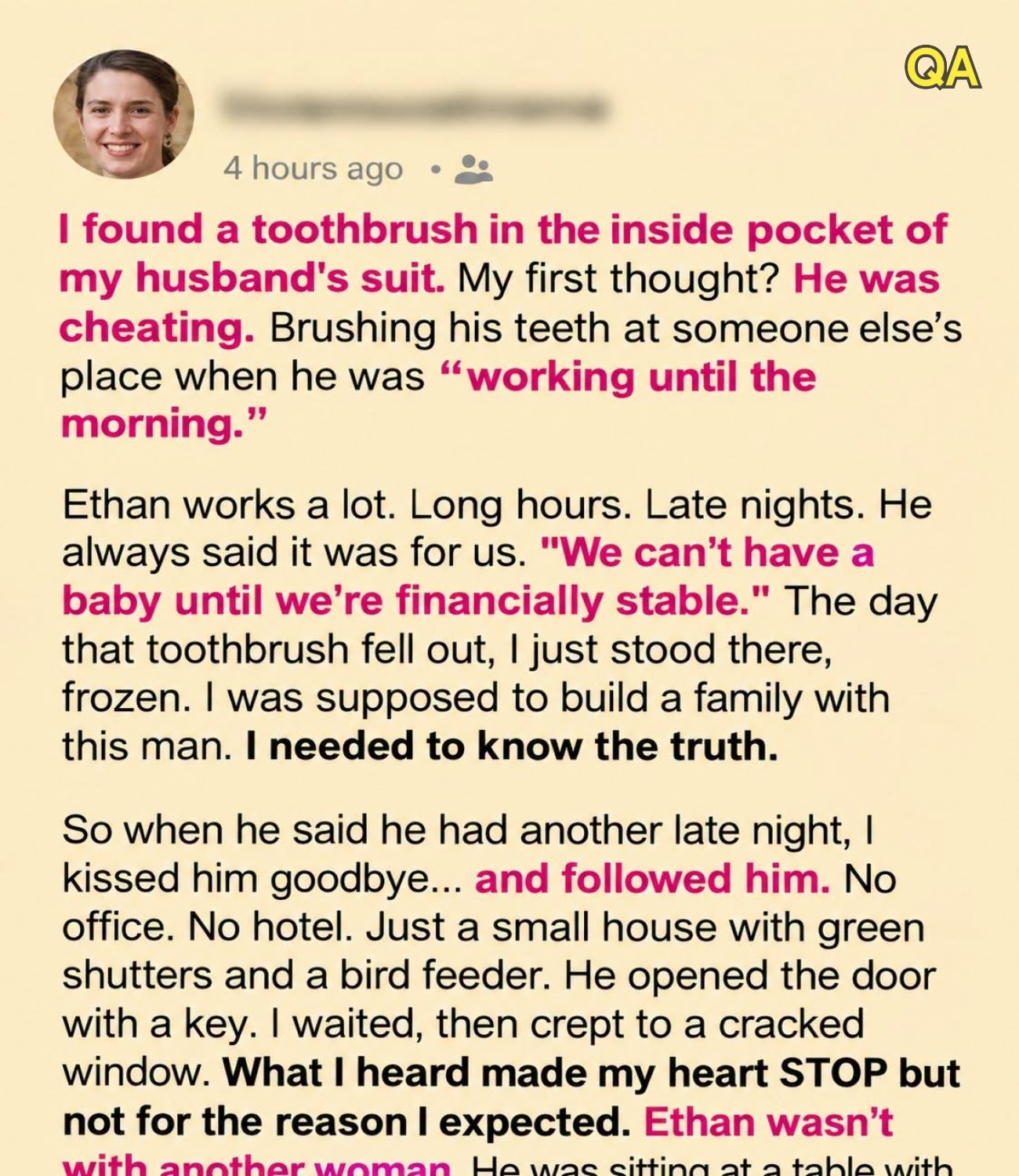
I Found A Toothbrush In My Husband’s Suit Pocket …The Secret Behind It Destroyed Our Marriage
Editor’s note: The following is a fictionalized relationship narrative. It explores themes of secrecy, trust, family pressure, divorce, and emotional recovery. It is not presented as a verified news report or professional legal or mental-health advice.
Sometimes, a small and ordinary object can make a person question everything they thought they knew. In this fictional story, that object was a toothbrush found in the pocket of a husband’s suit jacket during an otherwise routine afternoon of laundry.
The toothbrush had dried toothpaste on its bristles. It did not belong in a suit pocket, and its presence immediately seemed out of place. For the narrator, it became a symbol of uncertainty. Her husband, Ethan, had been staying late at work, travelling frequently for supposed business obligations, and avoiding serious conversations about their future. She had begun to feel that the marriage they had planned together was being repeatedly postponed.
After four years of marriage, she wanted clarity. She wanted to talk about building a family, shared financial goals, and a more stable future. Ethan, however, continued to say that the timing was not right. On the surface, his answer sounded practical. Couples often do face genuine concerns about money, work, housing, and readiness for parenthood. Yet in this case, the repeated delays had gradually created a deeper emotional distance.
A Discovery That Raised Questions About Trust
Trust is one of the central foundations of a healthy relationship. It does not require partners to share every private thought or spend every moment together. Instead, it relies on honesty, consistency, respect, and a shared understanding that both people are participating fully in the relationship.
In the story, the toothbrush did not prove what had happened or explain why it was there. However, it prompted the narrator to confront concerns that had been building for months. Ethan’s schedule had become difficult to verify, and his explanations no longer seemed to match the emotional reality of their marriage.
When he left home for another day of work, she chose to follow him. Rather than driving to his office, Ethan travelled to a quiet suburban neighbourhood. He parked outside a well-kept house, used a key to unlock the door, and went inside.
From a distance, the narrator watched in confusion. She knew the house belonged to Ethan’s parents—or at least, she believed it had once belonged to them. Ethan had told her that his parents had moved away. Seeing him enter the home with a key immediately suggested that she had not been given the full truth.
Seeking answers, she approached carefully and looked through an open window. What she saw was not what she had feared when she first found the toothbrush. Ethan was sitting at a dining table with his mother and father, sharing a meal as though it were an ordinary family visit.
The Pain of Being Hidden From a Partner’s Family
The moment became more distressing when Ethan’s mother asked him when he would settle down and find the right woman. Rather than correcting her, Ethan said that he had been focused on work and had not yet met the right person.
The narrator was devastated because Ethan was already married to her.
As the conversation continued, Ethan’s parents referred dismissively to a woman he had introduced to them in the past. They described her as difficult and unsuitable. Ethan joined the conversation, complaining about someone who wanted marriage and children. The narrator realized that they were discussing her, while treating her not as Ethan’s wife but as an unpleasant former girlfriend.
The core betrayal in this fictional account was not simply a hidden toothbrush or a misleading work schedule. It was the discovery that Ethan had concealed the marriage itself from his parents. He had allowed his wife to remain invisible in a major part of his life, while also misleading his parents about who she was.
Family approval can be emotionally significant for many couples, especially where family traditions, cultural expectations, religion, finances, or close intergenerational relationships shape everyday life. However, an adult partner is responsible for setting appropriate boundaries with relatives. Disagreement from family members does not justify dishonesty, humiliation, or the concealment of a marriage.
Healthy boundaries do not mean cutting off relatives at the first sign of conflict. They can involve respectful conversations, clear limits, and a willingness to protect a spouse from unfair treatment. A partner may not be able to control a parent’s opinion, but they can control whether they participate in disrespectful behaviour or allow it to define the marriage.
Confronting a Pattern of Deception
That evening, the narrator confronted Ethan. She held up the toothbrush, the small item that had led her to uncover the larger secret. She described the house, the meal, and the conversation she had overheard. Ethan’s reaction made clear that he had not expected his wife to learn the truth.
Eventually, he admitted that his family had never approved of her. Rather than defend the relationship or tell his parents that they were married, he had chosen to keep the marriage hidden. He had also lied to his wife by claiming his parents had moved away.
His explanation was that the situation was complicated. But for the narrator, the issue was more direct: years of decisions had been made without her knowledge or consent. The secrecy had not protected the marriage. It had weakened it.
In real life, relationship conflicts can be complex. People may avoid difficult conversations because they fear rejection, conflict, disappointment, or loss of family support. Avoidance can offer temporary relief, but it often allows problems to grow. When one partner repeatedly avoids transparency, the other partner may experience anxiety, self-doubt, grief, and a loss of emotional safety.
Communication is not only about speaking. It also involves listening, taking responsibility, and providing information that materially affects a shared life. A marriage involves decisions about home, money, family relationships, health, future plans, and personal identity. Keeping a spouse secret from close relatives can undermine the mutual recognition and partnership that marriage is meant to represent.
Why Emotional Honesty Matters in Marriage
Emotional honesty means being truthful about difficult feelings, conflicts, fears, and commitments. It does not require perfection. Couples can make mistakes, disagree about priorities, and struggle with outside pressures. What matters is whether both partners can address those problems openly and respectfully.
In the narrative, Ethan did not merely delay a conversation with his parents. He built an alternative version of his life in which his wife did not exist. For the narrator, that realization changed how she understood the previous four years. His reluctance to discuss children and future plans no longer felt like a temporary financial concern. It appeared connected to a larger refusal to fully stand beside her.
Relationship specialists commonly emphasize that trust is rebuilt through consistent action, not only through apologies. When trust has been damaged, both people may need time, clear accountability, reliable communication, and, in some circumstances, professional support. Couples counselling can be useful when both partners genuinely want to understand the harm, communicate safely, and work toward change. It may not be appropriate or desired in every situation, particularly when one person has decided the relationship cannot continue.
For anyone facing serious concerns in a relationship, it can be helpful to slow down before making major decisions when possible. Speaking with a trusted friend, licensed therapist, family-law professional, or local support service may provide practical and emotional guidance. Individual circumstances, legal rights, finances, children, housing, and personal safety can all affect the best next steps.
Choosing Divorce and Beginning Again
By the end of the month, the narrator filed for divorce. Ethan asked her to reconsider and promised that he would finally tell his parents the truth. Yet the promise came after years of deception. In her view, the marriage had been damaged beyond repair.
Divorce is rarely a simple or painless decision. Even when ending a relationship is the right choice, people may experience grief, anger, loneliness, relief, uncertainty, and concern about the future. These emotions can exist at the same time. Leaving a marriage does not erase the value of the hopes a person once had, nor does it mean they have failed.
For the narrator, choosing divorce was an act of self-respect. She decided that she did not want to remain in a relationship where she was treated as a secret. The decision allowed her to focus on rebuilding a life that reflected her own needs, goals, and identity.
Recovery after the end of a marriage is different for everyone. Some people lean on friends and relatives. Others find structure through work, exercise, volunteering, education, faith communities, or creative interests. Professional mental-health support can also offer a confidential space to process loss, rebuild confidence, and develop coping strategies during a major life transition.
Rebuilding Identity Through Small, Meaningful Steps
In the months after filing for divorce, the narrator began doing things she had postponed. She took a holiday she had long wanted to take. She enrolled in pottery classes. She began attending therapy and made space to rediscover who she was outside of a disappointing marriage.
These choices may sound simple, but small routines and new activities can be meaningful during periods of change. Creative hobbies can offer focus and personal satisfaction. Travel, when financially and practically possible, can create distance from familiar pressures. Therapy can help people put difficult experiences into words and consider what they want from future relationships.
She kept the toothbrush that had started the chain of events and had it framed with a humorous plaque: “The plaque doesn’t lie!” In the context of the story, the object became less about pain and more about perspective. It represented the moment she stopped dismissing her own concerns and began paying attention to what she needed.
The larger lesson is not that every unusual object proves betrayal or that suspicion should replace communication. Rather, it is that persistent secrecy and disrespect deserve to be taken seriously. When a person repeatedly feels excluded, misled, or minimized, seeking clarity can be an important step toward making informed decisions.
Moving Forward After a Breach of Trust
The ending of this fictional narrative is ultimately about reclaiming agency. The narrator does not portray divorce as easy, nor does she suggest that personal healing happens overnight. Instead, she finds freedom in no longer accepting a role that required her to be hidden.
Healthy relationships should make room for mutual dignity. Partners may face external pressures, family conflict, financial stress, and differing expectations, but they should be able to speak honestly about those challenges. Respect includes recognizing a spouse publicly and privately, defending reasonable boundaries, and making decisions together.
For people navigating similar feelings of disappointment or uncertainty, compassionate support can make a difference. A qualified therapist or counsellor can help individuals explore their experiences without judgment. Legal advice from a properly licensed professional may also be important when considering separation or divorce.
In this story, a toothbrush uncovered a secret. More importantly, it led one woman to recognize that her future did not have to be shaped by someone else’s dishonesty. By choosing support, creativity, rest, and self-respect, she began building a life in which she no longer had to ask for permission to be seen.
Sources
Disclaimer: This content is intended for entertainment purposes only and is not based on real events.