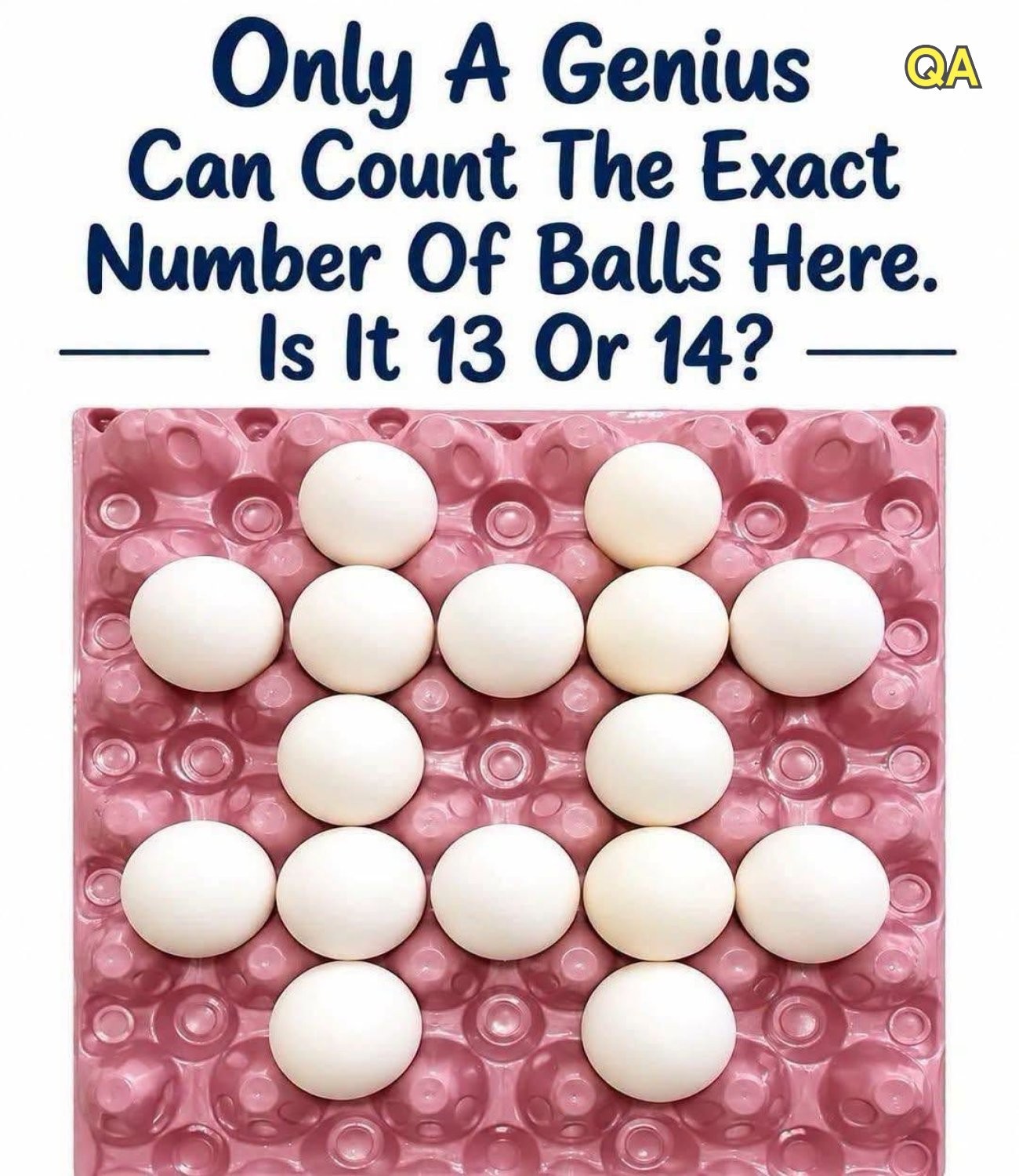
Visual counting puzzles can appear easy at first glance, yet they often test more than basic arithmetic. This white-ball puzzle is a useful example of how quickly the human brain forms an impression, groups objects together, and sometimes overlooks details that are directly in front of it.
Can You Count All the White Balls?
A tray of white balls may seem like one of the simplest possible visual challenges. There are no complicated equations, unfamiliar symbols, or lengthy instructions. The task is simply to look at the arrangement and identify the total number of balls.
However, the puzzle becomes more difficult when viewers try to answer immediately. At first, many people may see 13 or 14 balls, particularly if they take in the entire arrangement at once. The layout can make individual rows blend together, while the empty spaces between balls may lead the eye to skip over some objects.
The correct answer is 16 white balls.
Rather than relying on a quick overall impression, the most reliable way to solve the puzzle is to count systematically, one row at a time. This approach reduces the chance of overlooking a ball or counting one twice.
The Correct Answer: 16 White Balls
The arrangement contains five horizontal rows. Counting each row separately produces the following result:
- First row: 2 balls
- Second row: 5 balls
- Third row: 2 balls
- Fourth row: 5 balls
- Fifth row: 2 balls
When these rows are added together, the calculation is straightforward:
2 + 5 + 2 + 5 + 2 = 16
The puzzle is not difficult because the numbers are complicated. Instead, it is challenging because the visual arrangement encourages a fast estimate. A viewer who sees the image as one large cluster may arrive at a different number than someone who deliberately follows each row from left to right.
Why Simple Visual Counting Puzzles Can Be Misleading
Visual puzzles often rely on ordinary features of human perception. The brain is highly efficient at interpreting large amounts of visual information, but efficiency sometimes involves making quick assumptions. In daily life, this ability is useful: people do not need to consciously count every object in a familiar scene before understanding what they are seeing.
In a puzzle, however, that fast processing can lead to mistakes. When objects are closely grouped, evenly colored, or arranged in a repeating pattern, the eye may treat several separate items as a single visual unit. This is especially likely when the viewer is given only a few seconds or feels pressure to choose an answer quickly.
The white balls in this puzzle are similar in size and color, so they can appear to merge into rows or clusters. The alternating pattern of two balls and five balls also makes the total less obvious than a uniform grid. A person may notice the larger rows first and fail to fully account for the smaller rows between them.
These effects do not mean that someone is poor at counting. They reflect the normal way attention works. Psychologists studying perception have long observed that people organize visual information into patterns, groups, and shapes. This tendency helps people navigate the world efficiently, but it can create errors when a task requires slow, exact observation.
The Role of Assumptions in Puzzle Answers
Another reason this puzzle can catch people out is the framing of the question. If a puzzle suggests possible answers such as 13 or 14, some viewers may assume that one of those options must be correct. Once that assumption is made, attention may shift from independently counting the objects to deciding which suggested number seems more plausible.
This is a common reasoning shortcut. People often use the information presented around a question to guide their response, particularly when the question appears simple. In this case, the suggested totals can act as an anchor, making it less likely that a viewer will consider a different answer.
The lesson is not that every multiple-choice question is misleading. Rather, it is a reminder that answer options should not replace direct observation. In a counting puzzle, the best method is to ignore assumptions temporarily and verify the total from the image itself.
Careful checking is valuable beyond puzzles. Whether someone is reviewing a bill, comparing figures in a report, reading a timetable, or checking a calculation, a structured approach can help prevent small errors caused by haste or expectation.
How to Count Objects Accurately in a Visual Puzzle
A systematic method can make nearly any object-counting puzzle easier. The goal is to create a repeatable process rather than relying on a first impression. For the white-ball puzzle, counting by rows is the clearest strategy, but several other techniques can also be useful.
Count in One Direction
Choose a starting point, such as the top-left corner, and move consistently across the image. For example, count each row from left to right before moving down to the next one. Avoid jumping between different parts of the picture, as this increases the risk of losing track.
Break the Image Into Smaller Groups
Large visual groups are easier to manage when they are divided into smaller sections. In this case, each horizontal row becomes its own short counting task. Once the row totals are known, they can be added together.
Use a Second Check
After reaching a total, count again using a different path. A second count from bottom to top, for example, can reveal whether an object was missed. If both methods produce the same result, confidence in the answer is much higher.
Pause Before Choosing an Answer
Many puzzles are designed to reward patience. Taking even a few extra seconds can make a meaningful difference. A brief pause gives the brain time to move beyond its first visual estimate and focus on the actual details of the image.
Do Not Let Suggested Answers Control the Count
When a puzzle includes possible answers, treat them as options to evaluate after counting, not as a guide to what must be true. The image itself should remain the primary evidence.
What This Puzzle Shows About Attention and Perception
Attention is limited. People can notice a great deal in a scene, but they cannot focus equally on every detail at the same time. When looking at an image quickly, the mind tends to prioritize the overall pattern. This is why a tray of balls may register first as a simple arrangement rather than as 16 separate objects.
Researchers in cognitive psychology distinguish between rapid visual impressions and more deliberate, controlled processing. Rapid impressions are useful for recognizing familiar objects and identifying broad patterns. Deliberate processing is more useful when accuracy matters, such as when counting, proofreading, or comparing similar items.
Visual grouping also matters. The human visual system naturally looks for order, proximity, and symmetry. Objects placed close together are often perceived as belonging to the same group. In the white-ball puzzle, spacing and repeated row patterns can encourage this grouping effect, making it easier to underestimate the total.
These principles are relevant in education, design, and communication. Teachers may use grouped objects to help children learn arithmetic, while designers often use spacing and alignment to guide a reader’s attention. At the same time, anyone creating charts, instructions, or interfaces should consider whether a layout makes important items easy to distinguish.
Why Brain Teasers Remain Popular
Simple visual brain teasers remain popular because they offer a quick, accessible challenge. They do not require specialist knowledge, expensive equipment, or a long time commitment. A person can look at an image for a few seconds, make a prediction, and then test whether that prediction was correct.
These puzzles can also encourage discussion. Different viewers may notice different features first, and comparing methods can be as interesting as finding the answer. One person may count each row immediately, while another may estimate the whole pattern and then need to check again.
Importantly, a counting puzzle should be viewed as light mental exercise rather than a measure of intelligence. A wrong answer often reflects the presentation of the image, the speed of the response, or a simple oversight. It does not provide a meaningful assessment of a person’s cognitive ability.
The most useful takeaway is practical: careful observation can outperform quick intuition when a task depends on precision. That principle applies to puzzles, but it also applies to many ordinary decisions that require checking details before reaching a conclusion.
A Step-by-Step Way to See the Total of 16
To confirm the answer without relying on guesswork, begin with the first row and count its two balls. Next, move to the second row and count five. Continue with the third row, which contains two, then the fourth row with five, and finally the fifth row with two.
The row pattern can be written as:
2, 5, 2, 5, 2
Adding the three smaller rows gives six balls. Adding the two larger rows gives 10 balls. Together, six plus 10 equals 16.
This method is more dependable than trying to count all the balls at once. It creates clear stopping points and makes it easier to identify where an error might have occurred if a second count produces a different result.
Final Answer: There Are 16 White Balls
The answer to the puzzle is 16. Its challenge lies not in advanced mathematics but in visual attention, grouping, and the temptation to accept an early estimate. Counting row by row reveals the correct total: 2 + 5 + 2 + 5 + 2.
The next time a visual puzzle seems obvious, it may be worth taking an extra moment to inspect the details. A slower, organized approach can turn a confusing image into a simple and verifiable answer.
Sources
- American Psychological Association: Attention and cognitive processing
- Encyclopaedia Britannica: Gestalt psychology and visual perception
- National Center for Biotechnology Information: Visual perception and attention
- National Institute of Mental Health: Information about attention and mental processes
Disclaimer: This content is intended for entertainment purposes only and is not based on real events.