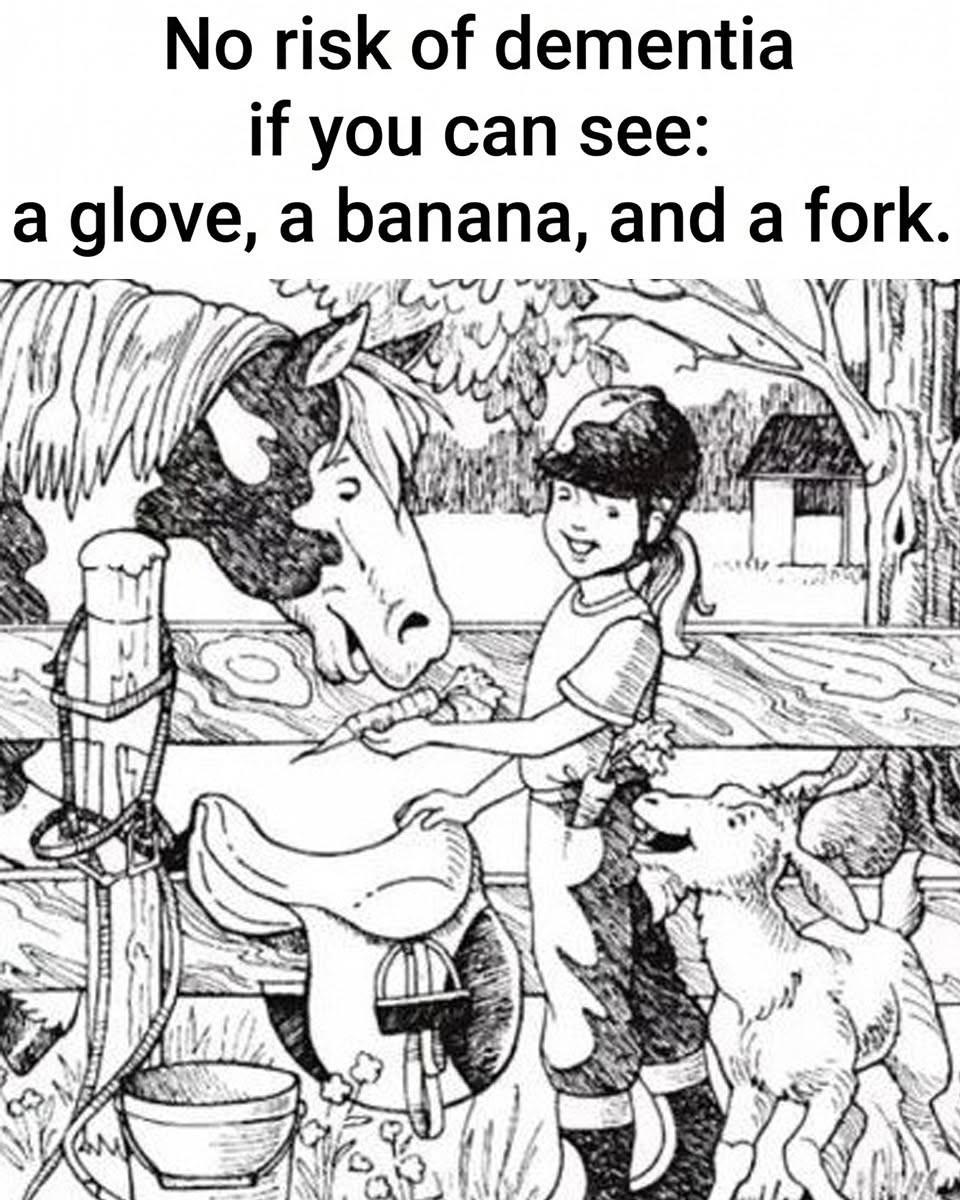
At first glance, this black-and-white illustration looks like a peaceful scene from the countryside. A young girl wearing a small hat stands beside a large horse, apparently offering it a carrot. A goat watches nearby, while a wooden fence and trees complete the charming rural setting.
But there is more to this picture than meets the eye.
Hidden among the familiar shapes are three everyday objects that do not seem to belong in a farmyard: a glove, a banana, and a fork. They have been cleverly incorporated into the illustration, making them difficult to recognize at first glance.
Can you find all three without looking at the hints?
A Simple Farmyard Scene with a Clever Visual Puzzle
The illustration uses an interesting technique to challenge the viewer. Instead of placing the hidden objects in obvious locations, their shapes are blended into the outlines of the characters and surrounding scenery.
This means that an ordinary curve might represent something completely different when viewed from another perspective.
The girl’s clothing, the horse’s body, the goat, and even the wooden fence may contain visual details worth examining.
The challenge is to stop seeing the picture as one complete farmyard scene and start looking at its individual shapes.
How to Find the Three Hidden Objects
If you have been searching without success, try examining the illustration in a more organized way.
1. Look for the Hidden Glove
A glove often has a distinctive outline, especially around its fingers and thumb.
Instead of searching for a complete glove shape immediately, look for small fingerlike extensions or a rounded section that seems slightly unusual compared with the surrounding lines.
Pay attention to the girl’s clothing and the animals’ outlines.
2. Search for the Banana
A banana is usually recognized by its curved silhouette.
Look for a long, slightly bent shape that may blend into the natural curves of the horse, the girl’s clothing, or the surrounding scenery.
Try turning your attention away from the main characters and examining smaller details.
3. Discover the Hidden Fork
The fork may be the most challenging object because its prongs can easily resemble ordinary decorative lines.
Look for a narrow handle connected to several short, parallel extensions.
The key is to recognize the relationship between the lines rather than focusing on any single shape.
Remember, these are visual search strategies rather than confirmed locations of the objects.
A 30-Second Observation Challenge
Want to make the puzzle more exciting?
Give yourself 30 seconds to find all three objects. Avoid zooming in immediately. Instead, look at the illustration as a whole before gradually examining smaller sections.
If you are playing with friends or family, ask everyone to write down their answers before revealing what they have found.
You may discover that different people notice different objects first.
Some viewers are naturally quick to recognize unusual shapes, while others prefer to examine every section carefully. Both approaches can make the activity enjoyable.
Why Hidden Object Puzzles Are So Entertaining
Visual puzzles have remained popular because they turn ordinary pictures into interactive challenges.
Rather than simply looking at an illustration, viewers actively search for patterns, compare shapes, and reconsider details they initially overlooked.
These activities can provide a relaxing mental break and create opportunities for friendly competition.
They are also suitable for different age groups. Children can enjoy identifying familiar objects, while adults may appreciate the clever way the illustrator incorporates everyday shapes into a larger scene.
Most importantly, there is no need to rush. The enjoyment comes from the process of looking carefully and experiencing that satisfying moment when a hidden object suddenly becomes recognizable.
Can These Puzzles Test Your Brain Health?
You may have seen online headlines suggesting that finding certain hidden objects proves you have no risk of dementia.
However, this claim is misleading.
Spot-the-difference and hidden-object puzzles can be enjoyable activities that involve visual attention and pattern recognition. But successfully finding a glove, banana, or fork cannot determine whether someone has dementia or predict their future risk.
Dementia is a complex group of conditions that affect memory, thinking, communication, and everyday functioning. It cannot be diagnosed or ruled out through a single picture puzzle.
If someone experiences persistent changes in memory, thinking, or daily activities, they should seek advice from a qualified healthcare professional.
Enjoying a visual challenge is worthwhile, but it should not be confused with a medical assessment.
Did You Find All Three Hidden Objects?
Take one more look at the farmyard illustration.
Check the girl’s clothing, follow the horse’s outline, examine the goat, and then move toward the fence and trees.
Somewhere among those familiar shapes are the three objects you are looking for.
Did you discover the glove, banana, and fork within 30 seconds, or did you need a little more time?
Share the puzzle with friends and family to see who has the sharpest eye for hidden details!