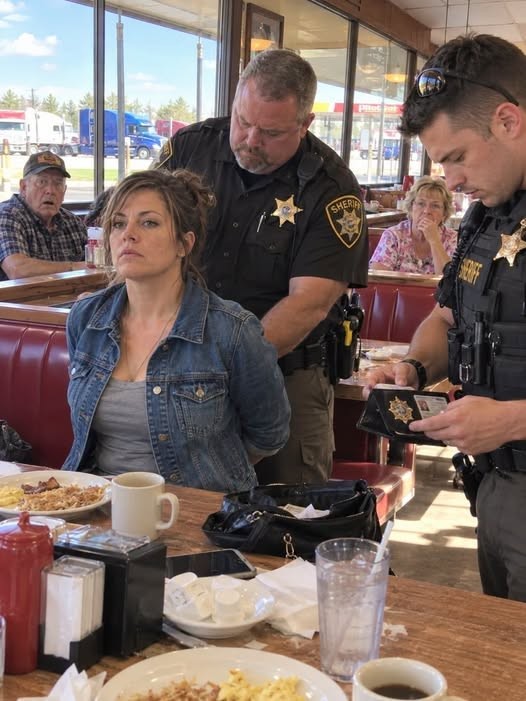
The deputy finally reached the patrol car.
His name was Daniel Mercer. He had worked under Sheriff Dalton Voss for nearly three years, long enough to recognize the difference between a routine arrest and something that could become a serious problem.
He opened the passenger door and placed my handbag on the seat.
“Want me to book her, Sheriff?” he asked.
“That’s exactly what I want,” Voss replied. “And make sure the report says she resisted.”
Daniel paused.
“Sir, I didn’t see her resist.”
Voss turned sharply.
“Did I ask what you saw?”
The younger deputy lowered his eyes.
“No, sir.”
“Then do your job.”
I remained beside the vehicle, my hands cuffed behind my back. My wrists were beginning to ache, but I kept my expression calm.
“Deputy,” I said, “I would appreciate it if you handled my identification carefully.”
Voss laughed.
“Now she’s giving us instructions.”
Daniel opened the handbag and began checking its contents. He found my wallet, a small notebook, my phone, and several official documents.
Then he stopped.
Inside the wallet was a government-issued identification card.
He pulled it out and looked at the photograph.
His expression changed.
He read the name once.
Then again.
Finally, his eyes moved to the official title printed beneath it.
“Your Honor…”
Voss frowned.
“What?”
Daniel didn’t answer immediately. His face had gone pale.
He turned the card toward the sheriff.
“Sir, I think you need to look at this.”
Voss snatched it from his hand.
For the first time since entering the diner, he had nothing to say.
The identification clearly displayed my name and position: Amara Whitlock, United States District Judge.
He stared at the photograph, then at me.
“This… this can’t be right.”
“It is correct, Sheriff,” I replied.
Daniel took a step backward.
Voss looked around as if someone might explain what was happening.
“Why didn’t you tell me?”
I held his gaze.
“I gave you several opportunities to ask questions before placing me in handcuffs. You chose not to.”
His confidence began to disappear.
“Your Honor, there must be some misunderstanding. We received a report about a robbery suspect. I was simply following procedure.”
“Then I suggest you preserve that report, along with every recording and document connected to this arrest.”
He swallowed.
“Of course.”
“That includes your patrol-car camera, the dispatch recording, the diner security footage, and the arrest report. Nothing should be deleted, altered, or replaced.”
Daniel looked at the sheriff.
For once, the deputy seemed unsure whose instructions he should follow.
Then my phone vibrated again inside the handbag.
Daniel glanced at its screen.
A notification displayed the name of the Chief Judge.
“Your Honor,” he said carefully, “I believe someone is trying to reach you.”
“Please hand me the phone.”
He unlocked the screen only after I gave him permission and placed it within my reach.
The message was brief.
We have received your emergency notification. Are you safe? Please confirm your location.
I looked toward the sheriff.
“Tell them where I am.”
Voss immediately stepped forward.
“Your Honor, let’s not make this bigger than it needs to be. We can resolve everything here.”
I shook my head.
“You made this bigger when you decided that your authority meant you didn’t have to respect another person’s rights.”
Daniel opened the rear door of the patrol vehicle.
“Should I remove the handcuffs, Sheriff?”
Voss hesitated.
That hesitation told me more than his earlier shouting.
“Yes,” he finally said.
Daniel carefully released the restraints. I rubbed my wrists and adjusted my jacket.
But I wasn’t finished.
“Deputy Mercer, I want you to write down exactly what happened. Include what you personally observed, not what someone tells you to write.”
He nodded.
Voss interrupted.
“Daniel, you don’t need to do that.”
The deputy looked at him, then at me.
“With respect, sir, I think I do.”
For a moment, nobody spoke.
The same man who had confidently dragged me out of a diner was now standing beside his patrol car, holding an identification card he could no longer pretend he hadn’t seen.
But the most important part of the afternoon had not yet begun.
I contacted the appropriate federal authorities and requested that the incident be documented and reviewed through the proper channels. My position did not give me permission to punish anyone personally, nor did it mean that every allegation against the department was automatically true.
The evidence would have to speak for itself.
And there was plenty to preserve.
The diner owner had security cameras covering the entrance and the booths. Several customers had witnessed the arrest. The dispatch system contained the original call that supposedly identified me as a robbery suspect.
Most importantly, the sheriff’s own words had been heard by more people than he realized.
Before leaving, I turned toward Daniel.
“Deputy, may I ask you something?”
“Yes, Your Honor.”
“How many times have you witnessed Sheriff Voss treating people this way?”
Daniel looked down.
His silence lasted several seconds.
“More times than I should have allowed,” he finally admitted.
“Why didn’t you report it?”
He took a breath.
“Because people who speak up don’t usually stay here very long.”
That answer stayed with me.
It suggested that the problem might extend beyond one arrest or one officer. It raised questions about supervision, accountability, and whether employees felt safe reporting misconduct within their own department.
I thanked him for being honest.
Then I walked back into the diner.
The overturned glass had been replaced, but the water stain remained on the table. The owner approached me cautiously.
“Ma’am… are you all right?”
“I’m fine. Thank you for asking.”
He looked toward the patrol vehicle.
“I’m sorry nobody helped you.”
I glanced around the room. Several customers were still watching.
“I understand why people were afraid,” I said. “But fear should never become the reason misconduct goes unchallenged.”
I left the diner with a clear understanding of what needed to happen next.
The investigation would not be decided by my title, the sheriff’s reputation, or the rumors circulating around town. It would depend on records, witness statements, and an independent review of the evidence.
Sheriff Voss had believed he could control the entire situation simply because nobody in that diner dared to question him.
Now, for the first time, people were beginning to speak.
And the deputy who had once been afraid to challenge his superior had made a decision that could change the course of the investigation.
But when the diner owner later agreed to provide the complete security footage, one detail caught everyone’s attention.
The sheriff had entered the diner already carrying a description of a supposed robbery suspect.
The question was no longer simply why he had arrested me.
It was this:
Who had given him that description, and why had he been so certain that I was the person he was looking for?
The answer would lead investigators toward a much larger question about the sheriff’s department—and the people who had been afraid to challenge it for years.
To be continued…