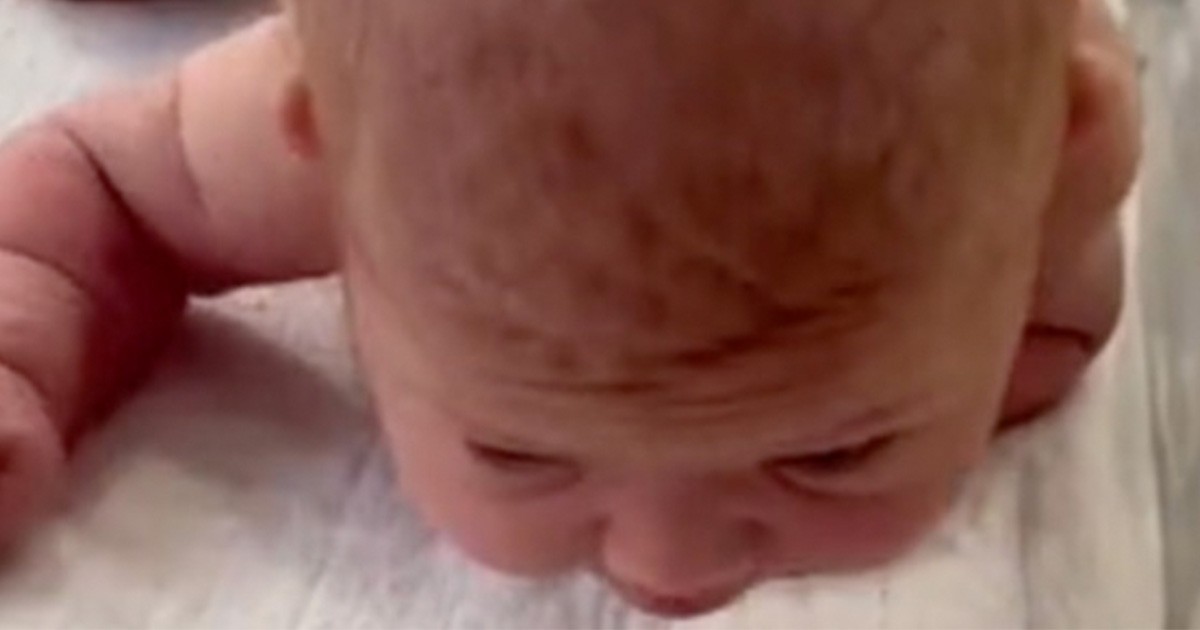
When Samantha Mitchell first watched her newborn move across a hospital cot, she could hardly believe what she was seeing. Her daughter, Nyilah Daise Tzabari, was not even three days old, yet she appeared to lift her head, push with her tiny arms and scoot forward.
Samantha had spent years caring for children, but she said she had never witnessed anything quite like it. The moment was so unexpected that her mother encouraged her to record it. Samantha later shared the video online, where millions of viewers became fascinated by the newborn’s unusually strong movements.
The story quickly inspired playful comments about a baby who seemed eager to skip ahead in the usual developmental journey. Yet behind the charming internet phenomenon lies a more interesting question: how much movement is actually possible for a newborn, and how should extraordinary-looking early behavior be understood?
Nyilah’s story offers an opportunity to explore newborn reflexes, early motor development and the difference between an unusual observation and a scientific conclusion.
A Remarkable First Few Days

Nyilah was born on February 27, 2023, to Samantha Mitchell and Ofer Tzabari. According to her mother’s account, she arrived approximately three weeks later than expected and weighed 7 pounds 6 ounces.
Just a few days later, Samantha recorded the movement that would eventually attract widespread attention.
In the video, Nyilah can be seen lifting her head and using her arms and legs to move her body forward while lying in her cot. To an adult viewer, the movement can resemble an early attempt at crawling.
Samantha was understandably surprised.
She later explained that the recording was made when Nyilah was approximately two and a half days old. Her mother had been present and encouraged her to capture the moment because Samantha knew family members might have difficulty believing what she had witnessed.
The video eventually attracted tens of millions of views on TikTok, turning a private family moment into a widely shared discussion about newborn development.
Can a Newborn Really Crawl?

The answer requires an important distinction between crawling and reflexive movement.
Most babies do not begin conventional crawling during their first days of life. According to pediatric developmental guidance, crawling and related forms of independent mobility generally emerge much later, often during the second half of the first year.
However, newborns are not completely immobile.
From birth, babies possess several primitive reflexes and movement patterns that help them respond to their surroundings. These automatic responses are part of early neurological development and are very different from the purposeful, coordinated crawling seen in an older infant.
A newborn lying on the stomach may push with the arms or legs, turn the head, flex the limbs or make movements that cause the body to shift across a surface.
When viewed from the outside, these actions can look surprisingly similar to crawling.
That does not necessarily mean the newborn has mastered crawling in the developmental sense.
The Science of Newborn Reflexes
Newborn movement is strongly influenced by primitive reflexes.
These are automatic responses controlled by the developing nervous system. They appear during infancy and typically become less prominent as voluntary motor control develops.
One example is the stepping reflex. When a newborn is held upright with the feet touching a firm surface, the baby may make alternating movements with the legs that resemble walking.
Another is the rooting reflex, which helps a newborn respond when the area around the mouth is stimulated.
There are also reflexive movements involving the arms, legs and neck.
These behaviors can sometimes look remarkably purposeful, especially when several movements occur together. However, appearances can be misleading. A newborn’s nervous system is still developing, and early movements are not necessarily evidence of advanced voluntary motor skills.
This distinction is particularly important when interpreting viral videos.
Why Some Newborn Movements Look So Advanced
Human babies develop rapidly, but their development does not happen in a perfectly predictable sequence.
Newborns have surprisingly strong muscles relative to their small bodies, and their movements can sometimes be energetic. Their heads may briefly lift during supervised tummy time, their legs may push against surfaces, and their arms may move with considerable force.
When several of these actions happen consecutively, observers may interpret them as a deliberate attempt to crawl.
There are also differences between babies.
Some newborns are more active than others. One baby may spend considerable time moving the arms and legs, while another may appear much calmer.
Neither pattern necessarily indicates superior or delayed development.
The range of normal infant behavior is broad, which is one reason developmental milestones are generally treated as approximate windows rather than exact deadlines.
Nyilah’s Development Continued to Surprise Her Parents
According to Samantha, Nyilah continued demonstrating noticeable physical activity as she grew.
Her mother reported that Nyilah rolled from her belly to her back at approximately 18 days old. At around one month, Samantha said she began smiling at her. By two months, her parents observed her rolling from her back toward her stomach.
Samantha also described her daughter as exceptionally alert and energetic.
Later, she reported that Nyilah enjoyed standing with support and appeared eager to push herself upward. Her parents emphasized that they were not deliberately forcing her to stand and instead described her as naturally eager to straighten her legs.
These observations contributed to the family’s impression that Nyilah was developing unusually quickly.
However, individual milestones should always be interpreted in context. A baby displaying one particular skill early does not necessarily mean that every area of development will progress at the same pace.
Early Strength Does Not Mean Early Walking

One of the most entertaining parts of Nyilah’s story was her mother’s prediction that walking might not be far away.
It is understandable why a parent might reach that conclusion after watching a very active newborn. Yet early strength and early walking are not necessarily the same thing.
Walking requires much more than strong legs.
A baby must develop balance, coordination, postural control, spatial awareness and the ability to shift weight from one side to another. These abilities emerge gradually as the nervous system and muscles mature.
A newborn who pushes strongly with the legs may therefore still be many months away from independent walking.
This is an excellent example of why developmental science looks at patterns rather than one isolated behavior.
From Reflexes to Purposeful Movement
During the first year of life, babies gradually transition from mostly reflexive movements toward increasingly controlled actions.
At first, many movements are automatic. Over time, babies learn to hold their heads steady, reach for objects, roll, sit, move around on the floor and eventually stand and walk.
Each new ability builds upon earlier development.
Head control becomes increasingly stable. Arm and leg movements become better coordinated. Balance improves. Muscles strengthen through repeated activity.
Eventually, movements that once appeared accidental become deliberate.
This progression helps explain why a newborn can produce a movement that looks surprisingly advanced without actually possessing the complete motor skills associated with that milestone.
Could Being Born Later Explain Nyilah’s Early Strength?
Nyilah’s parents noted that she was born approximately three weeks later than her expected arrival.
It is tempting to speculate that this might explain her physical abilities. However, there is not enough information to establish such a connection.
Pregnancy length can influence aspects of newborn development, but an individual baby’s movements cannot be explained by one factor alone.
Genetics, individual physiology, muscle tone, neurological development and many other variables can contribute to how a newborn moves.
Therefore, the idea that arriving later directly caused Nyilah’s unusual movements should be treated as speculation rather than established fact.
The most responsible interpretation is simply that she appeared to be an unusually active newborn based on her family’s observations.
When Internet Videos Meet Developmental Science
Nyilah’s story also illustrates how social media can change the way people understand child development.
A short video can capture an extraordinary-looking moment and make it available to millions of people within hours. Viewers then compare the child with their own experiences, share theories and add humorous comments.
That can be entertaining, but it can also create unrealistic expectations.
Parents may see a viral newborn performing an unusual movement and wonder why their own baby does not behave similarly. Such comparisons can create unnecessary concern.
Development is highly individual.
One baby may roll earlier while another focuses on reaching. One may babble frequently while another is quieter. Another may spend more time practicing movement before suddenly developing a new skill.
A viral example should never become a universal standard for what every baby is expected to do.
The Cultural Fascination With “Super Babies”
Stories about exceptionally capable babies have fascinated people for generations.
Different cultures have traditions celebrating children believed to possess unusual strength, intelligence or special abilities. Modern social media has given this fascination a new platform.
Today, phrases such as “super baby” can spread quickly because they capture the imagination.
Nyilah’s story fits naturally into that tradition. Her movements were unusual enough to surprise her parents, and viewers responded with humor and affection.
There is nothing wrong with enjoying that sense of wonder as long as extraordinary interpretations remain clearly separated from established science.
A fascinating video can simply be a fascinating video.
It does not need to become evidence of a mysterious ability.
What Parents Can Learn From the Story
Perhaps the most valuable lesson from Nyilah’s story is that babies should be observed as individuals.
Parents naturally pay close attention to their newborn’s movements, expressions and reactions. Those observations can be useful, especially when shared with a pediatrician during routine visits.
At the same time, parents should avoid judging development solely against viral videos or strict timelines found online.
If a parent has concerns about movement, muscle tone, feeding, responsiveness or any other aspect of development, discussing those concerns with a qualified pediatric professional is the most reliable approach.
Professional guidance takes the entire child into account rather than focusing on a single memorable moment.
A Tiny Moment That Captured Millions of Imaginations
Nyilah’s first viral video was ultimately a very simple family moment.
A mother saw her newborn doing something that surprised her. Her mother encouraged her to record it. The video was shared online, and millions of strangers became fascinated by the tiny baby’s movements.
The science behind the moment may be less mysterious than some of the playful internet theories, but that does not make it any less remarkable.
Newborns are capable of movements that can surprise even experienced caregivers. Their nervous systems are developing rapidly, their muscles are adapting to life outside the womb, and their reflexes can produce actions that look surprisingly coordinated.
Nyilah’s story reminds us that development is not always as predictable as a checklist might suggest.
Final Thoughts: Why We Love Stories About Extraordinary Babies

Human beings are naturally drawn to moments that challenge our expectations.
A newborn lifting her head or appearing to scoot across a cot can instantly make people stop and wonder. Is it a reflex? Is it an unusually early skill? Is the baby simply very active?
Science encourages us to investigate those questions carefully rather than immediately choosing the most extraordinary explanation.
Nyilah’s story is best appreciated as a charming example of how varied early infant behavior can appear. Her movements delighted her parents, entertained millions of viewers and sparked a broader conversation about how babies develop.
The real wonder may not be that one newborn seemed to move ahead of schedule. It may be that every newborn is already undergoing an extraordinary process of neurological and physical development from the moment they enter the world.
Curiosity gives us the reason to ask questions. Science gives us the tools to explore them. And sometimes, the most fascinating stories are those that remind us how much there still is to learn about the earliest stages of human life.
Sources
Healthline, “When Do Babies Crawl?” for general information about typical crawling timelines and infant mobility.
American Academy of Pediatrics, HealthyChildren.org, for information about infant developmental milestones and early motor development.
Centers for Disease Control and Prevention, developmental milestone resources for babies and young children.
Mayo Clinic, infant development resources covering early physical and motor development.
Cleveland Clinic, educational resources concerning newborn reflexes and infant neurological development.