
A honeymoon is usually imagined as the beginning of a new chapter: unfamiliar landscapes, quiet moments together, and memories that are meant to last a lifetime. For British newlyweds Alexander “Alex” Cromie and Marie Ebert, their journey to the Greek island of Sifnos was intended to be exactly that.
Instead, their trip became the subject of international attention after the private helicopter carrying the couple and their pilot crashed near the island’s heliport on August 17, 2026.
The incident has prompted grief among their families, colleagues and friends, while aviation authorities work to establish what happened during the helicopter’s final moments. Early reports have mentioned unusual sounds and a possible mechanical problem, but investigators have not yet established a definitive cause.
Beyond the immediate investigation, the story also touches on something much broader. Greece has long carried a powerful place in the imagination of travelers, with its islands associated with romance, mythology, transformation and new beginnings. Sifnos, with its hills, villages and Aegean scenery, represents the kind of destination many couples choose for precisely those reasons.
The contrast between that peaceful cultural image and the uncertainty surrounding this incident has naturally captured public attention.

The Journey to Sifnos
Alexander Cromie and Marie Ebert were British professionals who had recently married and were traveling through Greece for their honeymoon.
Cromie worked at Blackstone as a vice president in private wealth solutions, while Ebert worked at Bain & Company as a senior specialist in market reputation. Their professional colleagues later remembered them with warmth, emphasizing the impact they had made in their respective workplaces.
The couple had arranged a private helicopter journey from Markopoulo, near Athens, toward Sifnos.
The aircraft was a Bell 206, a helicopter model that has been used extensively around the world for decades. At the controls was Giorgos Raikos, a Greek pilot who had previously served in the military and was described in reports as highly experienced.
According to reports, the helicopter was approaching its destination when something unexpectedly went wrong.
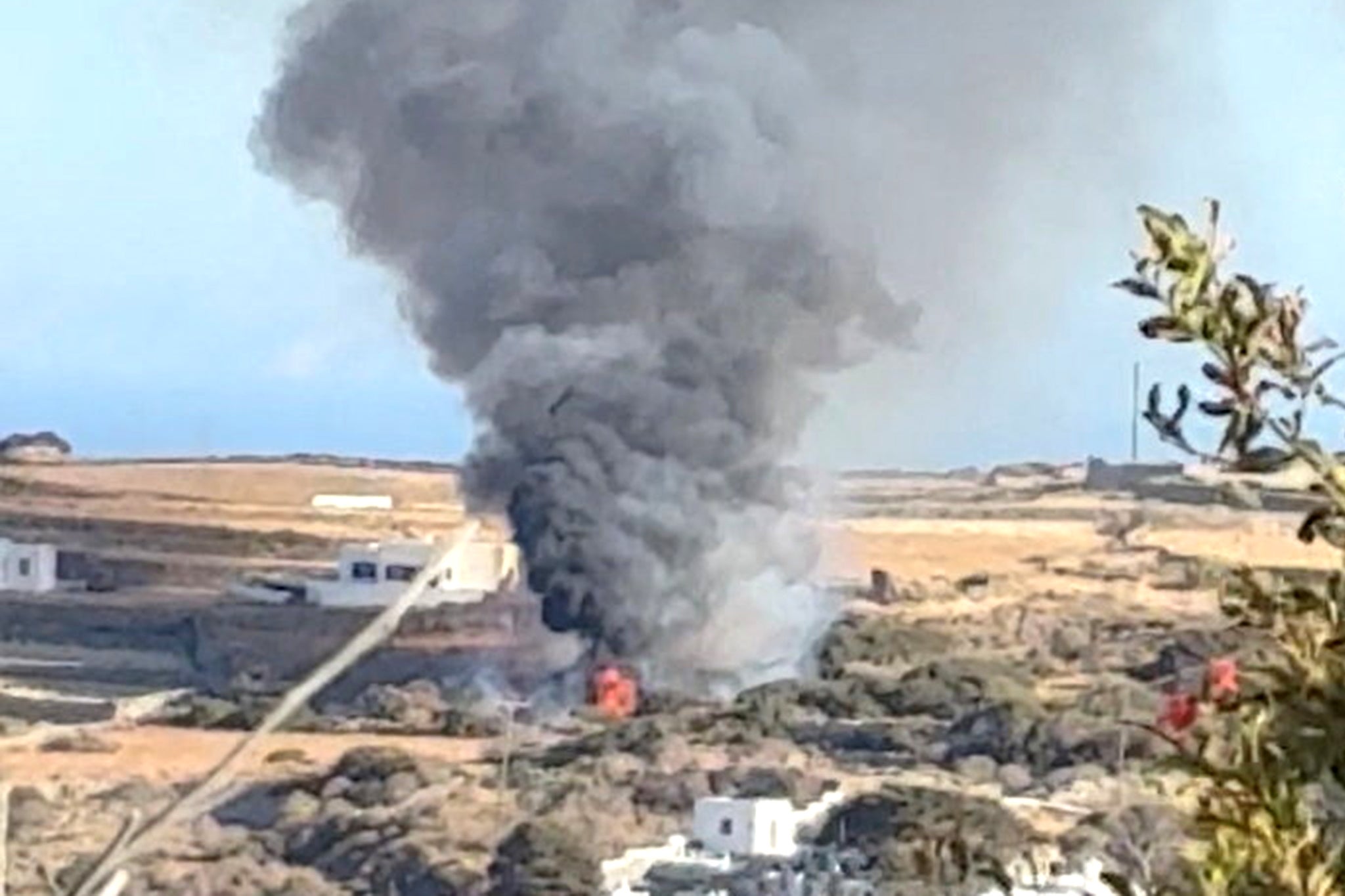
The aircraft came down in the Tholos area of Sifnos, close to the island’s heliport. Greek authorities confirmed that three people aboard were lost in the incident.
Why the Final Moments Have Raised Questions
One of the most important details emerging from early reports concerns the timing.
The helicopter was reportedly close to its destination. Reports indicate that the pilot had communicated with air traffic control shortly before the planned landing, after which communication stopped. Witnesses in the area also reported hearing an unusual sound from the aircraft.
Video footage circulating through news organizations appears to show the helicopter rotating before rapidly losing altitude.
However, it is important to distinguish observation from conclusion.
Seeing an aircraft rotate does not, by itself, establish why the rotation occurred. Likewise, hearing an unusual sound cannot prove that a particular component failed. Aviation investigations require examination of aircraft parts, maintenance records, flight information, weather conditions and other evidence before a reliable conclusion can be reached.
That distinction is particularly important when an incident attracts widespread attention online, where speculation can sometimes move faster than verified information.

The Scientific Perspective: What Could Cause a Helicopter to Lose Control?
Helicopters rely on several interconnected systems to remain stable and controllable.
The main rotor provides lift, while the tail rotor plays an important role in controlling the helicopter’s tendency to rotate in response to the main rotor’s movement. The transmission system connects mechanical power to these components.
If a critical flight system develops a malfunction, the aircraft’s handling characteristics can change dramatically.
That does not mean investigators have established such a malfunction in this particular case. Reports have indicated that Greek aviation authorities are examining the possibility of a mechanical problem, including components associated with the rotor system.
The investigation therefore has to answer several scientific questions.
Was there a mechanical malfunction?
Was the aircraft operating normally before the final approach?
Did weather or environmental conditions contribute?
Was there an issue involving the engine, transmission or rotor system?
Could a medical or operational factor have played a role?
These questions cannot responsibly be answered through photographs or short videos alone.
A Possible Mechanical Problem Remains Unconfirmed
One of the most widely discussed possibilities is a technical malfunction.
Greek aviation authorities have reportedly taken precautionary measures involving Bell 206 helicopters following the Sifnos incident, including inspections of tail rotor and related transmission systems.
Such a precaution should not automatically be interpreted as proof that a particular component caused the incident.
Aviation regulators routinely use early information to reduce potential risks while investigations continue. If investigators identify a component that deserves closer examination, inspections can help determine whether the issue was isolated or potentially relevant to other aircraft.
The final explanation will depend on technical evidence rather than assumptions.

Why Sifnos Carries Such Powerful Cultural Meaning
There is another dimension to this story that goes beyond aviation.
Sifnos is part of the Cyclades, an island group strongly associated with the Aegean Sea, whitewashed settlements, traditional architecture and ancient Greek cultural heritage.
For centuries, Greek islands have occupied an almost mythical position in literature, art and popular imagination.
Ancient Greek mythology frequently connected journeys across the sea with transformation. Heroes left familiar surroundings, encountered uncertainty and returned changed. Islands could represent places of separation, discovery and renewal.
That symbolism has survived in modern tourism.
Today, couples travel to Greek islands looking for many of the same emotional qualities that have fascinated visitors for generations: beauty, tranquility, history and the feeling of temporarily stepping outside ordinary life.
For Cromie and Ebert, Sifnos was meant to be part of their own new beginning.
That makes the circumstances surrounding their journey particularly poignant.
The Contrast Between Myth and Modern Science
Stories surrounding unusual events often develop two parallel interpretations.
One comes from culture and emotion.
The other comes from science.
Culturally, people naturally search for meaning when something unexpected interrupts a major life event. The contrast between a honeymoon and an unforeseen aviation incident can feel almost impossible to reconcile. It encourages people to describe the event through ideas such as fate, coincidence or destiny.
Science approaches the same situation differently.
Rather than asking what the event symbolizes, investigators ask what physically happened.
They examine evidence.
They reconstruct the aircraft’s movements.
They study components.
They review communications.
They examine weather data.
They compare witness accounts.
They determine whether maintenance or operational factors could have contributed.
Neither approach needs to erase the other. Cultural interpretation helps explain why people emotionally respond to events, while scientific investigation seeks to explain the physical mechanisms behind them.
The Importance of Waiting for Verified Evidence
Because footage from the Sifnos incident has circulated online, many viewers have attempted to interpret the helicopter’s final movements themselves.
That can be understandable, but aviation accidents are notoriously difficult to diagnose from a short recording.
A video may show what an aircraft did, but not necessarily why it did it.
For example, an unexpected rotation could potentially result from several different technical or operational circumstances. Without access to the aircraft, maintenance history, flight data and expert analysis, assigning a precise cause would be premature.
The responsible position at this stage is therefore to distinguish confirmed information from possibilities.
Authorities have confirmed the incident and the identities of the British couple. Investigators are examining the circumstances, and mechanical factors have been discussed in early reporting. But the definitive explanation remains a matter for the investigation.
Remembering Alex Cromie and Marie Ebert
Away from the investigation, the people who knew Cromie and Ebert have emphasized their professional achievements and personal qualities.
Blackstone described Cromie as a valued colleague and expressed sympathy for those close to him. Bain & Company similarly expressed shock after learning about Ebert and her husband.
Those statements offer a reminder that public stories can quickly become focused on circumstances, timelines and unanswered questions.
Yet behind those headlines were two individuals who had careers, relationships, friendships and plans for the future.
Their honeymoon was supposed to be a private celebration of their marriage. Instead, their names became associated with an event that raised difficult questions for aviation investigators and left colleagues remembering what they had contributed during their lives.
What Happens Next in the Investigation?
The investigation will likely take time.
Aviation investigators typically need to examine the aircraft remains, relevant technical systems, maintenance documentation, flight information and available communications. Weather observations and witness accounts may also contribute to the reconstruction.
Authorities may also compare the aircraft’s condition with manufacturer requirements and applicable aviation regulations.
The goal is not simply to determine what happened to one helicopter. A thorough investigation can also identify lessons that may improve aviation safety in the future.
This is one of the most important principles of modern aviation investigation: understanding an incident can help prevent similar circumstances from occurring again.
Until investigators publish their findings, claims about the exact cause should therefore be treated cautiously.
A Story That Brings Together Travel, Culture and Curiosity
The Sifnos incident has attracted attention partly because of its setting.
Greece is often presented as a destination of romance, mythology and timeless beauty. A newly married couple traveling toward a Greek island naturally fits that cultural image.
The unexpected turn of events creates a striking contrast.
But perhaps the deeper lesson is not about fate or coincidence. It is about the way human beings respond when an ordinary journey suddenly becomes extraordinary.
We search for explanations.
We look at the evidence.
We revisit cultural stories.
We wonder whether events have meaning beyond what science can measure.
And ultimately, we wait for facts.
The story of Alexander Cromie and Marie Ebert will continue to develop as Greek authorities investigate the circumstances surrounding the Sifnos helicopter incident. For now, the most respectful approach is to remember the couple and their pilot while allowing investigators the time needed to establish what happened.
Human curiosity has always pushed us to look beyond the obvious. Ancient cultures used myths to understand journeys, uncertainty and the forces they could not explain. Modern society uses science, engineering and evidence to answer many of those same questions.
Both reveal something fundamental about us.
When faced with the unknown, we want to understand.
And sometimes, the most meaningful response is not to rush toward an explanation, but to remain curious, thoughtful and patient until the evidence speaks for itself.