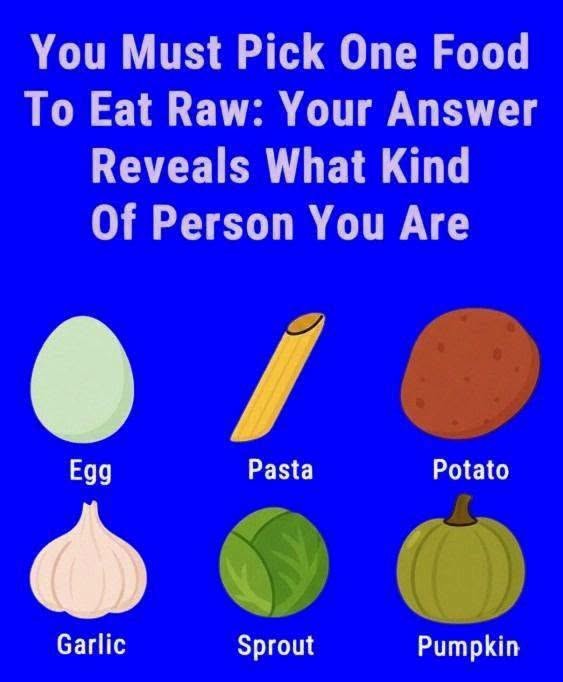
Then comes the challenge.
You can choose only one, and whatever you select must be eaten completely raw.
At first, it sounds like a silly question designed to create a quick laugh. But once you actually consider the options, the decision becomes surprisingly difficult. Some choices seem practical, others uncomfortable, and a few raise obvious questions about food safety and texture.
What makes the question interesting is that there is no universally appealing answer. Instead, the choice can reveal something about how people respond when every available option has some kind of disadvantage.
Of course, choosing a particular food does not scientifically determine someone’s personality. Any interpretation is simply a playful observation rather than a psychological assessment.
Still, the thought experiment offers an entertaining way to explore risk, familiarity, patience, and decision making.
The First Choice: Sprouts
For many people, sprouts may be the easiest answer.
Some types of sprouts are commonly served raw, making them feel more natural in this particular challenge than the other options. Their texture is relatively familiar, and they do not require the same level of imagination as eating uncooked pasta or pumpkin.
Choosing sprouts could reflect a practical approach.
Instead of asking which option might be the most interesting, a practical thinker may immediately look for the choice that requires the least adjustment.
The reasoning is simple: if the challenge says everything must remain raw, choose something that is already commonly associated with raw preparation.
That does not necessarily indicate that someone is cautious in every area of life. It simply suggests that, within this hypothetical situation, they may prefer the most straightforward solution.
There is also an important food safety consideration.
Not all sprouts are equally low risk when eaten raw. Certain raw sprouts can support bacterial growth under warm, humid growing conditions. Food safety authorities therefore recommend particular caution with raw or lightly cooked sprouts, especially for people who are more vulnerable to foodborne illness.
So even the apparently obvious choice deserves some thought.
Choosing Garlic: Intensity Over Comfort
Garlic presents a completely different experience.
Unlike several of the other options, raw garlic is familiar to many people. It is regularly used uncooked in certain sauces, dressings, dips, and other preparations.
But eating a whole piece of raw garlic is another matter.
The flavor can be extremely strong, and the sensation can linger long after the first bite.
Someone who chooses garlic might be thinking less about comfort and more about efficiency.
The logic could be:
“This will be unpleasant, but at least I know what I’m dealing with.”
That kind of reasoning reflects an interesting approach to uncomfortable decisions. Instead of searching for the perfect option, a person accepts an obvious disadvantage and chooses something that can be dealt with quickly.
Again, this is not a scientific personality test.
Someone may choose garlic simply because they enjoy its flavor.
But as a playful thought experiment, garlic represents the willingness to tolerate intensity in exchange for simplicity.
Pumpkin: The Patient Choice
Pumpkin is perhaps one of the more unusual options.
People generally associate pumpkin with soups, roasted dishes, pies, purées, and other cooked preparations. Raw pumpkin is possible to eat, but its firm texture can make the experience considerably less appealing.
Someone choosing pumpkin may therefore be accepting inconvenience rather than avoiding it.
The decision might come from a simple idea:
“If I have to do this, I will choose something substantial and take my time.”
This represents patience within the hypothetical challenge.
Instead of looking for the easiest immediate experience, the person accepts that the food may require more effort.
There is another interesting psychological element here: expectations.
Because pumpkin is normally associated with cooking, the idea of eating it raw feels unusual before the challenge even begins. That expectation can influence how people judge the option.
The same food might seem completely ordinary in one context and strange in another.
Dry Pasta: Familiarity Can Be Powerful
Dry pasta might be one of the most tempting answers simply because it is so familiar.
Almost everyone recognizes it.
You know what pasta looks like, how it is normally prepared, and what it becomes after cooking.
But that familiarity can be misleading.
Uncooked pasta is hard and has a very different texture from the soft food people normally associate with it. Certain dry pastas can also be difficult to chew comfortably.
The interesting part is why someone might still choose it.
Familiar objects often feel safer than unfamiliar ones, even when they are not necessarily the most practical option.
This is a broader feature of human decision making.
When faced with uncertainty, people often rely on what they already know. Familiarity can reduce the psychological discomfort of making a decision.
So the person choosing dry pasta may not necessarily be seeking comfort.
They may simply be choosing the option they understand best.

The Raw Potato: Familiar but Unpleasant
The potato creates another interesting compromise.
It is an extremely familiar food, but most people are accustomed to eating it after cooking.
A raw potato is firm, starchy, and quite different from the soft texture associated with baked, boiled, or mashed potatoes.
Someone selecting it might therefore be choosing predictability over pleasure.
They know what the food is.
They know its flavor will not be completely unfamiliar.
But they also recognize that the experience will probably not be especially enjoyable.
There is a practical lesson hidden inside that decision.
Sometimes people choose options not because they are attractive, but because they seem manageable.
A predictable inconvenience can feel preferable to an unfamiliar one.
The Egg: The Choice That Divides People
The egg may create the greatest disagreement.
Some people might immediately choose it because an egg can be consumed without cooking and requires almost no preparation.
Others would reject it because of concerns surrounding raw egg safety.
This is where the playful question becomes a useful reminder that food choices involve more than taste.
Food safety depends on factors such as freshness, handling, storage, preparation, and the presence of harmful microorganisms. Raw eggs can carry foodborne bacteria, which is why food safety guidance often recommends using pasteurized eggs or egg products when a recipe calls for them without cooking.
So someone who chooses an egg may be thinking about convenience.
Someone who avoids it may be prioritizing risk reduction.
Neither reaction necessarily tells us everything about the person.
It simply shows how differently people evaluate the same choice.
What Does Your Choice Really Say About You?
The fun of the challenge comes from trying to interpret the decision.
If someone immediately chooses sprouts, you might jokingly call them practical.
If they choose garlic, perhaps they are willing to tolerate discomfort.
If they choose pumpkin, maybe they are patient.
Dry pasta could represent familiarity.
The potato could represent predictability.
The egg might represent convenience or confidence.
But there is an important distinction between a fun interpretation and a scientific conclusion.
There is no reliable psychological test that can determine someone’s personality simply by asking which food they would eat raw.
Personality is far more complex.
It develops through many influences, including genetics, experiences, environment, relationships, learning, and individual circumstances.
A single hypothetical choice cannot capture all of that.
Why Small Decisions Can Still Be Interesting
Even though the challenge cannot scientifically diagnose personality, it does demonstrate something real about decision making.
People constantly make choices under imperfect conditions.
Sometimes there is no ideal option.
You simply have to compare advantages and disadvantages and select what seems most acceptable.
Researchers studying decision making have explored how people evaluate risk, uncertainty, reward, familiarity, and potential consequences.
In everyday life, those processes can influence everything from shopping choices to travel plans and career decisions.
A playful food challenge reduces all of those complicated factors to six simple options.
That is what makes it entertaining.
Instead of making a major life decision, you are imagining which piece of food would be least unpleasant.
The Role of Food Culture
Cultural background can also influence the answer.
Different foods have different meanings and preparation traditions around the world.
A food that seems unusual raw in one household may be perfectly familiar in another.
For example, certain vegetables and herbs are commonly served fresh, while other ingredients are traditionally cooked before consumption.
Personal experience therefore matters.
Someone who grew up eating a particular ingredient in fresh preparations may have a very different reaction from someone who has only ever encountered it cooked.
This means the challenge is not simply about personality.
It is also about memory, culture, familiarity, and individual taste.
A Better Way to Think About the Challenge
Instead of asking, “What does my answer prove about my personality?” a more useful question might be:
“Why did I choose this option?”
Did you choose based on safety?
Texture?
Familiarity?
Convenience?
Taste?
Or did you simply pick the option that seemed least unpleasant?
That small reflection can be more interesting than the answer itself.
It encourages people to notice how they make choices when none of the options is perfect.
Food Safety Should Still Come First
Although the challenge is hypothetical, it is worth separating entertainment from real-world food advice.
Not every food is equally suitable for raw consumption, and preparation methods can significantly affect safety.
Raw eggs may present foodborne illness concerns, while certain sprouts have also been associated with food safety risks.
Dry pasta is not intended to replace properly cooked pasta, and raw vegetables should be handled and washed appropriately.
Anyone preparing food should follow reliable food safety guidance rather than treating an online challenge as practical culinary advice.
The safest choice in real life is not necessarily the same as the most entertaining choice in a hypothetical question.
Conclusion: A Simple Question With a Surprisingly Big Answer
So, which would you choose?
The sprouts?
The garlic?
The pumpkin?
The dry pasta?
The potato?
Or the egg?
There may never be a universally correct answer.
The real appeal of the question comes from what happens before the choice is made. You begin comparing texture, familiarity, convenience, safety, and personal preference. Suddenly, a silly question becomes a miniature exercise in decision making.
Your choice does not define your personality, but the reasoning behind it can provide a small glimpse into how you approach an imperfect situation.
And perhaps that is why humans enjoy questions like this so much.
We are naturally curious about ourselves and about one another. Even the simplest choices can become opportunities to compare perspectives, share a laugh, and discover that other people may see the same situation completely differently.
Sometimes, the most ordinary question can reveal the most interesting thing of all: how differently human beings think when there is no perfect answer.
Sources
Food and Drug Administration, Food Safety and Raw Eggs.
U.S. Food and Drug Administration
Centers for Disease Control and Prevention, Food Safety and Sprouts.
Centers for Disease Control and Prevention
U.S. Department of Agriculture, Food Safety and Inspection Service.
USDA Food Safety and Inspection Service
Harvard T.H. Chan School of Public Health, The Nutrition Source.