
Have you ever looked at an ordinary photograph and suddenly noticed something that made you do a double take?
Perhaps a shadow looked like a person, a strangely shaped object seemed to have a familiar outline, or two completely unrelated objects appeared to form one unusual picture. You look again, and suddenly you realize that your brain may have created an entirely different interpretation of what is actually in front of you.
These funny visual moments are surprisingly common. They are not necessarily evidence that someone has a particularly imaginative mind. Instead, they reveal something fascinating about how the human brain processes visual information.
Our minds are constantly searching for familiar patterns, shapes, faces, and objects. Sometimes, that remarkable ability produces amusing misunderstandings.

Why Does the Brain See Familiar Shapes?
The human brain receives an enormous amount of visual information every second. Rather than consciously analyzing every line, shadow, color, and shape, the brain uses shortcuts to interpret what the eyes are seeing.
This allows us to recognize objects quickly. We can identify a chair, a tree, a person, or a familiar face without carefully examining every individual detail.
However, these shortcuts are not always perfect.
When an image contains an unusual combination of shadows, curves, objects, or perspectives, the brain may compare those shapes with something familiar. If there is enough visual similarity, we may briefly interpret the scene as something completely different from what it actually is.
That moment of confusion is what makes accidental visual illusions so entertaining.
Pareidolia: When Random Shapes Become Familiar Images
One concept that helps explain these experiences is called pareidolia.
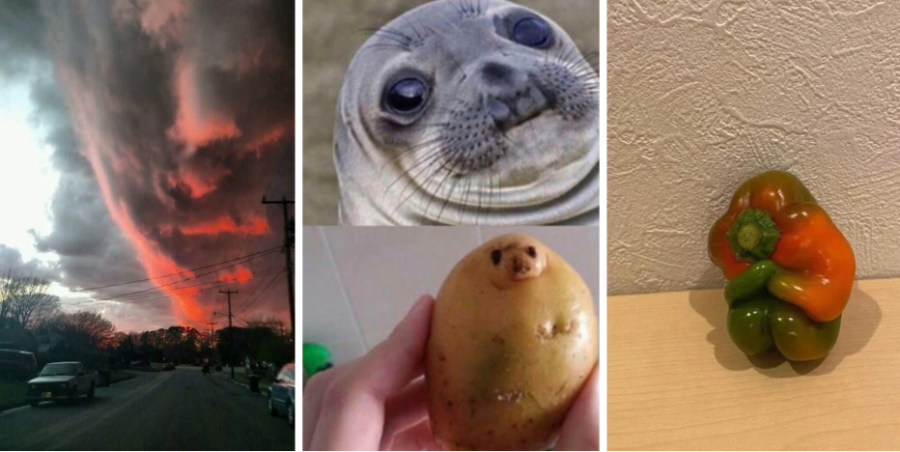
Pareidolia occurs when people perceive recognizable patterns in ambiguous or random visual information. Seeing a face in the clouds is one of the most familiar examples.
A cloud has no actual facial features, but its arrangement of light and shadow may resemble two eyes, a nose, and a mouth. Once the brain detects that pattern, the image can suddenly appear obvious.
The same process can happen with many other shapes.
A tree trunk might appear to have a face. A rock formation may resemble an animal. A stain on a wall might look like a familiar object. Even household items can occasionally create surprisingly convincing shapes.
The important point is that the object itself has not changed. The interpretation has.
Nature Is Full of Accidental Optical Illusions
Natural environments provide countless opportunities for pareidolia.
Trees develop irregular branches as they grow. Rocks are shaped by erosion over long periods. Clouds constantly change according to atmospheric conditions. Shadows shift as the position of the sun changes.
When these elements happen to form familiar outlines, our brains can immediately recognize them.
For example, a curved tree branch may resemble an arm or another familiar silhouette. A rock formation may look like an animal from one particular viewing angle. A group of clouds may briefly resemble a person, object, or even a recognizable face.
Photographers often capture these moments by accident.
The unusual shape may disappear completely when viewed from another direction, which is one reason such photographs can be so entertaining.
Everyday Objects Can Create Funny Visual Confusion
You don’t need to travel into the wilderness to encounter optical illusions.
Your own home may contain dozens of objects capable of creating unexpected shapes.
A pile of clothing can form an unusual silhouette. A folded blanket may resemble a person sitting on a couch. Kitchen utensils can overlap in ways that make them appear to be one strange object.
Even food can create visual surprises.
Potatoes, carrots, tomatoes, peppers, and other naturally grown foods sometimes develop unusual shapes. Because the human brain is excellent at recognizing familiar forms, an oddly shaped vegetable can quickly become the subject of a photograph.
The more unusual the resemblance, the more likely someone is to take a picture and share it.
Photography Can Make the Illusion Even Stronger
Sometimes the objects themselves are not particularly unusual. The illusion is created by the camera.
Photography freezes a single moment in time. That moment may contain a perfect alignment that disappears immediately afterward.
For example, one object in the foreground may line up with another object in the background. Because the camera compresses the scene into a flat image, the two objects can appear connected.
This is known as forced perspective.
The technique is commonly used intentionally in photography, but accidental examples can be even more amusing.
A person standing behind an object may appear to be holding something much larger than expected. A distant object may seem to sit directly on someone’s head. A shadow may appear to belong to the wrong person.
The photograph is technically accurate, but the brain initially interprets the relationships between objects incorrectly.
Shadows Can Completely Change What We See
Lighting is another major factor.
A familiar object can look completely different when viewed only as a silhouette. A lamp, plant, chair, or piece of furniture may cast a shadow that creates an unexpected shape on a wall or floor.
Our brains are particularly good at identifying silhouettes because they often provide enough information to recognize a person or object without seeing details.
But when the silhouette is ambiguous, the brain fills in the missing information.
This is why a photograph can look ordinary after you understand it but confusing during the first few seconds.
Why Do We Notice Certain Shapes So Quickly?
Humans are naturally attentive to familiar forms, particularly faces and human-like shapes.
Recognizing people quickly has obvious advantages in everyday life. Our brains therefore devote considerable processing power to detecting meaningful visual patterns.
This sensitivity can sometimes produce false positives.
A shadow may resemble a face even though there is no face present. A collection of objects may resemble a familiar body outline. A random arrangement of lines may appear to form something recognizable.
In other words, the brain would rather make a quick interpretation and correct itself than spend unnecessary time analyzing every visual detail.
That is one reason a photograph can make you think, “Wait, what am I looking at?” before you understand the real explanation.

The Power of Context
Context also influences visual perception.
The same shape can look completely different depending on what surrounds it.
Imagine seeing a curved object by itself. You might interpret it one way. Place that same object next to another shape, change the lighting, or photograph it from another angle, and your interpretation may change immediately.
This demonstrates that vision is not simply a camera-like process.
The brain combines visual information with expectations, memories, surroundings, and previous experience to construct an interpretation of what we see.
That is why two people can occasionally look at the same ambiguous photograph and notice different things.
Why These Pictures Are So Popular Online
Accidental optical illusions are particularly well suited to social media.
They are simple to understand, encourage people to look twice, and often invite viewers to compare their interpretations.
A photograph that initially appears confusing can create an immediate reaction: “Did you see that too?”
People naturally enjoy puzzles that require them to reconsider what they are seeing. These images turn an ordinary moment into a small visual challenge.
The best examples are often completely innocent once the explanation is revealed.
After seeing the original objects and understanding the camera angle, the illusion disappears. What seemed mysterious becomes perfectly ordinary.
Looking Twice Can Be a Useful Reminder
These amusing photographs also demonstrate an important principle about perception: seeing is not always the same as understanding.
Our eyes collect visual information, but the brain interprets that information. Most of the time, this process works remarkably well.
Occasionally, however, unusual angles, shadows, overlapping objects, and ambiguous shapes create a temporary mismatch between appearance and reality.
The result can be funny, surprising, or simply fascinating.
And once you know what caused the illusion, it can become almost impossible to see the original interpretation again.
The Fascinating World of Visual Perception
The next time an innocent photograph makes you look twice, remember that it may have less to do with the picture itself and more to do with the extraordinary way your brain works.
From clouds and trees to household objects and carefully timed photographs, the world is full of shapes that can be interpreted in unexpected ways.
Pareidolia and optical illusions remind us that human perception is an active process. Our brains constantly organize incomplete information, search for familiar patterns, and create meaning from what we see.
Perhaps that is what makes these photographs so entertaining. They show that even an ordinary scene can become fascinating when viewed from the right angle.
Human curiosity has always encouraged us to look closer, question our first impressions, and discover what lies behind appearances. Sometimes, all it takes is one unusual shadow or perfectly timed photograph to remind us just how creative our own minds can be.