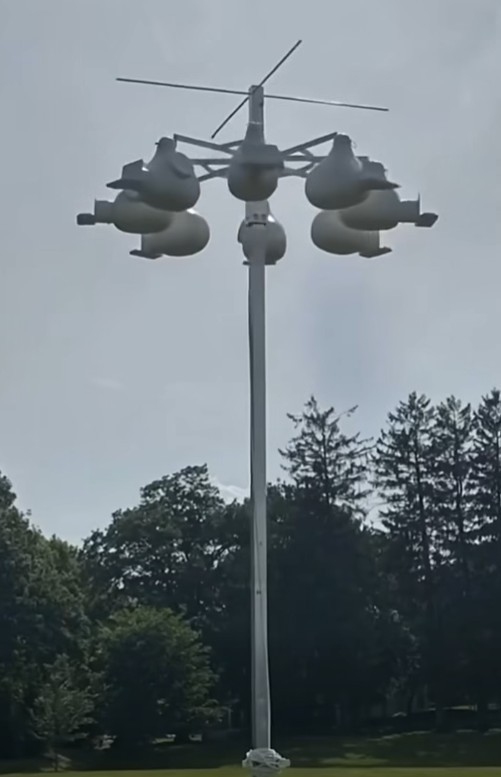
A tall pole topped with a group of white, rounded pods can look unusual in a public park. At first glance, it may resemble weather-monitoring equipment, a communications device, or even part of a lighting system. A closer look often reveals small entry holes in each pod, followed by the rapid flight of birds circling overhead. These structures are purple martin nesting stations: purpose-built homes designed for one of North America’s most recognizable aerial insect-eating birds.
The round compartments are commonly known as gourd houses. Each one provides a separate nesting cavity for a pair of purple martins, while the full rack creates space for a colony. Purple martins are social breeders, and multiple pairs often nest close together when suitable housing is available. In parks, school grounds, nature centers, and open community spaces, these poles give visitors an opportunity to observe the birds’ seasonal return and their fast, graceful flight.
Although the white pods may remain in place all year, purple martins usually use them only during the breeding season. The birds migrate thousands of miles between North America and South America, making the nesting stations a visible reminder of a much larger annual journey.
What Are Purple Martin Houses?
Purple martin houses are artificial nesting structures with multiple enclosed chambers. Traditional versions were made from dried, hollowed gourds, which gave modern plastic or aluminum units their familiar rounded shape. Today’s installations may include several individual gourds attached to horizontal arms, or a larger multi-room house mounted at the top of a pole.
Every gourd or compartment has an entrance opening that leads to a protected interior nesting space. A pair of martins may use that chamber to lay eggs and raise young. The birds generally build a nest using materials such as leaves, twigs, small stems, mud, and grass. From ground level, the individual chambers may look nearly identical, but each entrance can represent a separate nesting territory within a larger colony.
The structures are typically installed in open areas rather than beneath dense tree cover. Purple martins approach their homes at speed and benefit from clear flight paths around the pole. Open lawns, playing fields, wetlands, large gardens, and park clearings can all provide the kind of airspace that makes a nesting station practical.
Purple Martins Are North America’s Largest Swallows
The purple martin (Progne subis) is the largest swallow species in North America. Adults are generally about seven to eight inches long, with a wingspan that can approach 16 inches. Their bodies are streamlined for flight, with pointed wings and a slightly forked tail that helps them maneuver through the air.
Adult males are especially distinctive, with dark, glossy feathers that can appear blue-black or purple in bright light. Females and young birds have paler underparts and less uniformly dark plumage. Because lighting, distance, and movement can make colors difficult to see, many observers first recognize purple martins by their size, their fast flight, and the presence of a nearby colony house.
Like other swallows, purple martins feed primarily on insects caught in flight. Their diet can include flying insects such as beetles, moths, flies, wasps, winged ants, and dragonflies. They often fly high over open ground or water and may travel considerable distances from their nest site while foraging. A bird seen sweeping across a field may be hunting well away from its nest, then return suddenly to the pole and disappear into one of the entrance holes.
This airborne lifestyle is one reason purple martins are so engaging to watch. They can change direction quickly, glide briefly, and then resume energetic wingbeats as they pursue prey. Their activity is often most noticeable during warm daylight hours, when flying insects are abundant.
Why Do Purple Martins Nest in Colonies?
A cluster of white gourds on one pole reflects the social nesting habits of purple martins. Rather than nesting as isolated pairs across a landscape, martins commonly form colonies where several pairs breed in close proximity. Each pair occupies its own cavity, but the birds share the broader nesting area and may gather on nearby wires, trees, or the housing rack.
For people passing through a park, the system can initially appear to be a single large object. In reality, it is more like an apartment building for birds. One martin may enter a gourd on the outside of the rack while another heads into a chamber on the opposite side. During the busiest part of the breeding season, adults repeatedly arrive and depart as they gather food and tend to their young.
The concentration of activity around a colony site can make purple martin housing useful for environmental education. Visitors can observe migration, nesting behavior, aerial feeding, and the relationship between wildlife and habitat management without disturbing the birds. However, responsible viewing matters. People should watch from a respectful distance, avoid touching the pole or housing, and follow any park guidance about restricted areas during nesting season.
A Long History of People Providing Gourd Houses
The practice of providing gourds for purple martins has deep roots in North American history. Indigenous peoples in some regions used hollow gourds as martin nesting sites, and the practice was later continued and expanded by European settlers. Over time, purpose-built martin houses became a familiar feature of farms, yards, and public spaces.
Natural tree cavities can provide nesting places for purple martins, particularly in parts of their range where natural habitat remains available. However, in much of the eastern United States, purple martins now nest predominantly in housing supplied and maintained by people. The Purple Martin Conservation Association notes that eastern populations have developed a strong dependence on human-provided nest sites, while martins in western areas are more likely to use natural cavities or cavities created by woodpeckers.
That regional difference is important. A purple martin house is not simply a decorative garden feature; it can be part of a long-standing relationship between people and a migratory bird species. Properly placed and maintained housing can offer breeding space where appropriate natural cavities are limited. At the same time, successful martin management requires commitment, because the structures may need regular monitoring, cleaning, and repair.
Why Purple Martin Houses Are Mounted on Tall Poles
The height of a purple martin house serves several practical purposes. Elevated housing helps create open approaches for birds in flight and can make the nests less accessible to some ground-based animals. Many stations are placed on poles well above head height, with the exact height depending on the design and local setting.
A pole may also include a smooth metal or plastic barrier called a predator baffle. This device is intended to make climbing more difficult for animals that could reach nesting compartments from below. A baffle does not eliminate every risk, and its effectiveness depends on proper installation and maintenance. Nonetheless, it is a common feature of managed martin housing.
Many modern systems use telescoping poles, cables, or winches that allow caretakers to lower the rack safely. This is important because purple martin housing should be accessible for inspection. Land managers, volunteers, or trained property owners may lower a house to check its condition, remove old nesting material between seasons, verify that entrances are functioning, and address maintenance needs.
Well-designed compartments may also include drainage holes and ventilation. Drainage can help prevent water from collecting inside after rain, while ventilation can reduce excessive heat during warm weather. These features may not be visible to park visitors, but they can make a meaningful difference to the quality of the nesting space.
How Parks and Communities Manage Purple Martin Nesting Stations
A purple martin station is most successful when it is actively managed. Simply placing a birdhouse on a pole does not guarantee that martins will use it. The location must be suitable, the housing must be clean and functional, and the entrance design should be appropriate for the birds. Local conditions, including competing bird species and nearby habitat, can also affect whether a colony becomes established.
Maintenance is especially important because some non-native bird species can compete for cavities. House sparrows and European starlings are known to use nest boxes and may interfere with native cavity-nesting birds. Conservation organizations commonly advise housing managers to follow local wildlife guidance and use responsible, lawful approaches to monitoring nest sites. Public parks may rely on trained staff, volunteers, bird clubs, or conservation partners for this work.
Seasonal timing also matters. Purple martins arrive at different times depending on latitude, weather patterns, and age. Older birds that have already bred may appear earlier than younger birds seeking a first nesting site. Once breeding is complete, the colony becomes quieter, and the birds eventually begin their southbound migration.
For park agencies, these stations can support broader goals beyond birdwatching. They create opportunities for public education about migration, native wildlife, habitat stewardship, and citizen science. A small sign near a martin pole can help visitors understand why the structures are present and encourage respectful observation.
Purple Martin Migration Connects Parks to South America
Purple martins are migratory birds. They breed across broad areas of North America and spend the nonbreeding season in South America, with Brazil recognized as an important wintering area. Their annual migration demonstrates how a nesting station in one local park is connected to habitats across an entire hemisphere.
Migration is demanding, and the timing of arrival can vary from year to year. Temperature, wind, food availability, and conditions along the route all influence when birds reach their breeding grounds. A pole that appears empty in winter may become active in spring as returning martins inspect nesting cavities and establish pairs.
This seasonal cycle also explains why the white gourds can seem mysterious to people unfamiliar with them. The equipment remains visible long after the birds have departed. Yet when the martins return, the same quiet-looking pole becomes the center of constant motion, calls, and aerial activity.
How to Identify a Purple Martin Nesting Station in a Park
If you see white pods high on a pole, look for a few key features. Purple martin stations usually have several rounded or box-like compartments arranged in a cluster. Each compartment will have a small entrance opening. The pole is often positioned in an open area, and it may include a circular or cone-shaped predator baffle below the housing.
During the breeding season, watch the airspace around the station rather than staring only at the pods. Purple martins may approach from almost any direction, flying quickly before braking and entering a cavity. You may also see several birds perched near the housing or hear their musical, chattering calls.
It is best not to tap on the gourds, attempt to look inside, or bring pets close to the pole. Nesting birds are sensitive to disturbance, and parks may have rules designed to protect wildlife. Binoculars are a useful way to observe activity without getting too close.
Why These White Pods Matter
The white pods on tall poles are more than unusual park fixtures. They are carefully designed nesting spaces for purple martins, birds whose lives span open North American landscapes and distant wintering grounds in South America. Their gourd-shaped chambers continue a long tradition of people providing nesting cavities for a species that often lives close to human communities.
For visitors, a purple martin station offers a chance to notice wildlife in an everyday setting. The next time you see a pole covered in rounded white compartments, look for the small entrances and scan the sky nearby. A fast-moving swallow may reveal the purpose of the structure by banking through the air and vanishing into a single gourd-shaped home.
Sources
Disclaimer: This content is intended for entertainment purposes only and is not based on real events.