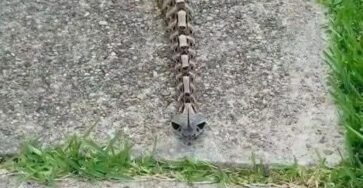
The Leaf-Like Snake Most People Would Never Notice
At first glance, a Gaboon viper can look less like a snake and more like part of the forest floor. Its body seems to disappear into a carpet of dead leaves, roots and shadow. For many people walking through African rainforests, this large venomous snake might be just a blur of color or a pattern they never truly see. Yet this “leaf-like” reptile is one of the most fascinating and specialized snakes on Earth, combining advanced camouflage, powerful venom and a surprisingly calm temperament.
What Is a Gaboon Viper?
The Gaboon viper (Bitis gabonica) is a large, heavy-bodied venomous snake native to parts of sub-Saharan Africa. It belongs to the viper family (Viperidae), which also includes puff adders, rattlesnakes and other well-known venomous species. Among African vipers, the Gaboon viper stands out for three main reasons: its size, its extremely long fangs and its extraordinary camouflage.
Adults commonly reach 1.2 to 1.5 meters (around 4 to 5 feet) in length, and some individuals can be even larger. Unlike slender snakes such as many colubrids or mambas, the Gaboon viper has a very thick, muscular body with a broad, triangular head. This stocky build helps it remain stable and hidden as it waits motionless for prey on the forest floor.
Herpetologists (scientists who study reptiles and amphibians) recognize two main subspecies: the West African Gaboon viper and the East African Gaboon viper. Both share similar overall appearance and habits, although there are differences in range and slight variations in pattern and coloration.
Masters of Camouflage: How the Snake Becomes a “Leaf”
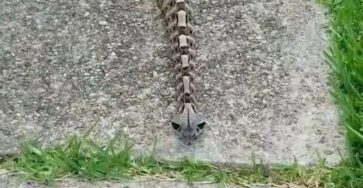
The Gaboon viper is often described as one of the best-camouflaged snakes in the world. Its body is covered in complex geometric patterns in shades of brown, cream, tan, gray and even subtle purples. These colors match the texture and tones of rotting leaves, tree bark and forest soil. From above, the snake’s outline is broken into irregular shapes that look like scattered foliage.
The snake’s head is also specially shaped and patterned. A pair of horn‑like scales above the nostrils add to the broken outline, helping the head resemble a curled, dry leaf. When the animal lies still under leaf litter, only the faintest hint of its eye or a small portion of its back may be visible. In dense forest, this makes it extremely difficult to spot even at close range.
This form of camouflage is known as cryptic coloration. It is an evolutionary adaptation that protects the snake from potential predators and simultaneously makes it an efficient ambush hunter. By blending into the background, the Gaboon viper does not need to chase prey; instead, prey animals come close enough for a rapid strike.
Habitat and Distribution in Africa
Gaboon vipers are primarily found in the rainforests and moist savannas of Central, West and parts of East Africa. Their range includes countries such as Nigeria, Cameroon, Gabon, the Democratic Republic of the Congo, Uganda and Tanzania, among others. They prefer environments with dense vegetation, deep leaf litter and relatively high humidity.
Within these habitats, the snakes tend to stay close to the ground. They may rest beside fallen logs, under shrubs or within piles of decaying leaves. Unlike arboreal (tree-dwelling) snakes, Gaboon vipers are almost exclusively terrestrial. They are also more active at night or during crepuscular periods (dawn and dusk), when temperatures are moderate and many small mammals are moving around.
Human activities such as logging, agricultural expansion and urban development can reduce or fragment their forest habitat. While Gaboon vipers are not currently considered one of the most critically endangered snakes, habitat change and direct killing by humans remain local threats in some regions.
Appearance in Detail: Fangs, Head and Body
Beyond camouflage, the Gaboon viper has several anatomical features that make it notable even among venomous snakes. Perhaps the most famous are its exceptionally long fangs. Measurements from scientific studies and zoo collections show that Gaboon vipers have some of the longest fangs of any venomous snake, often exceeding 5 centimeters (around 2 inches) in length.
These fangs fold back against the roof of the mouth when not in use and swing forward when the snake strikes. Because of their length, they can penetrate deeply into prey, delivering venom efficiently. The head is large and triangular, with a distinct neck. This broad head accommodates well-developed venom glands.
The body pattern includes hourglass or leaf‑shaped markings along the back and sides. Each individual snake has a unique arrangement of these shapes, but the overall effect is similar: the snake appears broken into overlapping “leaves.” The tail is relatively short and often ends in a darker tip, which may play a minor role in luring curious prey close enough for an ambush.
Diet and Hunting Strategy
Gaboon vipers are ambush predators. Rather than actively hunting over large distances, they usually select a promising spot—such as a game trail or area with frequent rodent activity—and remain motionless for long periods. When a potential meal comes within striking distance, the snake can launch a rapid, precise attack.
Their diet consists mainly of small to medium-sized mammals, including rodents, shrews and sometimes larger animals such as small antelope species, depending on the size of the snake. They may also eat birds and occasionally other vertebrates. Studies and field observations show that Gaboon vipers use their heavy body as an anchor to deliver a quick lunge, inject venom and then either hold on to the prey or release it and follow the scent trail to the immobilized animal.
The combination of long fangs and potent venom allows them to subdue relatively large prey compared with their own body size. This strategy is energy efficient: a single sizable meal can sustain a Gaboon viper for weeks, reducing the need to move frequently and lowering the risk of detection by predators or humans.
Venom: Potency and Medical Importance
The Gaboon viper’s venom is primarily hemotoxic, meaning it affects blood and tissues. It contains a mixture of enzymes and proteins that can disrupt blood clotting, damage blood vessel walls and cause local tissue destruction. In untreated human bites, this type of venom can lead to severe swelling, internal bleeding, pain and potential complications such as organ damage.
Although the venom is powerful, documented human bites are relatively rare compared to those from more aggressive or widespread species like puff adders. Gaboon vipers tend to be calm and reluctant to bite unless they are stepped on, handled or feel directly threatened. Nonetheless, any suspected bite requires immediate medical attention.
In regions where the snake occurs, hospitals and clinics may use polyvalent antivenom designed for African viper species. Early treatment can significantly reduce the risk of serious complications. Public health agencies and medical organizations emphasize prevention—wearing protective footwear, using lights at night and avoiding handling wild snakes—as the best strategy to reduce snakebite incidents.
Behavior: Calm but Potentially Dangerous
Despite their formidable reputation, Gaboon vipers are not typically aggressive. Field biologists and experienced handlers report that these snakes often remain motionless even when approached closely. Their first line of defense is camouflage, not confrontation. If they believe they are unseen, they usually do not move.
However, this same behavior can increase the risk of accidental encounters. Because the snake stays still rather than fleeing, people may step directly on it without realizing it is there, especially in dim light or thick leaf litter. In such cases, the snake may react defensively and deliver a bite.
For this reason, local communities, park rangers and ecotourism guides often stress the importance of careful walking, using a stick to disturb leaf litter ahead, and watching where hands and feet are placed. Education about local wildlife, including vipers, is a key part of reducing injuries while still allowing people to live, farm and hike in areas where these snakes are present.
Reproduction and Life Cycle
Gaboon vipers are ovoviviparous. Instead of laying eggs externally, the female retains the eggs inside her body, and the young are born live. A single litter can be quite large, with some documented cases including dozens of offspring. The newborn snakes are fully formed miniature versions of adults, with functioning venom glands and camouflage patterns.
After birth, the young are usually independent and must fend for themselves. Their survival depends on finding suitable hiding places and small prey. As they grow, they gradually increase the size of their prey and expand their range within the forest. Like many reptiles, Gaboon vipers grow throughout their lives, though the rate slows once they reach maturity.
In the wild, their lifespan is less well documented than in captivity, where they can live for many years with proper care. Factors such as disease, predation on young snakes, habitat change and encounters with humans all influence their survival in nature.
Human Perception and Cultural Context
In many parts of Africa, venomous snakes are viewed with a mix of caution and respect. Local knowledge often includes stories and practical advice about how to avoid snakebites, recognize dangerous species and respond to encounters. The Gaboon viper’s impressive size and distinctive pattern make it a subject of curiosity among residents and visitors.
Some communities may kill venomous snakes on sight out of fear or to protect livestock and family members. Others recognize the ecological role these animals play in controlling rodent populations and reducing crop damage. Conservation organizations and researchers frequently work with communities to promote coexistence and provide accurate information about risk, identification and first aid.
Internationally, the Gaboon viper fascinates reptile enthusiasts, photographers and scientists. Documentaries, field guides and educational exhibits in zoos often highlight its camouflage and massive fangs as examples of extreme specialization in nature. At the same time, experts emphasize that these snakes are wild animals that require respectful distance and should not be kept or handled by untrained individuals.
Ecological Role and Conservation Considerations
Ecologically, Gaboon vipers are important mid to top-level predators in forest ecosystems. By feeding on rodents and other small mammals, they help regulate populations that can otherwise grow quickly, damage crops and spread disease. This natural control contributes to the balance of both wild and human-shaped environments.
Currently, major international conservation lists do not classify the Gaboon viper as critically endangered, but reliable population data are limited in some regions. Forest loss, fragmentation and hunting of wildlife for bushmeat or traditional practices can indirectly affect these snakes. As forests shrink or become more disturbed, encounters between humans and snakes may increase, potentially leading to more killings of vipers.
Conservation strategies that protect large, continuous areas of rainforest and promote sustainable land use benefit Gaboon vipers along with many other species. Environmental groups and scientific institutions often point out that preserving habitat for such specialized reptiles also supports birds, mammals, insects and plants that share the same ecosystem.
Safety, Education and Responsible Tourism
For people living in or visiting regions where Gaboon vipers occur, basic safety measures can greatly reduce risk. Wearing sturdy boots, using a flashlight at night and staying on well-marked paths are simple but effective steps. Guides who know local wildlife can point out areas where snakes are more likely to rest and explain how to behave if one is spotted.
Educational materials from public health agencies, universities and conservation groups commonly recommend leaving any wild snake alone, regardless of whether it is believed to be venomous. Attempting to capture, handle or kill a snake significantly increases the chance of a bite. Instead, observing from a safe distance and contacting local wildlife authorities if necessary is the safer approach.
Responsible ecotourism can also support research and conservation. Visitors who learn about species such as the Gaboon viper often develop greater appreciation for rainforest ecosystems and may be more likely to support projects that protect habitats and improve community health services, including treatment for snakebite.
A Hidden Specialist of the Forest Floor
The Gaboon viper is a striking example of how evolution shapes organisms to fit specific niches. With its leaf‑like camouflage, massive fangs and patient hunting strategy, it thrives by remaining almost invisible. Many people walking through its habitat may never realize that such a powerful predator lies just steps away under the leaves.
Understanding this snake through careful scientific study and public education helps replace unfocused fear with informed respect. While the Gaboon viper is certainly capable of delivering a dangerous bite, it is also a vital part of African forest ecosystems and a remarkable illustration of nature’s complexity. Recognizing its role and learning how to coexist safely are important both for human communities and for the long‑term health of the habitats they share.
Sources
Disclaimer: This content is intended for entertainment purposes only and is not based on real events.