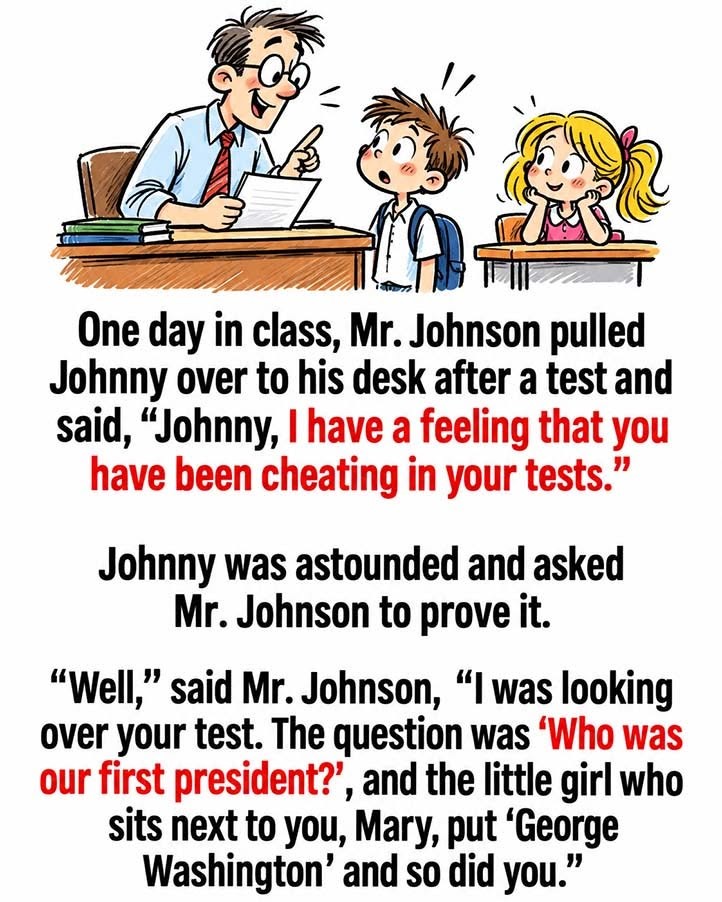
Stop Cheating, Johnny: Why Academic Integrity Matters in School
A classroom story about a student named Johnny who is challenged over matching test answers may be presented as a humorous setup, but it points to a serious issue in education: academic integrity. When students copy answers, use unauthorized help, submit someone else’s work, or misrepresent what they know, the immediate concern is not simply a rule violation. The deeper problem is that learning becomes harder to measure, trust between teachers and students can be damaged, and students may miss the opportunity to identify what they need to improve.
Academic dishonesty is not limited to one age group, one subject, or one country. Schools and universities around the world continue to address concerns about plagiarism, unauthorized collaboration, test cheating, contract cheating, and the misuse of digital tools. The growth of online learning and artificial intelligence has also made it more important for educators to explain expectations clearly and design assessments that support genuine learning.
A fair response matters. Students should understand the evidence, be given a chance to explain their perspective, and receive consequences that are appropriate to the situation and consistent with school policy. At the same time, schools can reduce cheating by addressing the pressures and misunderstandings that often contribute to it.
What Academic Integrity Means
Academic integrity is the commitment to doing schoolwork honestly, acknowledging help and sources appropriately, and presenting one’s own understanding. It applies to exams, homework, research papers, group assignments, laboratory reports, online courses, and creative projects.
In practical terms, academic integrity means completing an individual test independently when that is the instruction. It means quoting and citing sources in a research assignment. It means telling a teacher when a group member has not contributed rather than claiming equal work. It also means asking questions when rules are unclear, particularly in classes where students may use calculators, online materials, translation tools, or generative AI.
Not every similarity between two students’ answers proves wrongdoing. Students may have studied together, used the same class notes, reached the same conclusion, or made the same predictable error. Teachers therefore need to look at the full context before making an accusation. Matching unusual wording, identical incorrect responses, copied formatting, inconsistent work quality, or evidence that students communicated during a restricted assessment may warrant further review. A careful process protects both academic standards and students’ rights.
Why Students May Cheat
Students cheat for many reasons, and understanding those reasons does not excuse the behavior. Some fear disappointing parents, teachers, or themselves. Others feel overwhelmed by heavy workloads, struggle with a particular subject, face time pressures from work or family responsibilities, or believe that a single grade will determine their future. In competitive environments, students may also wrongly assume that everyone else is taking shortcuts.
Research and education experts frequently emphasize that cheating can be connected to stress, unclear expectations, inadequate preparation, and a focus on grades over learning. A student who does not understand a lesson may see copying as a quick way to avoid embarrassment. Another may panic during an exam and make a poor decision. These circumstances call for accountability, but they also show why prevention must include academic support and a school culture where asking for help is encouraged.
Technology can create additional temptations. A phone, smartwatch, messaging application, answer-sharing website, or AI system can make it easier to obtain information quickly. However, access to information is not the same as learning. If a student submits work they cannot explain, they may receive a score without gaining the knowledge or skills the assignment was meant to develop.
The Real Cost of Copying Answers
Cheating can appear to offer a short-term advantage, but it often creates longer-term problems. A copied answer may produce a better score on one assessment, yet it leaves gaps in understanding that can become more difficult later. In subjects such as mathematics, science, languages, and history, many lessons build on earlier concepts. Missing the foundation can make future assignments more frustrating.
There is also a personal cost. Students who rely on dishonest methods may feel anxious about being discovered or may lose confidence in their ability to succeed independently. Honest effort, including mistakes and revisions, is how learners discover what they can do and where they need support. A lower mark that accurately reflects current understanding can be more useful than a higher mark that hides a problem.
For schools, academic dishonesty makes assessment less reliable. Teachers use quizzes, essays, and projects to decide whether students have understood the material. When work is not authentic, educators may not know which topics need to be retaught or which students need additional help. This can affect the entire class.
At a broader level, integrity in education supports trust in qualifications. Employers, universities, and professional organizations need confidence that a grade, certificate, or degree represents real learning. This is especially important in fields where knowledge and judgment affect public wellbeing, including health care, engineering, education, law, and public service.
How Teachers Can Investigate Concerns Fairly
A responsible teacher should avoid rushing to judgment. If two tests contain similar answers, the teacher can compare the responses with other work completed by each student, review seating arrangements or assessment procedures, and consider whether the matching content is unusually specific. Schools should follow established policies and document concerns carefully.
When speaking with a student, educators can explain what they observed without using humiliating language or making assumptions. A private conversation is usually more constructive than a public confrontation. The student should have an opportunity to respond, clarify circumstances, and understand the school’s expectations. For younger learners especially, the conversation can become a teachable moment about honesty, responsibility, and how to seek help.
Consequences vary by institution and by the seriousness of the situation. They may include a discussion, an opportunity to redo work under supervision, a reduced grade, parent or guardian communication, counseling, or a formal disciplinary process. A proportionate response should consider factors such as the student’s age, the nature of the assignment, prior incidents, and whether there was a deliberate attempt to deceive.
Consistency is essential. Students are more likely to view rules as legitimate when expectations and consequences are applied fairly. Clear written policies, accessible appeal procedures, and training for staff can help schools respond appropriately while maintaining trust.
Preventing Cheating Through Better Learning Design
Prevention is more effective than relying only on punishment. Teachers can reduce confusion by stating clearly what help is allowed for each assignment. For example, an instructor might specify whether students may work together, use notes, consult websites, use grammar-checking software, or use AI tools. Vague instructions can lead to misunderstandings, particularly when students are accustomed to different rules in different classes.
Assessment design can also make a difference. Questions that ask students to explain reasoning, connect ideas to classroom discussions, reflect on their process, or apply concepts to a new scenario are often more meaningful than tasks that depend solely on memorization. Short check-ins, drafts, oral explanations, and feedback throughout a project can help teachers see students’ progress and offer help before a deadline becomes overwhelming.
Creating a supportive classroom culture is equally important. Students should know that it is acceptable not to understand something immediately. Teachers can normalize revision, offer extra help, share study strategies, and direct students to tutoring or counseling services when needed. When students believe that effort and improvement are valued, they may be less likely to see dishonesty as their only option.
Parents and Guardians Have a Role
Parents and guardians can reinforce academic integrity by focusing on learning rather than demanding perfect scores. Questions such as “What did you learn?” and “What part was difficult?” can be more helpful than concentrating only on a grade. Young people need to know that mistakes are manageable and that asking for help is a responsible choice.
Families can also help students build practical habits: keeping a calendar, breaking large assignments into smaller tasks, setting aside a quiet study time, and communicating early with teachers about difficulties. If a student is struggling with anxiety, attention, language barriers, or an unmet learning need, seeking appropriate school or health support may be more helpful than treating the issue as a lack of effort.
Responsible Use of AI and Digital Tools
Digital tools can support education when used transparently and within a teacher’s rules. Spell-checkers, learning platforms, translation resources, calculators, and AI systems may help students organize ideas, practice concepts, or receive feedback. Yet students should not submit generated or copied material as their own original work when that is not permitted.
Schools increasingly need clear guidance on AI use. Students may be allowed to use an AI tool for brainstorming, outlining, or grammar suggestions in one class, while another assignment may require entirely independent work. The key principle is disclosure and authorization. If a tool was used, students should follow the teacher’s instructions for acknowledging it. They should also verify facts independently, since automated systems can produce inaccurate or misleading information.
Building a Culture of Trust and Accountability
The most effective approach to academic integrity combines high expectations with meaningful support. Students should understand that honesty matters, not because they are expected to be perfect, but because authentic work allows real growth. Teachers should have the tools to assess fairly and respond calmly when concerns arise. Families and schools should communicate openly about stress, workload, and the value of perseverance.
In the end, a test is more than a chance to earn a mark. It is an opportunity to learn what a student knows today and what they can learn next. A classroom response to suspected cheating should protect that purpose. By emphasizing honesty, fairness, clear expectations, and access to help, schools can turn difficult moments into opportunities for stronger learning and stronger trust.
Sources
Disclaimer: This content is intended for entertainment purposes only and is not based on real events.