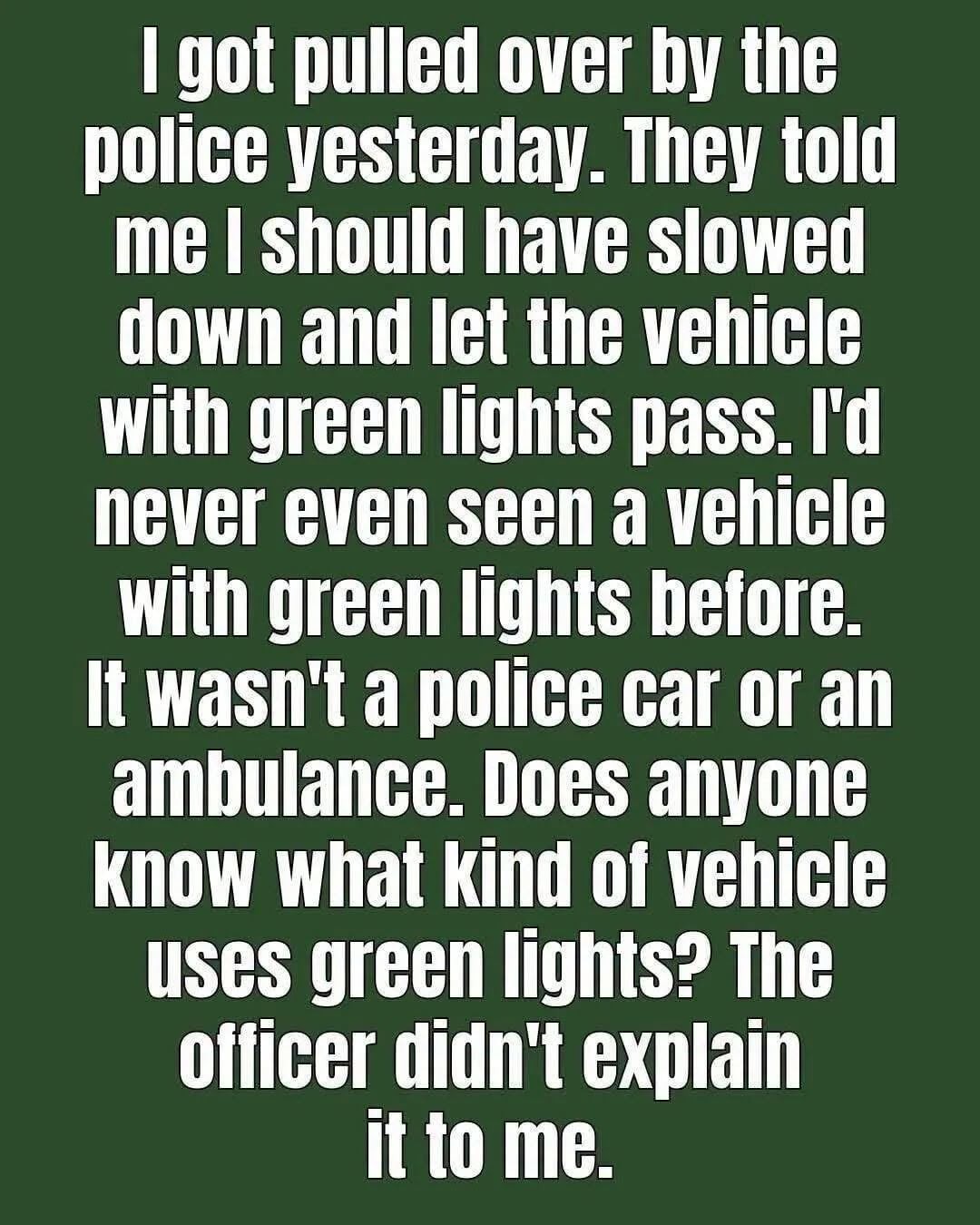
You are driving home when something strange appears in your rearview mirror.
A small green light is flashing from a vehicle behind you.
At first, you barely notice it.
Then you look again.
The light isn’t the familiar red and blue associated with emergency vehicles. It is green, and you cannot immediately tell what it means.
For a moment, your mind starts filling in the blanks.
Is the driver trying to warn you about something? Is the vehicle responding to an emergency? Should you pull over? Or is the green light simply part of a system you’ve never encountered before?
That uncertainty is exactly why unusual vehicle lighting can catch drivers off guard.
And while the meaning of a green light can vary depending on the country, state, vehicle and situation, there is one important lesson: never assume that an unfamiliar warning light is meaningless.
The Green Light in Your Rearview Mirror
Most drivers quickly learn the visual language of the road.
Red usually means stop.
Yellow tells you to be cautious.
Blue and red lights often signal emergency services.
But green?
That is where things become less obvious.
Certain vehicles may use green lighting for specific purposes, including volunteer emergency responders or other authorized vehicles, depending on local regulations.
The exact rules are different from one jurisdiction to another, which means a green light that has a specific meaning in one location may not have the same meaning somewhere else.
That is why drivers should avoid relying entirely on assumptions.

Why Green Lights Can Be Confusing
Part of the confusion comes from the fact that emergency vehicle lighting is not completely standardized worldwide.
Different countries and regions have developed their own systems for identifying emergency, service and specialized vehicles.
Some green lights can be associated with volunteer responders, while other applications may involve particular official or service vehicles.
In some places, green lights may have no special traffic significance at all.
The safest approach is therefore to understand the rules where you live rather than assuming every green light represents the same thing.
What Should You Do When You See One?
The most important principle is simple:
Do not make a sudden maneuver simply because you are uncertain.
If a vehicle behind you displays an unfamiliar light, remain calm.
Maintain control of your vehicle, check your surroundings and avoid abruptly changing lanes or stopping in an unsafe location.
If the vehicle clearly appears to be an emergency or authorized response vehicle and local law requires drivers to yield, follow the applicable road rules.
Your goal should be to create a safe path rather than react emotionally.
A sudden lane change can create more danger than calmly allowing another vehicle to pass.
The Meaning Depends on Where You Drive
This is perhaps the most important part of the story.
There is no universal rule saying that every green light on a vehicle means the same thing.
Traffic regulations are established by individual countries, states, provinces and municipalities.
That means a responsible driver should check the official regulations applicable to their location.
For example, emergency lighting rules in the United States can vary between states. Some jurisdictions give specific meanings to green lights, while others restrict their use to particular vehicles or circumstances.
This is also why viral social media posts claiming that a particular colored light “always means” one thing should be treated carefully.
The color alone may not tell the entire story.
Why These Lights Exist
At a basic level, specialized vehicle lighting serves one purpose: communication.
Drivers need to recognize that a particular vehicle may require attention.
The light provides a visual signal that can be understood quickly, especially in situations where there may not be enough time for a driver to read a sign or identify the vehicle itself.
This principle has existed for decades.
As vehicles became faster and roads became busier, standardized visual signals became increasingly important.
Modern lighting systems simply make those signals more visible.
Don’t Let Curiosity Become a Driving Risk
There is another lesson hidden behind the mystery of the green light.
When people see something unfamiliar, they naturally want to understand it immediately.
But driving requires a different priority.
You don’t need to solve the mystery while moving.
You don’t need to stare at the vehicle.
And you certainly shouldn’t stop suddenly just to figure out what the light means.
First, maintain safe control of your vehicle.
Then, once you are safely parked, you can research the meaning of the light in your local area.
That small change in mindset can make unfamiliar situations much easier to handle.
The Bigger Story Behind Road Signals
Road signs, traffic lights and vehicle warning systems all represent a fascinating form of communication.
They allow thousands of strangers to coordinate their movements without speaking to one another.
A red light tells everyone to stop.
A turn signal tells another driver where someone intends to go.
A warning beacon tells drivers that something about the situation may require additional attention.
The system works because people learn the visual language of the road.
When an unfamiliar signal appears, however, that shared language suddenly becomes less clear.
And that is exactly what makes a mysterious green light so interesting.
What Drivers Should Remember
If you encounter a vehicle displaying green lights, remember four basic principles.
First, stay calm.
Second, avoid sudden maneuvers.
Third, give way when required by your local traffic laws.
And finally, check your jurisdiction’s official rules if you are unsure about what the light means.
The color itself is only part of the information.
The vehicle type, location, purpose and local regulations can all matter.
Final Thoughts
A mysterious green light in your rearview mirror can create a surprisingly powerful reaction.
For a few seconds, something completely ordinary can suddenly feel unfamiliar.
But perhaps that is what makes road systems so fascinating.
Behind every flashing light is a story about how people have learned to communicate without words.
And behind every traffic rule is an attempt to make thousands of individual decisions work together safely.
So the next time a green light appears behind you, don’t panic and don’t guess.
Stay focused.
Stay predictable.