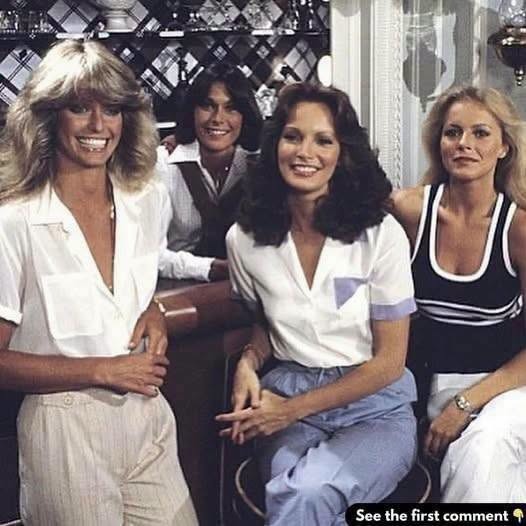
There are some celebrities whose photographs instantly transport us to another era. For millions of people, one particular image brings back the style, optimism, and energy of 1970s Hollywood: a young woman with a radiant smile, a red swimsuit, and famously feathered blonde hair.
That woman was Farrah Fawcett.
Long before she became one of television’s most recognizable stars, Fawcett was a young woman from Texas with an interest in science and an uncertain future in entertainment. Her journey from college student to international celebrity was remarkably fast, but her career ultimately became much more than a story about beauty and television fame.
Through acting, television, film, and later dramatic performances, Farrah Fawcett repeatedly challenged the expectations placed upon her. Her decision to leave one of the most successful television shows of the 1970s demonstrated that she wanted to build a career on her own terms.
Today, decades after her greatest television success, her name remains closely connected with classic Hollywood, 1970s fashion, and the cultural phenomenon surrounding Charlie’s Angels.

From Texas Student to Hollywood Actress
Farrah Fawcett was born on February 2, 1947, in Corpus Christi, Texas. She grew up in a close-knit family and initially seemed to be heading toward a very different career.
After graduating from high school, Fawcett attended the University of Texas at Austin. Interestingly, she initially studied microbiology rather than theater or film.
Her striking appearance eventually attracted attention while she was at university, and she began receiving opportunities to work in entertainment. By 1968, she had decided to move to Hollywood and pursue acting professionally.
The decision changed the direction of her life.
Like many aspiring performers, Fawcett initially built her career through smaller television appearances and commercial work. Her natural screen presence made her a popular choice for advertising campaigns, and she gradually began appearing in television programs.
During the late 1960s and early 1970s, she accumulated roles in a variety of productions, slowly establishing herself as a familiar face to American audiences.
Her career was progressing, but her biggest opportunity was still ahead.

Building a Career Before Charlie’s Angels
Before becoming a television superstar, Fawcett appeared in several films and television productions.
One of her early film roles came in 1969 in Love Is a Funny Thing, a romantic comedy featuring French actor Jean-Paul Belmondo. She also appeared in the 1970 film Myra Breckinridge, alongside stars including Raquel Welch.
Television proved especially important during these early years. Fawcett appeared in programs such as I Dream of Jeannie and The Partridge Family, while also taking roles in television movies.
In 1973, she married actor Lee Majors, who was already well known for his role as Colonel Steve Austin in The Six Million Dollar Man. Fawcett also made appearances on the popular series.
Her professional profile continued to grow, but it was a 1976 film that helped bring her wider attention.
Fawcett appeared in Logan’s Run, a science-fiction film that attracted considerable interest. Around the same period, television producer Aaron Spelling was developing a new series that would eventually transform Fawcett’s career.
That series was Charlie’s Angels.
The Breakthrough of Charlie’s Angels
In 1976, Farrah Fawcett was cast alongside Kate Jackson and Jaclyn Smith in Charlie’s Angels.
The premise was simple but distinctive for its time. The three women played private investigators working for the mysterious Charlie Townsend, whose voice they heard but whose face was rarely seen.
The series quickly became a television sensation.
Fawcett played Jill Munroe, a confident and energetic character who helped define the visual identity of the show. Although Charlie’s Angels was often criticized for emphasizing glamour, its popularity was undeniable.
Audiences responded strongly to the three leading actresses, and the show quickly became one of the most talked-about programs on television.
Fawcett, in particular, became a cultural phenomenon.
Her popularity extended far beyond the television screen. Her image appeared on posters, merchandise, magazines, and advertising campaigns, turning her into one of the most recognizable celebrities of the decade.
The Farrah Hairstyle Becomes a Cultural Phenomenon
One of the most enduring parts of Fawcett’s legacy was not actually a television role.
It was her hair.
Her feathered blonde hairstyle became one of the defining looks of the 1970s. Women across the United States and beyond visited salons hoping to recreate the layered, voluminous style.
The hairstyle became so closely associated with her that it was simply known as “The Farrah.”
It was an early example of the enormous influence a celebrity could have on everyday fashion and beauty trends.
Her appearance on the famous 1976 poster, wearing a red swimsuit and smiling toward the camera, further strengthened her status as a pop-culture icon. The poster became extraordinarily popular and remains one of the most recognizable celebrity images of the era.
Yet behind the glamorous image was an actress who wanted audiences to take her seriously.

Why Farrah Fawcett Left Charlie’s Angels
Perhaps one of the most interesting decisions in Fawcett’s career came when she chose to leave Charlie’s Angels after only one season.
From the outside, leaving one of television’s biggest hits might have seemed surprising. But Fawcett had ambitions beyond becoming a television celebrity.
She wanted to pursue more challenging acting opportunities and establish herself as a serious performer.
Her decision was not without consequences. ABC took legal action over her departure from the series, and Fawcett later described experiencing resistance from parts of the entertainment industry.
The transition was difficult, but it demonstrated something important about her personality.
Fawcett was willing to risk the security of a successful television role in pursuit of a different kind of career.
She was eventually replaced on Charlie’s Angels by Cheryl Ladd, who became an important part of the show’s later years.
Fawcett, meanwhile, continued looking for opportunities in film and television that would allow her to demonstrate a wider range of abilities.
From Television Star to Dramatic Actress
Fawcett’s career after Charlie’s Angels did not follow the straightforward path of a conventional television celebrity.
She increasingly pursued dramatic projects and roles that allowed her to move away from the glamorous image associated with her early fame.
Over time, she appeared in television movies and dramatic productions that showcased a more serious side of her acting.
Her performances earned recognition and demonstrated that she was capable of handling emotionally complex characters.
This transition was significant because Fawcett had become famous primarily for her appearance and her role in a hugely popular television series. Breaking away from that image required persistence.
Instead of remaining defined solely by Charlie’s Angels, she continued working to establish a broader artistic identity.
A Celebrity Who Changed Her Own Direction
Fawcett’s story is particularly interesting because her career illustrates the complicated relationship between celebrity image and personal ambition.
When she became famous, the public quickly developed an image of her: blonde hair, athletic appearance, bright smile, and effortless glamour.
But that image represented only one part of her.
Behind the scenes, she wanted to explore different forms of acting and take greater control over the direction of her career.
Her decision to leave Charlie’s Angels therefore became an important turning point. It showed that success does not always mean continuing along the safest path.
Sometimes, maintaining a sense of purpose requires taking a risk.
Fawcett’s later work helped demonstrate that a performer initially recognized for beauty and television popularity could also pursue serious dramatic roles.
The Lasting Influence of Farrah Fawcett
Farrah Fawcett’s influence can still be seen today.
Her hairstyle remains one of the most recognizable beauty trends associated with the 1970s. Her Charlie’s Angels role continues to appear in discussions of classic television. And her famous poster has become part of the visual history of American popular culture.
But her influence goes beyond fashion and nostalgia.
Fawcett helped illustrate how female television stars could become major cultural figures whose influence extended into fashion, advertising, entertainment, and popular culture.
She also demonstrated that an actress could attempt to move beyond the role that initially made her famous.
That ambition is an important part of understanding her legacy.

Remembering Farrah Fawcett
Farrah Fawcett’s career cannot be reduced to one hairstyle, one television series, or one famous photograph.
She was a Texas-born actress who entered Hollywood in the late 1960s, became a television sensation in the 1970s, and then spent much of her career attempting to expand the public’s understanding of who she was as a performer.
Her journey included extraordinary success as well as professional challenges. Yet perhaps the most memorable part of her story is her determination to keep evolving.
The young actress who arrived in Hollywood in 1968 could hardly have predicted that her hairstyle would become a cultural symbol or that her appearance on Charlie’s Angels would make her internationally famous.
Nor could she have known that audiences would still be talking about her decades later.
A Legacy That Goes Beyond Nostalgia
Looking back at Farrah Fawcett’s life and career reminds us that celebrity is rarely as simple as it appears in photographs.
A single image may become iconic, but behind that image is usually a person making difficult choices, pursuing opportunities, facing setbacks, and trying to determine what kind of life and career they want.
Fawcett’s decision to leave Charlie’s Angels remains one of the defining moments of her professional journey because it reflected her desire to grow beyond the image that had made her famous.
Her story also explains why certain celebrities remain fascinating long after their most famous roles have ended. It is not simply nostalgia that keeps their names alive. It is curiosity about the person behind the image and the choices that shaped their journey.
Farrah Fawcett became one of the defining faces of 1970s television, but her lasting legacy is much broader. She was an actress, a cultural influence, and a performer who continually searched for new ways to express herself.
Perhaps that is why her image still feels familiar today.
Fashion changes. Television changes. Hollywood changes. Yet human curiosity remains remarkably constant. We continue to look back at people like Farrah Fawcett not only because they remind us of another era, but because their stories encourage us to ask what happens behind the famous photograph, the successful role, and the public image.
And sometimes, that story is even more fascinating than the fame itself.
Sources
Harper’s Bazaar, “Farrah Fawcett’s Life in Photos”
Biography.com, “Farrah Fawcett”
The New York Times, archival coverage of Farrah Fawcett and Charlie’s Angels
People, archival interviews and features on Farrah Fawcett
The University of Texas at Austin, historical information about notable alumni and campus history