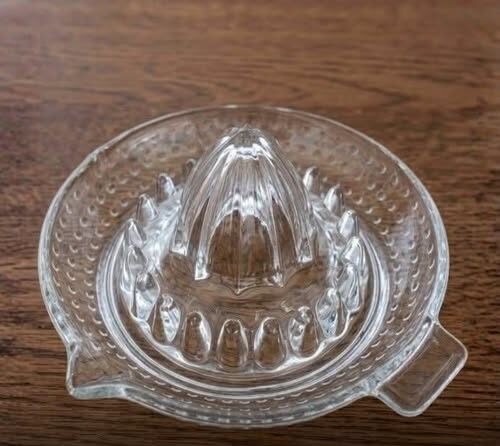
A small glass citrus juicer can look unremarkable at first: a shallow bowl, a ridged cone in the center, and sometimes a modest pouring spout at the edge. Yet for many people, spotting one in a cupboard, antique store, or family kitchen can prompt an immediate sense of recognition. The object may recall orange juice at breakfast, lemons prepared for a recipe, or the steady routines of a parent, grandparent, or other relative.
These hand-operated juicers were designed for a straightforward task, but their continued appeal goes beyond practicality. They represent a period when many everyday kitchen jobs were completed by hand, using durable tools with simple forms. Today, vintage glass citrus juicers remain useful household items, collectible examples of domestic design, and personal reminders of family traditions.

What Is a Vintage Glass Citrus Juicer?
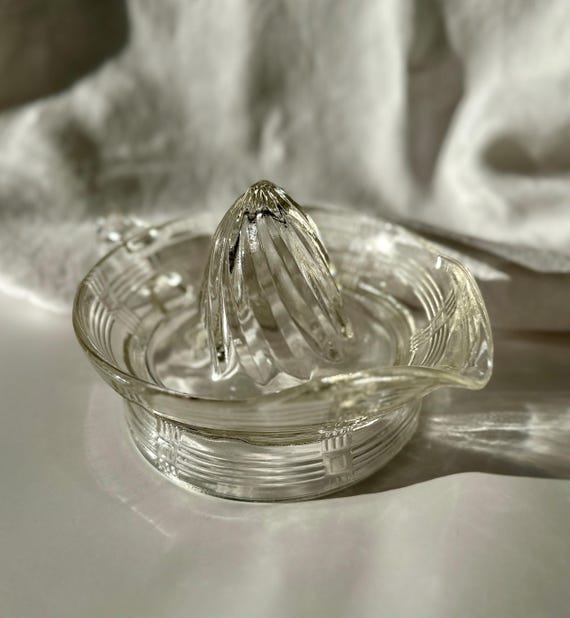
A traditional glass citrus juicer is a manual kitchen tool used to extract juice from citrus fruit, including oranges, lemons, limes, and grapefruits. Its main feature is a raised reamer, often called a cone, with grooves or ridges around its surface. A halved piece of fruit is pressed onto the cone and twisted by hand. The ridges help break up the pulp and release juice, which collects in the bowl around the center.
Many examples include a spout for pouring juice into a glass, measuring cup, or mixing bowl. Some were made from clear pressed glass, while others appeared in colored glass or opaque milk glass. Their sizes varied as well: compact versions were suitable for lemons and limes, while larger pieces could accommodate oranges or grapefruit.
The appeal of this design is its clarity. There are no switches, electrical parts, batteries, or complicated attachments. The person using it can see the fruit, pulp, seeds, and juice throughout the process. Although electric juicers are widely available today, the basic manual reamer still performs the same essential function with little storage space and no power source.
A Familiar Tool in Home Kitchen History
Hand juicing citrus fruit predates modern countertop appliances by many generations. Before electric kitchen equipment became common in homes, manual tools were often the most practical option for preparing fresh ingredients. Citrus juicers were part of a broader category of everyday kitchenware that included hand graters, flour sifters, egg beaters, can openers, and glass measuring cups.
Glass was a popular material for household items because it was nonporous, relatively easy to clean, and suitable for foods with strong flavors or aromas. Citrus juice is acidic, so a glass tool could be especially useful because it did not retain odors in the way some materials may do. The weight of thick glass also helped many juicers remain stable on the counter while someone worked the fruit against the ridged center.
It is important not to romanticize every aspect of earlier home life. Past generations also faced demanding schedules, financial pressures, and the labor of maintaining a household with fewer conveniences. Still, the survival of a modest kitchen object can offer a valuable view of ordinary domestic life: the meals prepared, the skills shared, and the routines that gave shape to a family day.
Why the Old Glass Citrus Juicer Feels So Memorable
The emotional impact of a familiar kitchen tool often comes from association rather than from the object itself. A citrus juicer may have been used during breakfast, while baking, before a holiday meal, or when someone was preparing a favorite family dish. Over time, the repeated presence of the same tool can become connected to people and places.
Memory is strongly influenced by sensory information. The smell of an orange peel, the sound of fruit turning over glass, and the sight of juice collecting in a bowl can all become linked with past experiences. Research on autobiographical memory has found that odors can be particularly effective cues for recalling personal events. This does not mean every person will have the same reaction to an old juicer, but it helps explain why familiar kitchen scents may bring back vivid details unexpectedly.
For one person, the memory may involve a grandmother squeezing lemons for a sauce or dessert. For another, it may be a parent making orange juice on weekend mornings. Others may remember being allowed to help, carefully turning a halved fruit while an adult removed seeds or finished the task. These are small moments, but they can become meaningful because they were repeated within a setting of care, food, and family connection.
Breakfast, Cooking, and Everyday Family Rituals
Food preparation has long been one of the ways families pass time together and share knowledge. A manual citrus juicer fit naturally into these routines because it was simple enough to demonstrate and, with appropriate supervision, easy for older children to use. It did not conceal the work inside a machine. Each step was visible: cutting the fruit, placing it on the reamer, twisting, pouring, and cleaning the tool afterward.
In many homes, recipes were learned through observation rather than formal instructions. Someone might learn how much lemon juice to add by watching a relative prepare soup, salad dressing, a cake, or a marinade. Measurements were sometimes based on familiar cups, spoons, and household tools rather than written recipes. This kind of learning was not limited to one country or culture; family cooking traditions around the world often depend on demonstration, repetition, and shared experience.
A glass juicer could therefore become part of a practical lesson. Children could see how citrus fruit releases juice, how seeds are separated, and how fresh ingredients affect flavor. The tool made the process tangible. Even today, using a manual juicer can offer a direct way to involve younger family members in simple food preparation while teaching safe kitchen habits.
The Lasting Appeal of Simple Kitchen Design
Modern kitchen appliances are designed to save time, automate repetitive work, and serve multiple functions. Electric juicers, blenders, food processors, and multifunction machines can be useful for people preparing large quantities of food or managing busy schedules. Their convenience is real, and they have expanded the options available to home cooks.
However, an old glass citrus juicer offers a different kind of value. It is compact, requires no assembly, and can be used immediately. Its operation is intuitive, and its single-purpose design can make it easier to clean than a larger appliance with numerous parts. For a small amount of citrus juice, such as a lemon for tea or a lime for a recipe, a manual tool may be entirely sufficient.
There is also a satisfaction in completing a small task by hand. The action is brief but deliberate: cut, press, twist, pour. The process encourages attention to the color, aroma, and texture of the fruit. For people seeking slower, more intentional cooking routines, this can be part of the attraction. It is not necessarily better than modern equipment; it is simply a different approach suited to a different scale of task.
Why Vintage Glassware Often Survives Across Generations
Many vintage kitchen items have lasted because their construction was uncomplicated. A manual glass juicer has no motor, cord, blade assembly, or electronic component that can fail with age. If it is not cracked or chipped, it may remain functional for decades. This durability is one reason such pieces still appear in inherited kitchen collections, thrift stores, estate sales, and antique markets.
Of course, glass requires careful handling. A juicer should be inspected before use for cracks, chips, sharp edges, or structural damage. Applying pressure to damaged glass can increase the risk of breakage. If a family heirloom is no longer safe for food preparation, it may still be displayed or stored as a keepsake rather than used in the kitchen.
The condition of a vintage object can also tell part of its story. Small signs of wear may reflect years of ordinary use, while an intact pouring spout or distinctive pattern may help collectors identify a particular manufacturer or era. Still, the financial value of a glass citrus juicer is not always its most important feature. For many families, its significance comes from provenance: who owned it, where it sat, and what it represented in daily life.
Using a Vintage Citrus Juicer Safely Today
An older glass juicer can still be a practical tool for fresh citrus juice, provided it is in sound condition. Before use, wash it with warm water and dish soap, then rinse thoroughly. Avoid using cracked, heavily scratched, or chipped pieces for food preparation. If the juicer has been stored for a long time, clean it carefully and examine the underside and rim as well as the raised reamer.
When juicing, cut the fruit on a stable cutting board with an appropriate knife. Press the cut side gently against the reamer and rotate it, rather than forcing the fruit down with excessive pressure. This protects both the fruit and the glass. If seeds are present, they can be removed with a spoon or caught with a small strainer when the juice is poured.
Freshly squeezed juice can be enjoyed as a drink or used in cooking. Citrus juice adds acidity and aroma to salad dressings, sauces, marinades, baked goods, and beverages. The U.S. Food and Drug Administration notes that food safety practices, including washing produce before preparation, remain important when handling fresh fruits and vegetables.
Nostalgia, Memory, and the Meaning of Ordinary Objects
Nostalgia is often connected to objects that were once so common they attracted little attention. People may remember major celebrations, but they also remember the background details of home: a patterned tablecloth, a familiar kettle, a recipe card, or a glass juicer beside the sink. These items become meaningful not because they were rare, but because they were present during repeated moments of everyday life.
Finding a vintage citrus juicer may remind someone of a kitchen that has changed, a family home that has been sold, or a relative who is no longer alive. Such reactions are personal and can be tender. The object cannot recreate the past, but it can provide a physical connection to it. Holding the same tool once used by a loved one can make an abstract memory feel more immediate.
This is also why inherited kitchenware can be worth preserving. It can be used, displayed, photographed, or passed along with a written family story. Recording who used the object and how it was part of family life may give it added meaning for future generations. A younger relative may not recognize the juicer immediately, but they can understand its importance when its story is shared.
Why the Vintage Glass Citrus Juicer Still Has a Place
In an era of increasingly specialized appliances, the vintage glass citrus juicer remains a useful example of lasting functional design. It does one job with minimal materials, no electricity, and little complexity. Its form has endured because squeezing citrus fruit by hand is still a practical method for many everyday recipes.
More importantly, this old kitchen tool demonstrates how ordinary objects can carry personal history. Its ridged glass cone may call to mind the bright scent of lemons, a quiet breakfast table, or the patient instruction of someone who taught a child how to cook. The memories associated with it are not universal, and they do not prove that the past was simpler for everyone. But they can remind us that connection is often built through small, repeated acts of care.
Whether it is found in a cupboard, purchased from a secondhand shop, or inherited from a relative, a vintage glass citrus juicer can be more than an old utensil. It can remain a functional piece of kitchenware, a modest example of household design, and a meaningful reminder of home.
Sources
- National Institute of Neurological Disorders and Stroke: Memory
- National Center for Biotechnology Information: Odor-Evoked Autobiographical Memories
- U.S. Food and Drug Administration: Selecting and Serving Produce Safely
- Smithsonian Institution: Food History
- Library of Congress: Food and Nutrition Resources
Disclaimer: This content is intended for entertainment purposes only and is not based on real events.