A new fence can seem like a straightforward home improvement project. It provides privacy, improves security, marks the edge of a property, and can make an outdoor space look more attractive.
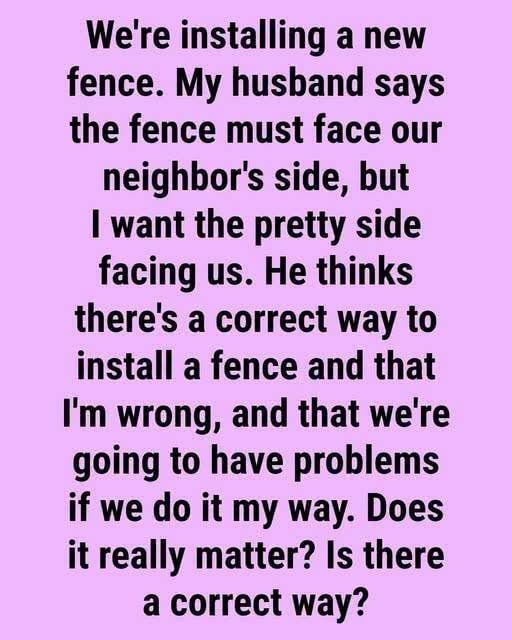
Yet one small detail can create surprisingly strong disagreements between neighbors: Which side of the fence should face outward?
The question often comes up before construction even begins. One homeowner wants to replace an aging fence, hires a contractor, and starts choosing materials. Then a neighbor notices the proposed design and asks why the less attractive side will face their yard.
At first, the disagreement may seem minor. After all, both properties will benefit from a new boundary. But when the fence separates two homes, its appearance can affect how both neighbors feel about their outdoor spaces.
The issue becomes especially noticeable when one side has a smooth, finished appearance while the other exposes vertical posts, horizontal rails, brackets, and structural supports.
Many homeowners believe the attractive side should face the neighboring property or the street. Others argue that the person paying for the fence should have the final say over its orientation.
So, who is actually entitled to the finished side?
The answer depends on several factors, including local regulations, property ownership, community rules, and any agreement between the neighbors. Understanding these considerations before construction begins can prevent a simple home improvement project from turning into a long-running neighborhood dispute.
Why Does a Fence Have Two Different Sides?
<AsyncImage query=”wooden privacy fence smooth finished side compared with exposed posts rails construction side” aspectRatio=”16:9″ width=”100%”/>
To understand the disagreement, it helps to look at how many traditional privacy fences are constructed.
A common wooden fence design uses vertical boards attached to horizontal rails. The rails are supported by posts that hold the entire structure in place.
On one side, the boards create a relatively smooth and continuous surface. This is commonly called the finished side, good side, or face side.
On the opposite side, the horizontal rails and supporting posts remain visible. Although this side performs the same structural function, it may look less polished.
This difference is not necessarily a sign of poor construction. It is simply a result of how certain fence designs are assembled.
However, appearance matters when the fence forms part of a shared neighborhood landscape.
A homeowner looking into their backyard may prefer the smooth surface because it creates a cleaner visual boundary. A neighbor looking at exposed posts may feel that their property has received the less attractive result, even if the fence was installed entirely at the other homeowner’s expense.
That is why the orientation question deserves attention before materials are purchased.
1. Traditional Fence Etiquette: The Finished Side Usually Faces Outward
<AsyncImage query=”beautiful residential wooden privacy fence smooth finished boards facing neighboring yard garden” aspectRatio=”16:9″ width=”100%”/>
In many neighborhoods, a common fencing tradition is to place the finished side facing outward, toward the street or neighboring property.
The idea is relatively simple: A fence should present its most attractive appearance to the surrounding community rather than exposing its structural supports to everyone outside the property.
This arrangement is often viewed as a gesture of courtesy.
For example, if a homeowner installs a fence along the boundary between two backyards, placing the smooth side toward the neighbor can make the shared space look more attractive from both properties.
The same principle is sometimes applied to fences facing public streets, sidewalks, or shared green spaces.
However, it is important to distinguish tradition from law.
Just because a particular arrangement is considered polite or customary does not mean every homeowner is legally required to follow it. Some local regulations and neighborhood associations establish specific orientation requirements, while others do not address the issue at all.
Homeowners should therefore avoid assuming that an unwritten neighborhood tradition automatically creates a legal obligation.
Still, following the finished-side-out approach can be a practical way to reduce tension, especially when both neighbors value the appearance of their properties.
2. Does the Person Paying for the Fence Get to Choose?
<AsyncImage query=”residential backyard new wooden fence installation contractor building fence posts and panels” aspectRatio=”16:9″ width=”100%”/>
One of the most common arguments in fence disagreements concerns who is paying for the installation.
A homeowner may believe that if they are covering the entire cost, they should be allowed to choose the design, materials, height, and orientation.
From a financial perspective, that position may seem reasonable.
After all, replacing a fence can involve considerable expenses. Homeowners may need to pay for materials, labor, old fence removal, permits, and additional landscaping work.
However, paying for a fence does not automatically override property boundaries, building regulations, or applicable community requirements.
The legal position depends on where the fence is located, who owns it, and which rules apply to the property.
For example, a fence installed entirely within one homeowner’s property may be treated differently from a structure placed directly on a shared boundary. Rules concerning shared fences, cost-sharing, maintenance, and construction responsibilities can also vary significantly between jurisdictions.
The important point is that financial responsibility and legal authority are not always the same thing.
Before deciding how a fence should face, homeowners should establish whether it is a private structure, a shared boundary fence, or something governed by a specific agreement.
A conversation with the neighbor can also help clarify expectations before construction begins.
3. Local Regulations May Determine Which Side Must Face Outward
<AsyncImage query=”residential neighborhood fence regulations wooden privacy fence street frontage neat landscaping” aspectRatio=”16:9″ width=”100%”/>
In some communities, the finished-side question is not left entirely to homeowners.
Local governments may regulate fence height, materials, placement, visibility, and appearance. Homeowners associations may also have additional design standards that apply to properties within their communities.
Depending on the location, these rules may address which side of a fence must face neighboring properties or public areas.
Other regulations may focus on different details, such as:
-
Maximum fence height in front, side, and rear yards.
-
Required setbacks from property boundaries or public rights-of-way.
-
Approved materials, colors, and construction styles.
-
Visibility restrictions near driveways, intersections, or sidewalks.
-
Requirements for permits or approval before installation.
These rules are not universal. A requirement that applies in one neighborhood may not exist in another.
Homeowners associations can also impose restrictions that are separate from general municipal building rules. A design permitted by the local government may still require approval under community guidelines.
Ignoring these requirements can create unnecessary complications.
A homeowner might have to modify the fence, pay for additional work, or deal with a formal complaint after construction has already been completed.
For this reason, checking the applicable regulations before hiring a contractor is one of the most important steps in the process.
4. Property Boundaries Matter More Than Many Homeowners Realize
<AsyncImage query=”land surveyor measuring residential property boundary wooden fence garden survey stakes” aspectRatio=”16:9″ width=”100%”/>
Before discussing which side should face outward, homeowners need to know exactly where the property boundary is located.
This may sound obvious, but boundary misunderstandings are a common source of neighborhood conflict.
A fence that appears to sit on the property line may actually extend several inches into one homeowner’s yard. Older fences can also remain in place for decades without either neighbor knowing whether their original position was accurate.
Problems can arise when a new owner assumes that an existing fence marks the legal boundary and begins replacing it in exactly the same location.
Unfortunately, the old fence may have been installed incorrectly.
A property survey can help establish the legal boundaries and identify potential encroachments. Depending on the situation, homeowners may need to consult a qualified surveyor or review official property records.
This is particularly important when a fence is being replaced, moved, or constructed close to a neighboring property.
Even a relatively small encroachment can become a serious disagreement if one homeowner believes that part of their land has been taken without permission.
A little preparation can prevent expensive corrections later.
5. Why Talking to Your Neighbor Before Construction Matters
<AsyncImage query=”two friendly neighbors discussing backyard wooden fence plans over garden boundary” aspectRatio=”16:9″ width=”100%”/>
Even when a homeowner has the right to install a fence, communicating with the neighbor beforehand is usually a sensible decision.
A short conversation can prevent misunderstandings that might otherwise develop into personal disagreements.
For example, one neighbor may prefer the finished side facing their garden because they spend more time outdoors. Another may be concerned about privacy, access for maintenance, or the appearance of the fence from the street.
These concerns are easier to address before construction begins.
Homeowners can discuss several practical questions:
-
Which fence design would look appropriate from both properties?
-
Where exactly will the fence be installed?
-
Who will be responsible for maintenance?
-
Will any trees, plants, or existing structures need to be moved?
-
Are there local rules or community requirements that must be followed?
If both parties are contributing financially, it is particularly important to agree on the design and responsibilities in advance.
Even when one homeowner is paying for everything, a respectful discussion can help preserve a positive relationship.
A fence may last for many years, but neighbors often live beside one another for much longer.
6. What If Your Neighbor Refuses to Agree?
Sometimes, a conversation does not produce an agreement.
One homeowner may insist that the finished side must face their yard, while the other refuses to accept that arrangement. In more difficult situations, disagreements may involve the fence’s location, height, construction costs, or maintenance obligations.
The best response is to avoid making assumptions or escalating the situation unnecessarily.
Start by reviewing the property documents and checking the applicable local regulations. If a homeowners association governs the property, request a copy of its fencing requirements.
If the disagreement concerns ownership or the exact boundary, consider obtaining a professional survey rather than relying on the position of an old fence.
For shared fences, review any written agreements that may already exist. Local property laws may also establish specific rights and responsibilities concerning boundary structures.
If the dispute continues, a local property lawyer or relevant municipal authority may be able to explain the available options.
Homeowners should be cautious about moving, damaging, or removing a fence without first establishing their legal rights. Taking matters into their own hands can make an already difficult situation more complicated.
In many cases, a neutral professional can help clarify the issue before it becomes a formal legal dispute.
How to Avoid a Fence Dispute Before It Starts
A successful fence installation involves more than choosing attractive materials and finding a reliable contractor.
The planning process should include a few important steps:
Check the property boundary. Review your survey or arrange for a professional to confirm the boundary before construction begins.
Review local regulations. Check municipal requirements, permit rules, and any homeowners association guidelines.
Discuss the design. If the fence borders another property, talk about its appearance, orientation, and practical considerations before work starts.
Clarify financial responsibilities. If the fence is shared, establish who will pay for installation, repairs, and future maintenance.
Put important agreements in writing. A written agreement can help prevent later misunderstandings about placement, costs, and responsibilities.
Choose a suitable design. If both neighbors dislike the exposed-post appearance, consider a fence style that looks finished on both sides. Some modern designs use alternating boards or specialized panels to create a more balanced appearance.
These steps may take a little extra time, but they can save homeowners considerable frustration and expense.
A Fence Should Protect Privacy Without Damaging Neighborly Relationships
Ultimately, the question of who gets the finished side of a fence has no single answer that applies to every property.
In many neighborhoods, facing the attractive side outward is considered a courteous tradition. In other places, local regulations or homeowners association requirements may establish a specific orientation. Where no such rule exists, the decision may depend on ownership, property boundaries, and any agreement between the neighbors.
What matters most is understanding the rules before construction begins and treating the neighboring homeowner with respect.
A fence is meant to provide privacy, security, and a clear boundary. It should not become the reason two households stop speaking to each other.
Sometimes, a simple conversation about a few wooden panels can prevent months of frustration.
And when homeowners take the time to plan carefully, a new fence can become exactly what it was meant to be: a practical improvement that makes both properties feel more comfortable and secure.