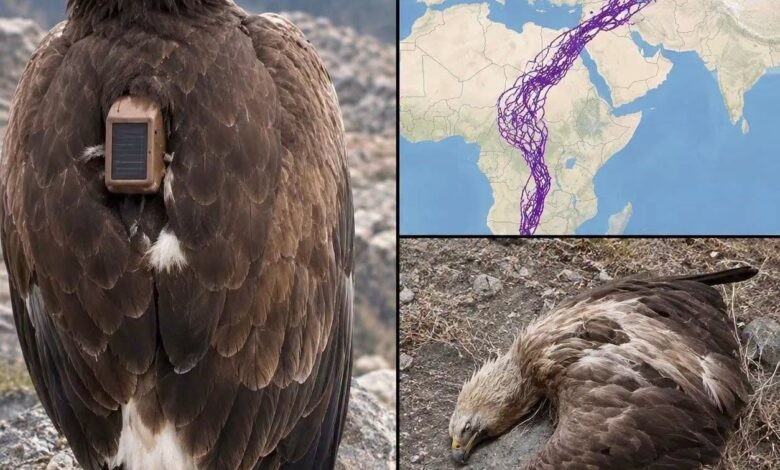
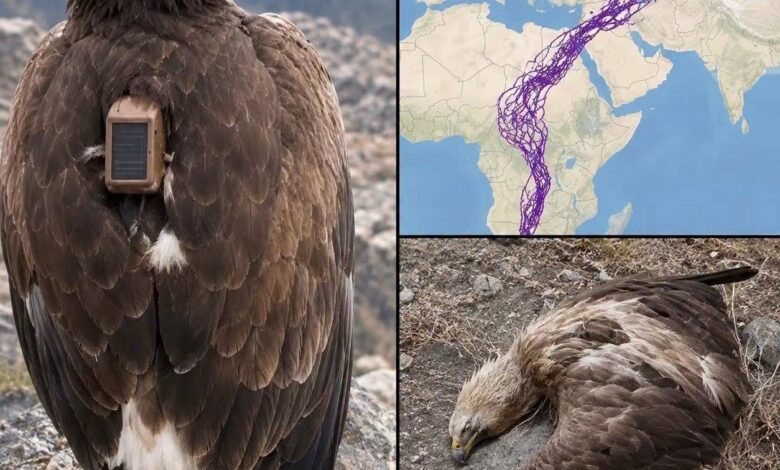
Editor’s note: The original account does not identify the eagle species, research institution, study authors, tracking programme, location, or peer-reviewed publication behind its central claim. As a result, the specific story of one GPS-equipped eagle being monitored continuously for 20 years cannot be independently verified from the information provided. However, long-term tracking of eagles and other migratory birds is an important and well-established field of research. Scientific studies show that birds of prey can alter their movements in response to weather, food availability, habitat conditions, age, and changing landscapes.
Why Eagle Migration Tracking Matters
Eagles are among the most closely watched migratory birds because they travel across large areas, often pass through several countries, and depend on habitats that may be vulnerable to development, disturbance, pollution, and climate change. Tracking their movements can help researchers identify breeding areas, wintering grounds, stopover sites, and migration bottlenecks where many birds gather.
GPS telemetry has transformed the study of raptors. Before satellite and GPS tags became widely available, scientists often relied on bird ringing, direct observation, and occasional recoveries of marked birds. Those methods remain useful, but they generally provide only a small number of locations. GPS tags can record repeated positions over days, months, or years, giving researchers a much clearer picture of how an individual bird uses the landscape.
Data from tagged eagles have helped conservationists understand issues such as collision risk near energy infrastructure, exposure to lead poisoning, loss of nesting habitat, and the importance of protected wetlands and mountain corridors. The technology also reveals that migration is not always a simple journey from one fixed point to another. Even within the same species, individual birds may use different routes or change their timing from year to year.
Can a GPS-Tagged Eagle Be Studied for Two Decades?
Long-term wildlife monitoring is possible, but a claim of uninterrupted GPS tracking over 20 years requires careful evidence. GPS devices need a source of power, and older battery-powered tags were not generally designed to transmit detailed locations continuously for decades. Some modern devices use solar panels, which can extend operational life when birds spend sufficient time in sunlight. Even so, equipment can fail, units can be damaged, data transmission can be interrupted, and a tag may eventually detach.
It is also important to distinguish between tracking a single bird continuously and conducting a research programme over 20 years. Many eagle projects operate over long periods by tagging multiple individuals across different seasons and generations. Such programmes can produce two decades of valuable data without meaning that one individual carried the same functioning GPS unit throughout the entire period.
The lifespan of an eagle varies by species and circumstances. Some large eagles can live for many years, particularly in captivity, while survival in the wild is affected by food supply, weather, disease, accidents, human activity, and other pressures. A long-lived individual could contribute significantly to a tracking study, but any exceptional claim should be supported by details from the scientists or organisation responsible for the work.
Why Bird Movements May Look Random at First
Maps of animal movement can be misleading when viewed without environmental context. A line between two GPS points may appear to show an unnecessary detour, a sudden reversal, or unexplained wandering. In reality, birds are making decisions within a changing environment. They may take advantage of wind, avoid dangerous weather, search for prey, rest, or respond to barriers such as deserts, open water, mountain ranges, or heavily altered farmland.
For soaring birds, including many eagles, atmospheric conditions are particularly important. These birds often use rising air, known as thermals, to gain altitude while reducing the energy required for flapping flight. Ridge lift, created when wind flows up a slope, can also support efficient travel. A route that seems longer on a map may be energetically cheaper if it follows areas with reliable uplift.
Weather may also force a bird to pause or change direction. Strong headwinds can increase the cost of migration, while storms and poor visibility may make travel unsafe or inefficient. Researchers studying raptor migration commonly compare tracking data with meteorological information to understand how wind direction, temperature, air pressure, and thermal conditions influence movement.
Food Availability Can Shape Eagle Routes
Eagles are predators and scavengers, and their movements are closely linked to access to food. The precise diet depends on the species and region. Some eagles hunt fish near lakes and coastlines, while others feed on mammals, birds, reptiles, carrion, or a combination of resources. Seasonal changes in prey abundance can influence where an individual stops, how long it remains in one place, and whether it returns to the same area in a later year.
A pause in an apparently unremarkable location may therefore have a practical explanation. A river valley, agricultural landscape, wetland, coastal area, or grassland may provide feeding opportunities that are not obvious from a broad-scale map. GPS points become much more informative when they are assessed alongside habitat maps, field observations, prey surveys, and local knowledge.
Scientists are cautious about assigning human-like motives to animal behavior. It is more accurate to say that eagles respond to cues in their environment than to claim that they “plan” routes in the same way people plan a journey. Yet the capacity to adjust movement in response to conditions is still highly significant. It can improve survival and reproductive success in an unpredictable world.
Migration Is Often Flexible, Not Fixed
Traditional descriptions of migration sometimes imply that birds follow one precise route every year. In practice, migration often combines inherited tendencies, learned behavior, local conditions, and individual experience. Young birds may explore more widely than experienced adults. Adults may return to familiar territories but still adjust their route or schedule when weather and food conditions differ.
Research on many migratory species has found that individual variation is normal. One eagle may cross a mountain pass, while another uses a nearby valley. A bird may leave its breeding area earlier in one year because of weather conditions, or remain longer if food is available. In some cases, a bird’s route becomes more consistent with age and experience. In others, flexibility remains an advantage.
This does not mean every unusual tracking record represents a mystery or a new discovery. Reliable interpretation requires enough locations, knowledge of the animal’s biology, and comparisons with environmental information. Researchers must also account for technical factors, including missed transmissions, inaccurate locations, and differences in the way devices collect data.
What Tracking Studies Tell Us About Climate and Habitat Change
Long-term datasets are increasingly valuable because the conditions encountered by migratory wildlife are changing. Rising temperatures, shifting rainfall patterns, drought, wildfires, land conversion, and changes in agricultural practices can affect food supplies and habitat quality. These pressures do not affect every species or region in the same way, but they can alter the timing and safety of migration.
Birds that can vary their routes, departure dates, or stopover choices may be better able to cope with some short-term changes. Flexibility, however, is not a guarantee of protection. A bird cannot easily adapt if critical habitat disappears across a large area, if prey declines severely, or if hazards increase along all available routes.
This is why conservation plans increasingly consider connected landscapes rather than isolated protected sites. An eagle may nest in one area, feed in another, migrate through several jurisdictions, and winter far from its breeding range. Effective protection can require cooperation among landowners, local communities, researchers, governments, and international conservation organisations.
How Eagle Tracking Supports Conservation
GPS data can identify locations where conservation action may have the greatest benefit. If many birds repeatedly pass through a narrow corridor, planners can assess potential risks from infrastructure and seek ways to reduce them. If tagged eagles repeatedly use a wetland or feeding area, that information may strengthen the case for habitat protection or restoration.
Tracking also supports efforts to understand mortality and threats. When a tag stops moving or shows an unusual pattern, researchers may be able to investigate, although a lack of transmissions alone does not prove what happened. The best studies combine telemetry with fieldwork, toxicology, nest monitoring, habitat assessment, and collaboration with wildlife authorities.
Responsible tracking programmes also consider animal welfare. Tags should be appropriately sized, carefully fitted, and used under permits and ethical procedures. The goal is to collect information that benefits conservation while minimising any impact on the bird. Scientific institutions typically review methods before fieldwork begins and report limitations alongside their findings.
How Readers Can Evaluate Viral Wildlife Claims
Wildlife stories can be compelling, especially when they describe extraordinary journeys or seemingly mysterious animal behavior. Before sharing such a claim, readers can look for the species name, the researchers involved, the institution leading the work, the country or region studied, and a link to a scientific paper, official report, or credible news coverage.
A trustworthy account should explain what was actually measured. Was the bird fitted with a GPS transmitter, a satellite tag, a radio transmitter, or a simple identifying ring? How long did the device function? Was one individual tracked, or were findings based on multiple birds? These details matter because they determine what conclusions can reasonably be drawn.
In the absence of verifiable information, it is best to treat dramatic claims with caution. The broader scientific lesson remains valuable: animal movement is often shaped by complex interactions between biology and environment. What looks unpredictable from a distance can reflect practical responses to wind, terrain, food, risk, and seasonal change.
The Bigger Lesson From Eagle Migration Research
Eagle tracking research offers a powerful reminder that migration is not merely a line on a map. It is a continuing process in which animals move through changing weather systems, habitats, and human landscapes. Modern technology allows scientists to observe this process with unprecedented detail, but interpreting the data still requires patience, field knowledge, and transparent evidence.
The unverified account of a single eagle tracked for 20 years should not be presented as established fact without a named source. Nevertheless, decades of credible research show that eagles and other raptors can display remarkable variation in movement and an ability to respond to environmental conditions. Understanding that flexibility is essential for protecting migratory birds in a rapidly changing world.
Sources
- BirdLife International — information on bird conservation and migratory species.
- IUCN Red List of Threatened Species — conservation status and species assessments.
- U.S. Geological Survey — wildlife telemetry research and methods.
- U.S. Fish and Wildlife Service — bird conservation, migration, and habitat information.
- Convention on the Conservation of Migratory Species of Wild Animals — international cooperation on migratory wildlife conservation.
- BBC Future — accessible reporting on science, wildlife, and environmental research.
Disclaimer: This content is intended for entertainment purposes only and is not based on real events.