Who else was obsessed with Cheers?

Cheers remains one of television’s most beloved sitcoms, a show that turned a Boston bar into a familiar gathering place for viewers around the world. For many fans, spending time with Sam Malone, Diane Chambers, Norm Peterson, Carla Tortelli, Frasier Crane, Woody Boyd, and the rest of the ensemble felt like dropping in on old friends. Decades after its original run, the series still attracts new audiences through streaming platforms such as Paramount+, where its humor and character-driven storytelling continue to hold up remarkably well.
Behind the easygoing laughs and witty banter, however, there is a rich production history filled with creative decisions, cultural impact, and personal stories that shaped the show’s legacy. From its unexpected ratings journey and its influence on real-world attitudes toward drinking and driving, to casting twists, set design quirks, and the enduring friendships between its stars, Cheers offers far more than meets the eye on a casual rewatch.
This article takes a closer, more analytical look at some of the most interesting, factual behind-the-scenes details about Cheers. Drawing on interviews, industry reports, and commentary from the show’s creators and cast, it explores how a single sitcom managed to leave a lasting mark on popular culture and television history.
Responsible drinking and the designated driver message
One of the most significant aspects of Cheers is how it handled alcohol use. Set almost entirely inside a bar, the show could easily have treated drinking as a purely comedic device. Instead, the writers and producers made a deliberate choice to avoid glamorizing dangerous behavior. From the beginning, they committed to never depicting a character leaving the bar intoxicated and then driving home.
This guideline might seem subtle, but it aligned closely with broader public awareness efforts in the 1980s and early 1990s about the dangers of drunk driving. Organizations and advocacy groups were working to change social norms, promoting the idea that friends should look out for one another and designate a sober driver for nights out. Cheers, with its large weekly audience on network television, offered a prominent platform to reinforce this idea in a non-preachy, story-driven way.
The show’s portrayal of bar culture emphasized conversation, community, and relationships rather than intoxication. Characters joked, debated, and shared their troubles over drinks, but the consequences of alcohol misuse were not played for laughs. This approach drew praise from anti–drunk driving organizations and public health advocates who saw it as a positive representation of more responsible social drinking.
The ethos on Cheers became part of a broader entertainment-industry collaboration in the United States. With support from the Writers Guild of America, television creators across multiple networks began integrating designated driver messages into storylines and dialogue.

According to accounts from the period, around 160 prime-time shows at one point incorporated references to designated drivers or responsible drinking. Collectively, this was estimated to amount to more than $100 million in donated airtime for public-interest messaging. While it is difficult to quantify the precise impact on behavior, public health experts have often cited such integrations as a helpful complement to formal campaigns and legal reforms aimed at reducing alcohol-related traffic fatalities.
Cheers therefore stands out not only as a comedy classic but also as a show that quietly contributed to a change in how mainstream audiences thought about drinking and driving, modeling safer norms within an entertaining context.
What was really in those beer mugs?
For a series set in a bar, Cheers naturally featured its cast constantly holding or sipping drinks. On camera, those frosty mugs and perfectly poured pints looked convincing, but the reality was much less appetizing for the actors.
Production teams on sitcoms typically avoid using real alcohol for practical and safety reasons, particularly during long days of filming multiple takes under bright studio lights. On Cheers, the bar taps were reported to be filled with a non-alcoholic, flat beer-like liquid. To create the illusion of fresh carbonation, the crew sometimes added a bit of salt to produce foam in the glasses when poured.
The result looked authentic on screen but was apparently far from refreshing. Cast members have described the prop drink as bland at best. Nevertheless, consistency was essential: maintaining continuity across scenes required the same visual appearance, so the team stuck with this solution throughout the show’s run.
From last place to number one in the ratings
Cheers is frequently cited in television history as a remarkable example of a show that overcame a rocky start to become a major hit. When the series premiered in 1982 on NBC, it did not immediately attract a large audience. In fact, on its first night it ranked 77th in the ratings, which at the time put it at the very bottom of the prime-time lineup.
However, strong critical reviews, support within the network, and the show’s growing reputation for smart writing and ensemble performances kept it on the air. Over time, word of mouth and repeated exposure helped audiences warm to the characters and the show’s gentle, character-driven humor. By its ninth season, Cheers had climbed all the way to number one in the ratings.
This trajectory—from “dead last” to the top spot—is often highlighted in media studies as an example of why networks sometimes benefit from giving shows time to find their footing. The case of Cheers demonstrates that immediate ratings success is not the only indicator of long-term potential, particularly for series that rely on ensemble chemistry and slow-building character relationships.
Kelsey Grammer’s challenges and professional resilience
Although Cheers generally maintained a light tone on screen, some of its cast members faced serious personal challenges away from the cameras. Kelsey Grammer, who joined the series as Dr. Frasier Crane, has publicly spoken over the years about his struggles with substance use and the personal traumas that contributed to them.
In interviews, Grammer has described using alcohol and cocaine during difficult periods of his life, including during his time on Cheers. Colleagues recalled that in the later years of the series he sometimes appeared withdrawn or exhausted between takes. Co-star Ted Danson has reflected candidly on that era, saying he confronted Grammer at one point but later wished he had done more to offer support as a friend.
Despite intervention attempts and professional pressures, Grammer’s full recovery took time. He has said that more sustained progress began during the early seasons of his spin-off series, Frasier, which debuted in 1993. Over the following decades he continued to work steadily, earning critical acclaim and multiple awards for his portrayal of the character in both series.
Grammer’s experience is often cited in discussions about the pressures of celebrity, mental health, and addiction in the entertainment industry. It also illustrates how long-running series can span significant chapters in their actors’ personal lives, sometimes intersecting with difficult periods that are not visible to viewers.
From barstools to best friends: Ted Danson and Woody Harrelson
One of the most enduring relationships to come out of Cheers is the friendship between Ted Danson (Sam Malone) and Woody Harrelson (Woody Boyd). Harrelson joined the cast in the fourth season, stepping into the role of an earnest Midwestern bartender who became an instant fan favorite.
According to stories shared by the actors, their first day together set the tone for a long-lasting bond. Harrelson has recounted a particularly eventful day early on in his time in Los Angeles, during which he experienced both a bar altercation and a car-related incident. Despite the chaotic introduction, colleagues quickly realized that behind his laid-back demeanor was a thoughtful and creative performer, interested in writing and theater as well as acting.

Behind the scenes, Danson reportedly advocated strongly for Harrelson to be cast as Woody Boyd. The role had originally been written and even tentatively associated with another performer, but when Harrelson auditioned, Danson found him more compelling and urged the producers to reconsider. The decision paid off, as Harrelson’s character became integral to the show’s later seasons.
The strength of their friendship became clear when NBC explored continuing Cheers with Harrelson’s character taking over the bar after Danson decided to leave the series. Harrelson declined the idea, indicating that he did not want to carry on without his co-star. Decades later, Danson and Harrelson remain close and have reunited professionally, including cohosting a podcast titled Where Everybody Knows Your Name, where they revisit memories and speak with former colleagues and friends.
The story behind Woody’s name and casting
Many viewers assume that the character Woody Boyd was named to match Woody Harrelson, but the timing actually went the other way around. According to the show’s creators, the name “Woody” and the concept of a naive, small-town farm boy were developed before casting began. The writers envisioned someone from the American Midwest—such as Iowa or Ohio—who would contrast with the more world-weary Boston regulars.
Harrelson, at that point relatively unknown, was not initially interested in doing television and had not been a viewer of Cheers. A friend reportedly encouraged him to audition. The casting team had already auditioned another actor who fit the creative brief very closely and even believed they had found their Woody. That actor was so confident in the opportunity that, according to producer anecdotes, he made major life decisions assuming the role was his.
Then casting director Steve Kozak brought in Harrelson to read. While the earlier candidate matched every requirement “on paper,” Harrelson brought something extra—a slightly unpredictable, layered quality that intrigued the producers. Ted Danson, after seeing Harrelson’s audition, argued passionately that this new performer would make the character more interesting and give the show additional depth. The creative team ultimately agreed, and Harrelson was cast, turning what could have been a straightforward “farm boy” role into a character with more nuance and charm.
Ted Danson’s carefully managed hairline
Sam Malone’s appearance was central to his character: a former professional baseball player turned bartender, proud of his looks and personal style. One of the most noticeable elements was his thick, well-styled hair, which became almost as recognizable as his catchphrases.

In reality, Ted Danson was already experiencing thinning hair during the run of Cheers. To maintain the illusion of a full head of hair for a character who was written as particularly image-conscious, Danson relied on a carefully crafted hairpiece that covered the balding area on the crown of his head. The styling team blended his natural hair with the piece to create the seamless on-screen look audiences remember.
Over time, Danson has spoken openly and humorously about this aspect of his appearance, offering a reminder that many seemingly effortless elements of television characters—wardrobe, hair, makeup—are the result of deliberate behind-the-scenes work.
Hiding Shelley Long’s pregnancy on screen
Shelley Long’s portrayal of Diane Chambers was crucial to Cheers in its early seasons. Her character—an intellectual, idealistic former graduate student drawn into the world of a neighborhood bar—created a dynamic contrast with Sam Malone and the regulars. The push-and-pull of Sam and Diane’s relationship became one of the show’s defining storylines.
Originally, Long did not plan a long tenure on the series; her early contracts were relatively short, and she had other career ambitions. Nonetheless, Diane quickly became central to the ensemble. This made production logistics especially important when Long became pregnant during the third season, at the same time that Rhea Perlman (Carla Tortelli) was also expecting.
Perlman’s pregnancy was written into the show, fitting naturally with Carla’s already-established life as a mother of several children. Long’s pregnancy, on the other hand, was kept off-screen. To conceal it, directors and camera operators used classic television techniques: placing Long behind the bar, seating her at desks, and blocking shots so that objects or the bar top obscured her midsection. Viewers rewatching season three with this knowledge can often spot how carefully scenes were staged.
Set quirks: the moving bathrooms
Even meticulously planned productions have continuity slips, and Cheers is no exception. Attentive fans have noticed that the signs for the men’s and women’s bathrooms sometimes appear to “switch places” over the course of the series. In some episodes, the women’s restroom door seems closer to the main bar area, while in others the men’s room appears in that spot, with the opposite sign farther down the hallway by the pool room.
There is no in-story explanation for such a renovation, so the most likely reason is simple production oversight. Sets on soundstages are occasionally adjusted, rebuilt, or re-dressed between seasons or even episodes. In this case, prop signage may have been swapped inadvertently or placed differently for specific camera setups. The inconsistency did not affect the storytelling, but it has become a small curiosity for dedicated viewers who enjoy examining continuity details.
A curtain cameo in season two
Another small but memorable production quirk appears late in the second season of Cheers. In wide shots that pan out from Norm’s familiar spot at the bar, viewers can sometimes see a curtain just at the edge of the frame on the left-hand side. The curtain is likely part of the soundstage, marking off an area behind the main set that the cameras normally avoid.
Given the production schedules of multi-camera sitcoms, such details occasionally slip by unnoticed during both filming and editing, especially when they do not interfere with the actors or major visual elements. Many viewers at the time probably never saw the curtain or simply ignored it, focusing instead on the dialogue and performances. In the era of streaming and high-definition re-releases, however, these small artifacts have become easier to spot for fans who enjoy frame-by-frame observations.
“One Last Fling” and real-life events
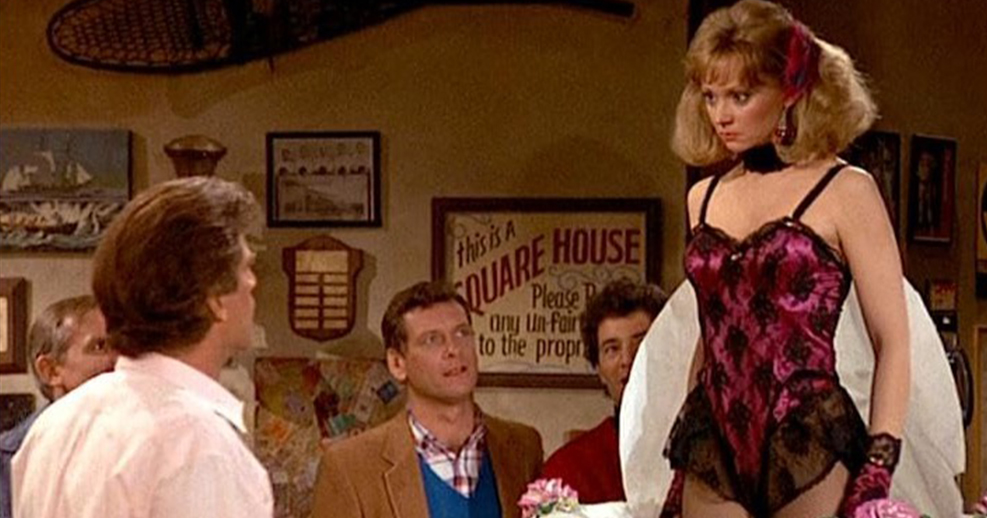
The season five episode “One Last Fling” is a good example of how Cheers sometimes wove real-life circumstances into its storytelling. Directed by James Burrows, a key creative force behind the series, the episode features a memorable sequence involving Sam’s bachelor party and an elaborate cake surprise involving Diane.
At the beginning of the episode, Frasier walks into the bar and notices that Woody has his arm in a cast. The character offers a humorous, meandering explanation about how he was injured. In reality, the cast reflected an actual accident: Woody Harrelson had hurt his arm when his car flipped during a practice drive for the Pro-Celebrity preliminary of the Toyota Grand Prix in 1987. Rather than hiding the injury, the writers chose to incorporate it into the episode’s narrative.
As the story unfolds, the bar regulars plan a typical sitcom-style bachelor party for Sam, including the idea—proposed by Cliff—of having a woman pop out of a giant cake. In a twist, Diane decides to be the one inside the cake, leading to an episode centered once again on the complex dynamics between Sam and Diane.
Tension arises when Sam, wearing a headpiece during the episode, makes a comment while Diane is hidden inside the cake, prompting her to challenge him to 24 hours of “uninhibited fun” before their marriage. The story explores trust, insecurity, and the characters’ differing expectations for their future. By the end, Sam admits he did not take advantage of the supposed freedom, only to learn that Diane had been observing him as well.
The episode is often praised for blending broad comedy with character insight. It also highlights how crucial Shelley Long’s presence was to the show’s early identity. Her performance as Diane brought a distinctive energy that many critics and colleagues have compared to classic television leads from earlier eras.
Ted Danson has publicly acknowledged Long’s contribution, noting that she arrived fully formed in the role from the pilot onward and gave Cheers a significant boost in its formative years. The Sam-and-Diane dynamic helped draw attention to the show and established character-based storytelling patterns that sustained later seasons even after Long’s departure.
The lasting legacy of Cheers
More than four decades after its debut, Cheers remains a touchstone in television comedy. Its influence can be seen in subsequent ensemble sitcoms set in workplaces or gathering places—such as bars, cafes, and offices—where the central appeal lies in watching a familiar group of characters navigate everyday life together.
The show’s commitment to consistent character development, its balance of humor and warmth, and its subtle engagement with social issues like responsible drinking helped it resonate across multiple generations. Behind-the-scenes stories about casting decisions, set design quirks, and the personal journeys of its actors add further depth for modern viewers revisiting the series.
Whether a fan’s favorite character is Sam, Diane, Carla, Norm, Cliff, Frasier, or Woody, the continued interest in Cheers reflects how well-crafted television can remain meaningful long after the final episode airs. For many, stepping back into that Boston bar—where “everybody knows your name”—still feels like coming home.
Sources
Disclaimer: This content is intended for entertainment purposes only and is not based on real events.