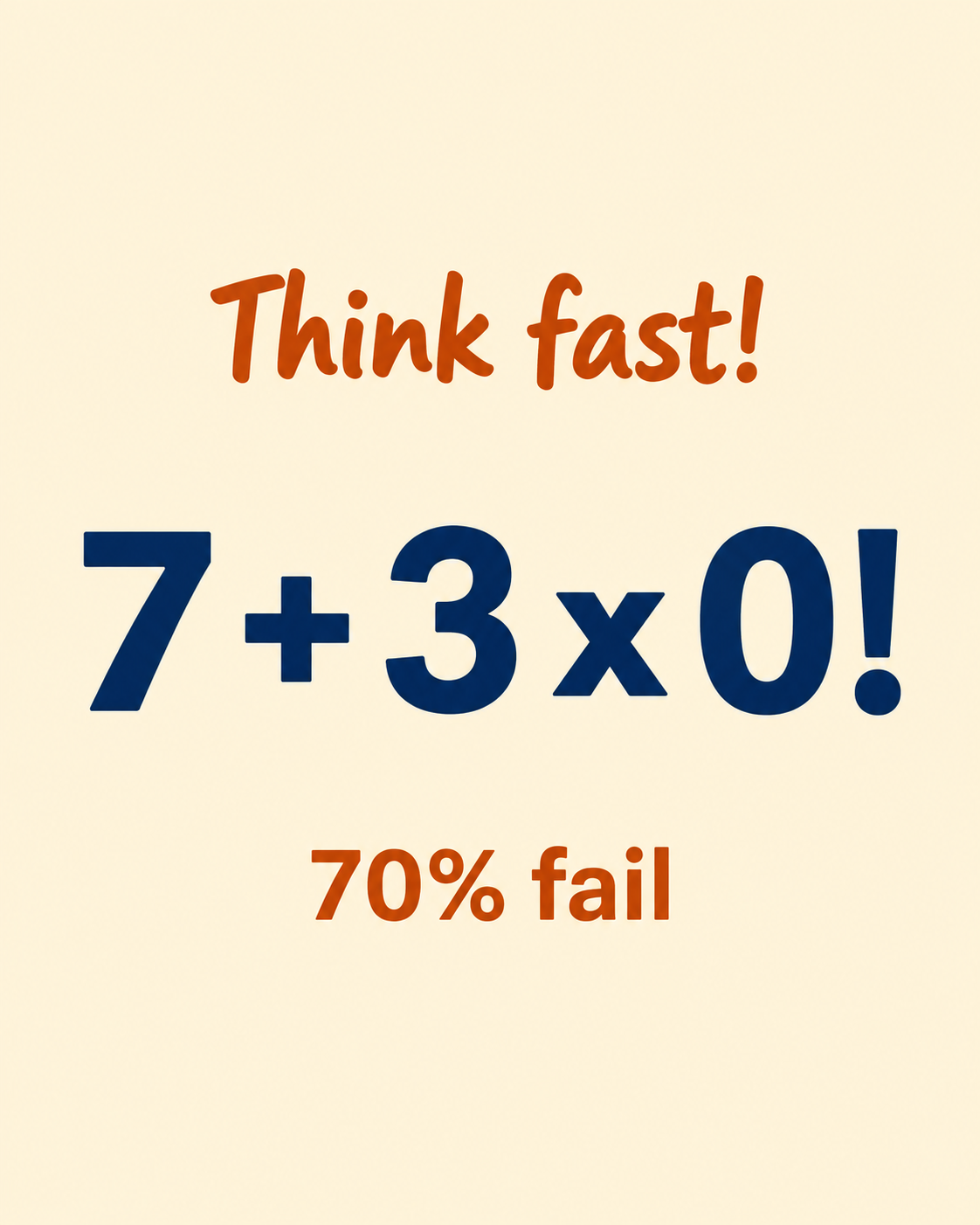
This Simple Math Puzzle Tricks Many: The Zero Factorial Surprise
At first glance, some math puzzles look almost too easy—just a few familiar numbers and symbols arranged in a way that seems straightforward. But sometimes, as in the case of the equation 7 + 3 × 0!, a small mathematical twist can catch even careful thinkers off guard. This seemingly simple problem highlights a lesser-known quirk of arithmetic that can trip up even seasoned problem-solvers. In this article, we’ll explore the details behind this puzzle, explain the logic step by step, and dive into the mathematical history and significance of the often-overlooked factorial function with zero.
Let’s take a closer look at exactly how this puzzle tricks so many—and why knowing your basics is key to solving it.
The Math Puzzle: First Impressions
Presented with the equation 7 + 3 × 0!, many people instantly notice the zero and fall back on familiar arithmetic rules. Since multiplying any number by zero always gives zero in standard mathematics, it’s easy to believe the solution is simply:
- 3 × 0 = 0
- 7 + 0 = 7
So, it seems the answer must be 7. Yet, that quick reaction—while logical in many situations—is precisely how this puzzle is designed to confuse.

The Hidden Twist: What Does the Exclamation Mark Mean?
The subtle trick is that the equation is not simply 3 × 0. Instead, it is 3 × 0!, and that little exclamation mark packs a lot of mathematical meaning. In mathematics, the exclamation mark denotes the factorial operation. Factorials are a foundational concept, especially in probability, statistics, and combinatorics.
Understanding Factorials
The factorial of a whole number n (written as n!) is defined as the product of all positive integers less than or equal to n. For example:
- 3! = 3 × 2 × 1 = 6
- 4! = 4 × 3 × 2 × 1 = 24
- 1! = 1
But what about 0!? While it might seem counterintuitive, the factorial of zero is defined as 1. This definition is crucial in many branches of mathematics, including combinatorics (where it ensures consistency in formulas for selecting objects) and algebra.
Why Is 0! Defined as 1?
Mathematically, there are two major reasons why 0! = 1:
-
Combinatorial Reason:
Suppose you have zero objects; in how many ways can you arrange them? There is exactly one way—to do nothing. This reasoning ensures continuity in permutation formulas:
n! = n × (n-1) × (n-2) × … × 1
so, 1! = 1 and 0! = 1 by definition. -
Mathematical Consistency:
Many formulas in algebra and calculus use factorials, and defining 0! as 1 helps avoid exceptions that would otherwise complicate the mathematics. For example, the binomial coefficient formula
C(n, k) = n! / [k! × (n-k)!]
works seamlessly if 0! = 1.
Both the combinatorial and mathematical conventions point toward the same result: 0! = 1.
Solving the Puzzle Correctly: Order of Operations
Armed with this knowledge, let’s return to the puzzle: 7 + 3 × 0!
- First, evaluate 0!:
0! = 1 - Next, according to the rules of arithmetic (order of operations, often remembered by the acronym PEMDAS/BODMAS: Parentheses/Brackets, Exponents/Orders, Multiplication/Division, Addition/Subtraction), multiplication comes before addition:
3 × 0! = 3 × 1 = 3 - Finally, add that result to 7:
7 + 3 = 10
Thus, the correct answer is 10. The true complexity of this puzzle lies not in difficult multiplication, but in recognizing the special meaning of the factorial symbol. Even a small mark can radically alter the calculation.
Why This Puzzle Stumps So Many: Common Psychological Pitfalls
Psychologists and educators note that such math puzzles often trip people up because of “pattern recognition” and “heuristics”—mental shortcuts we use to solve everyday problems quickly. When scanning a math question, most people see the zero and recall the rule that “anything times zero is zero.” But by working too quickly, they overlook the special meaning of symbols they might not expect, such as the factorial sign.
This kind of oversight illustrates the value of reading mathematical expressions carefully. As math experts advise, always “slow down and look for every clue” before making assumptions.
Factorials in Real Life: Where Do We Use Them?
The factorial function plays a crucial role in various mathematical and scientific contexts, such as:
- Combinatorics: Calculating permutations and combinations. For example, the number of different ways to arrange n distinct objects is n! (factorials everywhere!).
- Probability and Statistics: Factorials appear in the formulas for probabilities, such as the binomial probability formula and the Poisson distribution.
- Algebra and Calculus: Factorials are involved in binomial expansions, Taylor series approximations, and many recurrence relations in higher mathematics.
- Computer Science: Many algorithms involve factorial calculations, particularly in recursion, enumeration problems, and combinatorial optimization.
The Historical Roots of Factorials and Zero Factorial
The factorial notation (!) was introduced in the 19th century by Christian Kramp, although factorial concepts had been used previously. Its wide adoption standardized permutations and combinations in mathematics.
The definition 0! = 1 dates from the early study of combinatorial mathematics, a field concerned with counting arrangements of objects. Mathematicians like Isaac Newton and James Stirling used “empty product” conventions (the value of a product with no elements) to reach this definition, which remains a cornerstone in mathematical consistency today.
Global Perspectives: Math Literacy and Puzzle Popularity
Math puzzles such as the “zero factorial” question circulate widely in schools and online forums worldwide. They serve as excellent tools for teaching the importance of mathematical notation and the order of operations. Many math educators use similar puzzles to emphasize careful attention to mathematical symbols, encouraging students not just to memorize rules but to truly understand them. Around the globe, these small brain teasers continue to stimulate curiosity and spark mathematical debates, demonstrating that sometimes it’s the smallest symbols that cause the biggest surprises.
Expert Opinions: The Importance of Mathematical Rigor
Experts in mathematics and education stress that puzzles like this highlight critical thinking and attention to detail. According to mathematical pedagogues and university lecturers, many students develop a much deeper understanding of arithmetic and algebra by grappling with these “trick” questions. Professor Ian Stewart, a prominent British mathematician, often emphasizes in his popular science books that “mathematics is not just about getting answers, but about understanding rules and definitions.”
This view is echoed in textbooks and math curriculums endorsed by educational authorities in Europe, Asia, and North America alike, underlining that proper mathematical reasoning forms the basis for success in advanced mathematics, data science, and engineering careers.
Lessons Learned: Attention to Detail in Mathematics
If you originally thought the answer to 7 + 3 × 0! was 7, you are in good company. Many well-meaning test-takers overlook the factorial sign, proving that mathematical literacy depends as much on attention to notation as it does on memorizing operations. This puzzle demonstrates the importance of reading, interpreting, and applying rules precisely.
So, the next time you encounter a deceptively simple math question, pause and consider whether there’s a subtle twist in the phrasing or symbols—a single mark could change everything.
Conclusion: The Value of Math Puzzles in Everyday Learning
Beyond the technical solution, the “zero factorial” puzzle serves as an excellent reminder of the beauty and subtlety of mathematical language. These types of challenges encourage learners of all ages to embrace curiosity, deepen their conceptual understanding, and enjoy the process of problem-solving. As mathematics continues to underpin modern science, technology, and daily problem-solving, nurturing close attention and analytical thinking remains more important than ever.
The correct answer to the puzzle is: 10
Sources
Disclaimer: This content is intended for entertainment purposes only and is not based on real events.