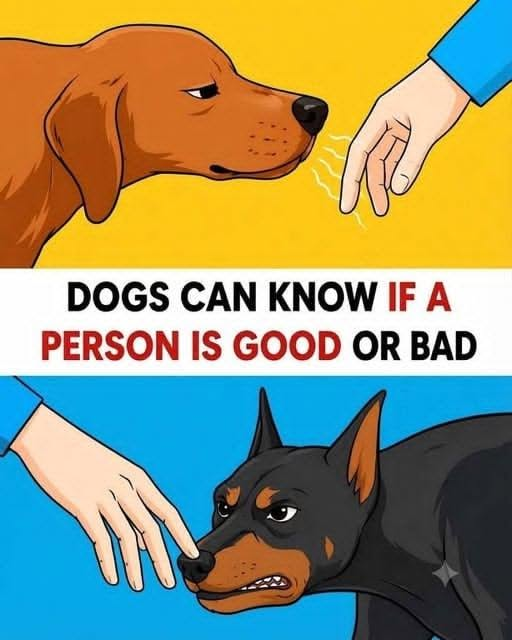
The Canine Oracle Unveiling the Ancient Mystery of How Dogs Read Human Souls
Since the dawn of human civilization, as the glow of the first campfires pushed back the terrifying darkness of the wild, the dog has sat faithfully by our side. They have shared our hearths, guarded our children, and walked beside us through the endless march of centuries. Because of this profound and unbroken companionship, it is entirely natural that we have come to view our canine friends as extensions of our own intuition. Every dog owner has experienced that sudden, spine-tingling moment of behavioral dissonance. You are walking down a sunlit street, and your dog wags its tail joyfully at a passing stranger. Minutes later, another individual approaches, and your dog stiffens, the hair on its spine rising in a ridge of primal warning, followed by a low, rumbling growl. In these sudden shifts of temperament, it is incredibly easy to believe that they are looking right past the physical form and peering directly into the human soul. We wonder if they can sense a fundamentally “good” or “bad” person. We desperately want them to be our moral compasses, offering a sign from nature that we can implicitly trust. Yet, the true mechanism behind your dog’s sudden unease is not a matter of supernatural morality; it is a masterpiece of biological and psychological observation.
Guardians of the Threshold and the Folklore of Fangs
To understand our deep-seated desire to view dogs as moral arbiters, we must look backward into the rich, atmospheric tapestry of human folklore and mythology. Across almost every ancient culture, the dog has been revered as a liminal creature, a guardian standing watchful at the threshold between the known world and the mysterious unknown. In ancient Egyptian cosmology, the jackal-headed god Anubis carefully weighed the hearts of the deceased, determining their spiritual worth and guiding their souls into the afterlife. In Greek mythology, the multi-headed hound Cerberus stood eternally at the gates of the underworld, his senses attuned to the subtle differences between the living and the dead. The ancient Celts whispered tales of the Cù Sìth, a mythical fairy dog that roamed the misty Scottish highlands, believed to possess the profound ability to sense impending doom and cross the boundaries of the mortal realm.
These enduring myths were not born from mere imagination; they were humanity’s early, poetic attempts to explain the undeniable sensory superiority of the canine species. When an ancient hunter watched his dog stare intently into an empty forest, growling at a threat the human eye could not perceive, it was entirely logical to conclude that the animal was interacting with spirits or sensing invisible malevolence. We have inherited this historical imagination. Today, when our modern dogs bark furiously at a delivery driver or shrink away from a well-meaning neighbor, our minds instinctively reach back to those ancient stories. We assume the dog has detected a shadow on the person’s soul, an invisible aura of bad intentions. We romanticize their fear, transforming a biological reaction into a profound, mystical judgment.
The Alchemy of Scent and the Invisible Landscape of Emotion
While the folklore of the spirit-seeing hound is beautifully romantic, the scientific reality of how dogs perceive the world is arguably even more magical. Dogs do not see “good guys” and “bad guys” in the complex, philosophical way that humans do; they read signals, not souls. The most powerful tool in their interpretive arsenal is their extraordinary sense of smell. A dog’s olfactory system is a marvel of evolutionary engineering, possessing hundreds of millions of scent receptors compared to our meager few million. They do not merely smell the world; they experience it in a vivid, three-dimensional tapestry of chemical information.
When a human being experiences a strong emotion, our bodies undergo rapid, involuntary physiological changes. Fear, anger, anxiety, and aggression trigger the release of a complex cocktail of hormones, including adrenaline and cortisol. We begin to sweat slightly, our heart rate elevates, and our body temperature subtly shifts. To a human, a person harboring bad intentions or nursing a hidden anger might simply look like an ordinary pedestrian. To a dog, that person is projecting a loud, undeniable cloud of chemical distress. The dog is not passing a moral sentence upon the stranger’s character; rather, the dog is interpreting an overwhelming wave of biological data. If a person approaches with a high heart rate and a surge of adrenaline, the dog reads this invisible aura of tension and reacts accordingly. They are sensing stress and unpredictability, which their primal instincts naturally translate into a potential threat to their pack.
The Silent Symphony of Movement and Posture
Beyond the invisible world of scent, dogs are the undisputed apex observers of the physical realm. Over thousands of years of domestication, they have evolved to study human body language with a microscopic, almost obsessive intensity. Our survival as a species has relied heavily on verbal communication, leading us to largely ignore the subtle physical cues we constantly project. Dogs, entirely devoid of spoken language, rely exclusively on the silent symphony of movement, posture, and spatial pressure.
Consider the casual approach of a stranger on the sidewalk. A person who is feeling tense, hurried, or aggressive will walk with a rigid gait, their shoulders tight and their jaw set. They might make direct, unblinking eye contact, or take a sudden, quick step forward. In the primate world of humans, direct eye contact and walking straight toward someone is often just a sign of focus or confidence. In the canine world, a looming body, a stiff posture, and prolonged eye contact are the universal, undeniable signals of a challenge. Conversely, slow movements, a relaxed physical form, slightly averted eyes, and softer vocal tones signal safety and submission. To a dog, these physical differences are incredibly loud, even when the humans involved barely register them. When your dog barks furiously at someone who appears perfectly normal to you, they are likely reacting to micro-expressions, a heavy footstep, or a subtle tension in the stranger’s posture that you have completely missed.
Echoes of the Past and the Shadows of Memory
While biology and observation play crucial roles, the deepest mysteries of a dog’s reaction lie within the vast, subjective landscape of their memory. A dog’s past experiences shape entirely how they interpret the present moment. Their minds operate on a system of intense associative learning, where a single, profound event can permanently color their perception of the world. This is particularly true for rescued dogs, whose early chapters are often written in the shadows of neglect or fear.
One harsh encounter in a dog’s youth can turn a completely innocuous trait into a blaring warning siren. If a dog was once frightened or harmed by someone wearing a wide-brimmed hat, smelling of a specific cologne, or speaking with a deep, booming voice, that dog will carry the echo of that trauma forward. When a perfectly harmless, wonderful person approaches wearing a similar hat or carrying a similar scent, the dog does not see a new friend; they see the ghost of their past fear. They will tremble, hide, or bark aggressively, entirely convinced that danger has returned. This is why a dog might inexplicably hate your kind-hearted uncle but gleefully approach a stranger who, to you, looks untrustworthy. Their fear is profoundly subjective, anchored not in the objective morality of the person standing before them, but in the complex, hidden diary of the dog’s own lived experience.
The Mirror of Empathy and Social Eavesdropping
Despite their lack of human morality, there is a fascinating layer of social intelligence in dogs that borders on ethical judgment. Recent scientific research has explored a phenomenon known as “social eavesdropping.” Studies have shown that dogs actively watch how humans interact with one another, particularly focusing on how strangers treat their beloved owners. In various experiments, researchers had dog owners struggle to open a container while a stranger sat nearby. If the stranger refused to help or acted aggressively toward the owner, the observing dog would subsequently refuse to accept a treat from that stranger.
These studies reveal a breathtaking level of social awareness. Dogs can indeed notice who helps and who hinders their family. They are fiercely protective of their pack’s cohesion and well-being. However, this is still rooted in survival and allegiance rather than a philosophical understanding of good and evil. A dog can absolutely adore an untrustworthy con artist if that person brings them high-value treats and speaks in a soothing voice, just as they can be terrified of a saintly pediatrician who moves too quickly and smells of sterile rubbing alcohol. They reflect the energy and the immediate social dynamics of the room, acting as highly sensitive emotional barometers rather than infallible lie detectors.

Honoring the Intuition Without Assigning Guilt
When we strip away the ancient folklore and the romanticized myths, what remains is something far more profound and beautiful than a simple parlor trick of reading souls. The dog’s ability to navigate the human world is a testament to their incredible empathy, their razor-sharp senses, and their unwavering dedication to their pack. When your dog reacts strongly to a stranger, it is vital to listen to them, but it is equally important not to rush to a definitive, moral judgment.
If the leash pulls tight and the hackles rise, do not immediately brand the approaching stranger as a villain harboring dark secrets. Instead, honor your dog’s discomfort in that specific moment. Acknowledge that they are experiencing a sensory overload of tension, unfamiliar scents, or triggering memories. Create physical distance, offer quiet reassurance, and observe the situation with a calm mind. They are not acting as judges passing a moral sentence; they are simply acting as faithful messengers, desperately trying to tell you exactly how the moment feels inside their skin. By understanding the complex symphony of scent, memory, and motion that guides them, we can deepen our bond with these magnificent creatures, respecting the unique and mysterious way they walk through the world beside us.
Have you ever experienced a moment where your pet reacted inexplicably to a specific person or environment?