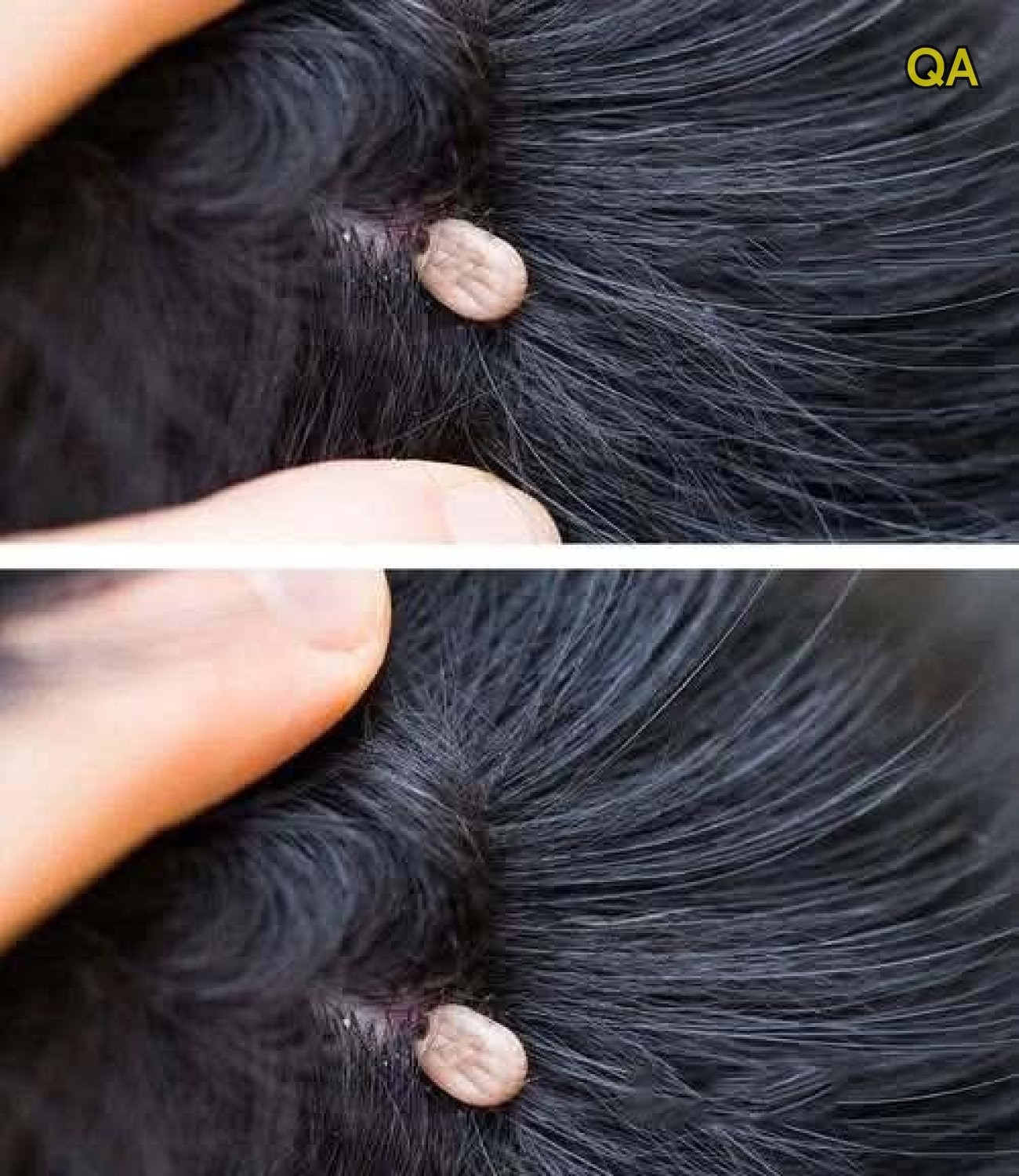
A parent running their fingers through a child’s hair usually expects to find nothing more serious than a tangle, a bit of grass, or perhaps a forgotten crumb from an afternoon snack.
But sometimes, the fingers stop.
There, close to the scalp, is a small, unusual object that seems firmly attached to the skin. It may be round, pale, grayish, or swollen, and it may not look like an insect at all. For a parent, the discovery can immediately create a wave of questions.
What is it? How long has it been there? How did it get there? And most importantly, what should happen next?
One possible explanation is a tick. Ticks can attach themselves to people and animals after outdoor exposure, and because some are extremely small, they can remain unnoticed for a considerable period. Once attached and feeding, their bodies can become noticeably larger, making them easier to spot.
Understanding what ticks look like, where they commonly attach, and how families can reduce exposure can help turn a frightening discovery into a manageable situation.
What Does a Tick in a Child’s Hair Look Like?
Ticks can look very different depending on their species, life stage, and whether they have recently fed.
Before attachment, many ticks are small and relatively flat. Some can be difficult to distinguish from tiny bits of dirt or other particles. After feeding, however, their bodies may expand considerably and become more rounded.
This change can make an attached tick appear surprisingly different from the image many people have in their minds.
A parent may notice something resembling a small gray or brown oval attached directly to the scalp. Unlike ordinary debris, it generally does not brush away easily because the tick has attached itself to the skin.
The appearance alone, however, is not enough to identify a tick with certainty. Other skin growths, particles, or small insects can sometimes look similar.
When there is uncertainty, a healthcare professional or another qualified source can help confirm what has been found.
Why Can Ticks Be Difficult to Notice?
One reason tick encounters can be surprising is that attachment does not always produce an immediate noticeable sensation.
Ticks can attach to areas of exposed skin and remain there without attracting much attention. Children may also be distracted while playing outdoors and may not notice a small tick among their hair.
The scalp can be particularly difficult to inspect because hair provides additional places for a tick to remain hidden.
Ticks may also be found around the hairline, behind the ears, or on the neck. These areas can be easy to overlook during a quick inspection.
This is why a careful check after outdoor activities can be useful, particularly when children have spent time around tall grass, wooded areas, brush, or places where ticks are known to occur.
How Do Children Encounter Ticks?
Ticks do not typically jump or fly toward people. Instead, they can attach when a person brushes against vegetation or another surface where a tick is present.
A child playing in grass, walking through wooded areas, exploring a garden, or spending time around outdoor animals may encounter ticks without realizing it.
Pets can also be relevant because dogs and other animals may carry ticks indoors after spending time outside.
This does not mean that every outdoor activity results in tick exposure. Millions of children spend time outdoors without encountering one.
However, understanding where exposure can occur helps families make sensible decisions about outdoor awareness.

Why Does an Engorged Tick Look So Different?
One of the most confusing aspects of finding a tick is the difference between its appearance before and after feeding.
A tick that has recently attached may be relatively small and difficult to see. As it feeds, its body can gradually expand.
The result can be a rounded, swollen appearance that makes the creature look almost like a small object attached to the skin.
This is why someone seeing an engorged tick for the first time may not immediately recognize it.
The size of the tick can also vary significantly depending on the species and stage of its life cycle. Therefore, appearance alone should not be used to determine exactly how long it has been attached.
Why the Scalp Deserves Extra Attention
The scalp can be an easy area to overlook during a quick tick check.
Hair can conceal small insects, particularly when the hair is thick or long. A tick may not become obvious until someone parts the hair carefully and examines the skin underneath.
Parents can pay particular attention to areas around the ears, hairline, and neck after children have spent time outdoors.
A routine check does not need to become an elaborate process. The goal is simply to become familiar with the child’s skin and notice anything unusual.
Regular awareness can make it easier to recognize a new attachment or unfamiliar mark.
Does Finding a Tick Mean a Child Will Become Ill?
Finding a tick does not automatically mean that a child will develop an illness.
Ticks are associated with a number of diseases, but the actual risk depends on several factors, including the species involved, geographic location, duration of attachment, and whether the tick was carrying a particular microorganism.
This distinction is important because discovering a tick can understandably cause anxiety.
Parents should avoid assuming the worst based solely on the presence of an attached tick.
Instead, the situation should be assessed carefully, and medical advice should be sought when appropriate.
Organizations such as the Centers for Disease Control and Prevention provide information about ticks, tickborne diseases, prevention, and what to do after a tick bite.
What Should Parents Do After Finding a Tick?
If a tick appears to be attached to a child’s skin, parents should avoid relying on unverified home remedies or internet suggestions.
The CDC recommends removing an attached tick promptly with fine-tipped tweezers. The tick should be grasped as close to the skin’s surface as possible and pulled upward with steady pressure.
After removal, the area and hands can be cleaned.
If the tick is difficult to remove, is embedded in a sensitive location, or the parent is uncertain about what they are seeing, contacting a healthcare professional can provide additional guidance.
For children, parents may understandably prefer professional assistance when they are uncomfortable handling the situation themselves.
What About Saving the Tick?
In some circumstances, a healthcare professional may recommend keeping information about the tick for identification.
The CDC notes that testing individual ticks for pathogens is generally not recommended as a way to determine whether a person will become ill.
Instead, healthcare decisions are usually based on factors such as symptoms, exposure circumstances, geographic location, and the type of tick involved.
If parents are concerned, they can ask a healthcare professional what information would be useful to retain.
Taking a clear photograph before removal may also help with identification in some situations, although a photograph cannot always provide a definitive answer.
What Symptoms Should Parents Watch For?
After a tick encounter, parents should pay attention to changes in their child’s health.
Depending on the type of tick and the illness involved, symptoms can include fever, headache, tiredness, muscle aches, or changes around the bite area.
Not every child will experience symptoms, and the timing can vary.
This is one reason it is helpful to remember when and where the tick exposure occurred.
If a child develops concerning symptoms following a tick bite, parents should contact a healthcare professional and mention the recent exposure.
Prompt communication can help clinicians decide whether further evaluation is appropriate.
How Can Families Reduce Tick Exposure?
Prevention begins with awareness of where ticks are commonly found.
When children spend time in wooded or grassy areas, families can take practical steps to reduce exposure.
Longer clothing can provide additional coverage, while insect repellents approved for the intended use can offer another layer of protection when used according to their labels.
After outdoor activities, families can check clothing, shoes, hair, and exposed skin.
A shower after returning indoors can also be useful as part of a routine outdoor hygiene practice.
Clothing can be checked carefully, and outdoor gear should not simply be left in piles where ticks could potentially remain unnoticed.
Don’t Forget to Check Pets
Dogs and other household pets can encounter ticks outdoors.
For this reason, regular pet checks can be an important part of a family’s overall tick awareness.
Pet owners should follow veterinary guidance regarding tick prevention products and routine examinations.
Checking a pet after outdoor activities can also reduce the possibility of an unnoticed tick being carried into the home.
The goal is not to eliminate every outdoor risk but to reduce unnecessary exposure through simple habits.
Why Parents Often Feel Guilty
Discovering a tick on a child can sometimes make parents wonder whether they should have noticed it sooner.
That reaction is understandable, but it is important to remember that ticks can be extremely difficult to detect.
A parent can conduct regular checks and still occasionally discover one later than expected.
Children move quickly, spend time outdoors, and may not notice something as small as a tick.
The discovery should therefore be viewed as an opportunity to respond appropriately rather than as evidence that someone failed to provide adequate care.
Turning an Unexpected Discovery Into a Learning Opportunity
A tick found in a child’s hair can be an unsettling discovery, particularly when the creature has become swollen and difficult to recognize.
Yet understanding the biology behind the appearance can make the situation considerably less mysterious.
Ticks can change in appearance as they feed, can remain hidden among hair, and can attach without immediately attracting attention.
That knowledge can help families recognize potential exposure and develop sensible checking habits.
The experience can also encourage children to become more aware of nature.
Outdoor environments contain countless small organisms, most of which never cause a problem. Learning to recognize potential hazards allows children and parents to enjoy outdoor activities while remaining appropriately cautious.
Final Thoughts
Finding an unfamiliar, rounded object attached to a child’s scalp can turn an ordinary moment into an immediate source of concern. When that object turns out to be a tick, understanding what it is and how ticks behave can replace some of the uncertainty with practical knowledge.
Ticks can be difficult to notice, particularly when they are hidden in hair. Their appearance may also change considerably after feeding, which can make identification confusing.
The most useful response is not panic but awareness. Families can learn where ticks are commonly encountered, check children and pets after outdoor activities, follow reliable removal guidance, and contact a healthcare professional when concerns arise.
Most importantly, parents should remember that an unexpected tick encounter does not automatically mean that a child will become ill. The circumstances surrounding the exposure matter, and reliable medical guidance is more useful than assumptions based on appearance alone.
A tiny discovery in a child’s hair may initially create a rush of fear and confusion. But with accurate information, it can become a reminder of something much more positive: curiosity, preparedness, and the importance of understanding the natural world around us.
Sources
Centers for Disease Control and Prevention, About Ticks and Tickborne Diseases.
Centers for Disease Control and Prevention, What to Do After a Tick Bite.
U.S. Environmental Protection Agency, Repellents: Protection Against Mosquitoes, Ticks and Other Arthropods.
Mayo Clinic, Tick bites: First aid.