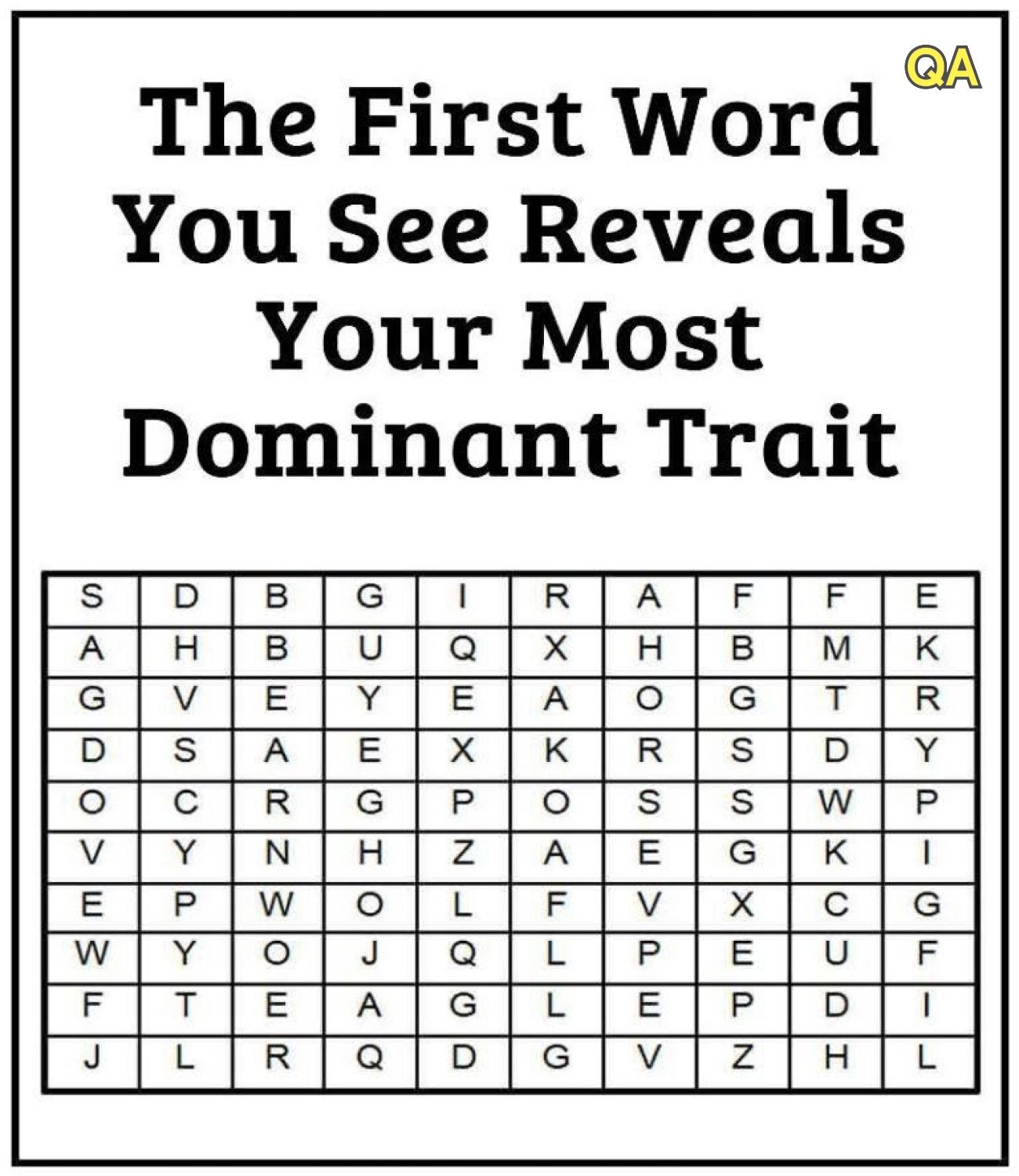
A word puzzle filled with hidden animal names can be an entertaining way to test visual attention. Some people immediately notice a familiar animal such as a giraffe, wolf, eagle, or bear, while others spot a non-animal word such as “eye” before anything else. The appeal is simple: what we see first can feel personal, especially when it is paired with a description of a possible character strength.
These visual personality quizzes are popular online because they invite quick reflection without requiring a long questionnaire. They can spark conversations about goals, relationships, habits, and the qualities people admire in themselves. However, it is important to approach them with the right expectations. The first word a person notices in a letter grid cannot scientifically identify a dominant personality trait or provide a formal psychological evaluation.
Instead, this kind of puzzle works best as a lighthearted prompt. The animal or word you spot first may encourage you to think about traits that resonate with you, but it does not define who you are. Personality is complex, develops over time, and is influenced by many factors, including life experiences, culture, relationships, biology, and environment.
How to Enjoy the Animal Word Puzzle
Take a quick look at the word grid and note the first animal name or word that catches your attention. Try not to search systematically at first. The playful idea behind the exercise is to notice your initial response rather than to find every hidden word.
Did you see giraffe, wolf, eagle, bear, or eye first? The descriptions below offer positive, broad associations commonly linked with these words in popular culture. They are not diagnoses, scientific findings, or predictions. You may identify with one description, several of them, or none at all.
Giraffe: Big-Picture Thinking and Perspective
If “giraffe” was the first word you noticed, the traditional interpretation is that you may appreciate perspective and long-term thinking. Giraffes are often used symbolically to represent the ability to see beyond immediate obstacles. In a personal reflection context, this can relate to someone who likes to consider future possibilities before making a decision.
People who value a big-picture approach may enjoy connecting individual details to wider goals. For example, they might ask how a current choice could affect a project months from now, how a team’s work supports an organization’s mission, or how a daily habit contributes to overall well-being. This type of thinking can be useful in planning, leadership, education, and problem-solving.
At the same time, strong planning skills are not limited to people who spot a particular word in a puzzle. Anyone can develop a broader perspective by setting realistic goals, reviewing progress, and considering more than one possible outcome before deciding what to do next.
Wolf: Independence, Connection, and Loyalty
Those who first notice “wolf” may connect with ideas of independence, instinct, loyalty, and community. Wolves have a powerful place in stories and cultural traditions around the world, although popular descriptions do not always reflect modern wildlife science. In reality, wolf social groups are often family-based, and researchers emphasize that their behavior is more nuanced than simplistic ideas about constant competition or rigid leadership.
As a personality prompt, the word “wolf” may appeal to people who value standing by their principles while also maintaining meaningful relationships. They may prefer a small circle of trusted friends, take commitments seriously, and feel responsible for people they care about. Others may interpret the word as a reminder of self-reliance and confidence in their own judgment.
Healthy independence does not mean facing every challenge alone. Research and public health guidance consistently recognize the importance of supportive social connections for well-being. Loyalty can be expressed through listening, reliability, respect for boundaries, and being present when friends or family members need support.
Eagle: Focus, Determination, and Clear Goals
If “eagle” stood out first, you may be drawn to the idea of focus. Eagles are frequently associated with sharp vision, ambition, and purposeful movement. In a lighthearted personality quiz, this can represent determination: the ability to set a goal, maintain attention, and keep working through ordinary setbacks.
Goal-focused people often benefit from turning large ambitions into manageable steps. Rather than relying only on motivation, they may create schedules, track progress, seek feedback, and adjust their plans when circumstances change. This approach can be useful whether the goal involves education, work, fitness, creative projects, or learning a new skill.
It is also worth remembering that persistence works best alongside flexibility. A person can be deeply committed to a goal while still changing direction when new evidence, responsibilities, or opportunities emerge. Determination is not simply about working harder; it can also include knowing when to pause, reassess, and choose a more effective path.
Bear: Strength, Stability, and Dependability
People who see “bear” first may relate to steadiness, dependability, and protection. Bears are often represented in stories as symbols of strength, resilience, and a calm but powerful presence. Within a personality-puzzle setting, this can point to the value of being someone others trust.
Dependability can take many forms. It may mean keeping promises, arriving prepared, offering practical help, or responding calmly when others feel uncertain. People who value stability may also prefer routines, thoughtful decisions, and environments where everyone feels respected and secure.
Strength does not have to mean being unshakable or handling everything without help. Emotional strength can include acknowledging limits, asking for support, and communicating honestly. A reliable person is not someone who never struggles; it is someone who treats themselves and others with consistency, care, and accountability.
Eye: Observation, Curiosity, and Perception
If the word “eye” caught your attention before the animal names, you may enjoy noticing details. In everyday life, observant people may be aware of changes in their surroundings, patterns in conversation, visual design, or small practical issues that others overlook. This can be a valuable quality in many settings, from creative work and research to caregiving and teamwork.
Observation is not the same as always being correct about what a detail means. Human perception is selective, and people can interpret the same situation differently. Good judgment often requires combining observation with context, evidence, and a willingness to revise an initial impression.
Curiosity can turn observation into learning. Asking open questions, checking reliable sources, and listening to perspectives that differ from one’s own are useful ways to understand a situation more fully. These habits are especially valuable in an online environment where quick impressions can spread faster than verified information.
Why Do Certain Words Stand Out First in a Letter Puzzle?
The first word you see in a visual word puzzle can be influenced by several ordinary cognitive processes. Your eyes may land near one area of the grid first. A word may be placed horizontally, vertically, or diagonally in a way that makes it easier to recognize. Larger or more familiar letter patterns may also stand out more quickly than less familiar ones.
Psychologists use the term selective attention to describe the brain’s ability to prioritize some information while filtering out other information. At any moment, people receive far more visual and sensory input than they can consciously process in detail. Attention helps the brain identify what seems relevant, recognizable, or interesting.
Pattern recognition also plays a role. Reading is not simply a process of inspecting one letter at a time. Skilled readers often recognize groups of letters and familiar word shapes quickly. If an animal name is already common in your vocabulary or connected to a recent memory, you may be more likely to notice it early.
Personal interests can influence visual attention as well. Someone who enjoys wildlife documentaries may spot animal names quickly. A person who has recently read about birds may notice “eagle,” while another person might find “bear” because its short, familiar letter pattern is easy to detect. None of these responses proves a fixed personality type.
Can a Word Puzzle Scientifically Measure Personality?
No. A single image, optical illusion, or word-search result cannot reliably measure personality. Scientific personality research relies on carefully developed methods, including validated questionnaires, repeated testing, statistical analysis, and large, diverse groups of participants. Researchers also examine whether a test produces reasonably consistent results and whether it actually measures the trait it claims to measure.
One widely studied framework in personality psychology is the Five-Factor Model, often called the “Big Five.” It describes personality through broad dimensions commonly known as openness, conscientiousness, extraversion, agreeableness, and neuroticism. These dimensions are studied using established assessment tools, but even they describe tendencies rather than permanently fixed labels.
Entertainment quizzes can still be enjoyable when they are presented honestly. They can offer vocabulary for self-reflection and encourage a person to consider their values. The key is to avoid treating the result as medical, psychological, or professional advice. A puzzle should never be used to diagnose a mental health condition, make important life decisions, or judge another person’s character.
Why Personality Quiz Results Can Feel Accurate
Many personality-style descriptions are written in broad, favorable language. Traits such as loyalty, focus, awareness, resilience, and vision are qualities that many people would like to recognize in themselves. A reader may also remember the statements that feel especially relevant while overlooking the ones that do not fit as well.
This does not mean people are being foolish when they enjoy these quizzes. It simply shows how naturally humans look for meaning and connection. Self-reflection can be valuable when it leads to thoughtful questions: What qualities matter most to me? When do I feel most capable? How do I support people around me? What would I like to improve?
For a more grounded understanding of personality, it can help to look at patterns over time. Feedback from trusted people, personal journaling, structured assessments from qualified professionals, and reflection on real-world behavior can all provide more useful insight than a single first impression from a letter grid.
A Fun Starting Point for Self-Reflection
Whether you first spotted giraffe, wolf, eagle, bear, or eye, the result can be a pleasant conversation starter. Perhaps the word you noticed reflects a quality you already value. Perhaps it highlights a trait you would like to develop. Or perhaps it was simply the word closest to where your eyes happened to land.
There is no right answer and no need to fit neatly into one category. People can be focused and flexible, independent and connected, observant and imaginative, dependable and ambitious. Human personality is richer than any quick puzzle can capture.
Enjoy the challenge, compare results with friends or family, and treat each interpretation as an invitation to think rather than a conclusion about who you are. The most meaningful insight is not necessarily the first word you find, but the values and choices you demonstrate in everyday life.
Sources
Disclaimer: This content is intended for entertainment purposes only and is not based on real events.