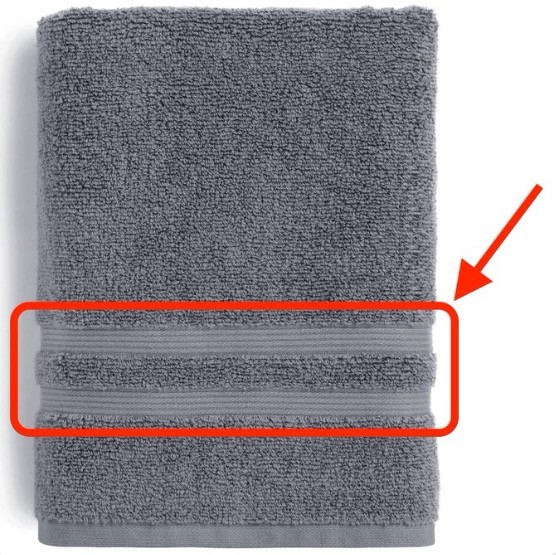
Why Is There That Strange Line on Bath Towels?

Bath towels are everyday household items, yet many of their design details can seem surprisingly mysterious. One of the most common questions is why so many towels have one or more flat, woven lines near their ends. These bands may look decorative, but they are usually part of a purposeful textile construction.
The stripes are often referred to as dobby borders, although terminology can vary between manufacturers. A dobby border is a patterned or tightly woven section created using a dobby mechanism on a loom. Unlike the soft, looped surface that covers most of a typical terry towel, the border is generally flatter and more densely woven.
That visual difference is not accidental. Towels must balance several competing needs: they should absorb water effectively, feel soft against the skin, withstand regular laundering, retain their shape, and look presentable when folded or hung. The woven bands found on many bath towels can contribute to that balance while also giving manufacturers a place to add pattern, texture, or color.
What Are the Lines on Bath Towels Called?
The horizontal lines near the edge of a bath towel are commonly called a dobby border. In textile production, “dobby” refers to a loom attachment or weaving system that controls selected warp threads to create small repeated geometric patterns. The term can describe the woven pattern itself as well as the decorative border made with that technique.
On a standard terry towel, most of the fabric contains raised loops. These loops are what give towels their familiar plush feel and much of their ability to hold moisture. The border, by comparison, usually has fewer loops or no loops at all. It may include narrow ridges, squares, diamonds, stripes, or a more elaborate repeating design.
Not every towel uses the same construction. Some inexpensive towels have simple woven bands, while premium towels may feature multiple decorative borders or use a contrasting yarn color. Some modern towels have very minimal borders, and others use a wide flat panel that is designed to complement a bathroom’s décor. Still, the underlying principle is similar: the border is a deliberate change in weave structure near the towel’s edge.

Why Towels Have Dobby Borders
The most visible purpose of a dobby border is decoration. A textured band can make a plain towel appear more refined without requiring an all-over pattern. It creates a finished look and helps distinguish the towel’s ends from its central drying area. Hotels, retailers, and home-textile brands often use borders as a simple way to create a coordinated collection of bath sheets, hand towels, and washcloths.
However, the border can also have practical value. The edges of a towel are exposed to considerable handling. They are pulled when the towel is hung, folded repeatedly, placed on hooks or rails, and subjected to friction during washing and drying. A denser woven area can help create a more stable transition between the absorbent terry pile and the finished hem.
This does not mean that every decorative stripe automatically makes a towel stronger or more absorbent. Overall towel durability depends on many factors, including fiber type, yarn quality, pile height, fabric weight, the stitching used at the hem, and how the towel is washed. Nevertheless, carefully constructed borders are commonly used as part of a towel design intended to support shape retention and a neat finish.
The border may also reduce the bulk near the ends of the towel. Terry loops can create a thick fabric, especially in high-weight bath towels. A flatter woven section provides visual contrast and can make the edge easier to hem cleanly. This is one reason the stripe is often positioned a short distance above the very end rather than directly at the edge.
How Terry Towels Absorb Water
To understand why the towel’s main body looks different from its border, it helps to understand terry fabric. Most bath towels are made from terry cloth, a woven fabric characterized by loops of yarn that stand up from the base cloth. These loops increase the surface area available to contact and retain water.
Cotton remains a widely used towel fiber because it is naturally absorbent and can feel soft after appropriate finishing and laundering. Other materials may be blended into towels for particular qualities. For example, some towels include rayon derived from bamboo or other cellulosic fibers, while microfiber towels are often made with synthetic materials designed for rapid drying or specialized cleaning tasks.
A towel’s performance is not determined by one feature alone. A heavier towel may feel substantial and absorb a large amount of water, but it can take longer to dry. A lighter towel may dry more quickly and be convenient for travel, yet it may not have the same plush feel. The loops, yarn twist, fabric density, fiber content, and finishing process all influence how the final product performs.
Because the dobby border is typically flatter than the towel’s terry section, it is not usually the part intended to provide maximum absorbency. Its role is more closely connected to construction, appearance, and edge design. The soft looped center is where most drying action occurs.

Are Towel Borders Only Decorative?
It would be inaccurate to say that all towel lines exist for only one reason. Textile design is rarely that simple. In many cases, the border serves both aesthetic and functional purposes. It can provide a decorative pattern, make the product easier to identify as part of a matching set, and offer a visually defined area that complements the towel’s hem.
For consumers, the border can also act as a helpful visual guide. It makes it easier to recognize which direction the towel is facing when folding it or arranging it on a towel rail. This is especially useful in homes, hotels, spas, and guest accommodations where towels are displayed neatly and consistently.
Some people jokingly describe the stripe as a line separating different uses of the towel. There is no universal textile rule supporting that idea. The border is not intended as a hygiene marker, and it does not divide the towel into designated sections. Good towel hygiene depends on regular washing, thorough drying between uses, and avoiding shared personal towels when someone is ill or has a skin infection.
Why Some Towels Have More Than One Line
The number and placement of towel borders are primarily design choices. A towel may have a single broad band, several narrow stripes, matching bands at both ends, or an all-over woven pattern. Manufacturers may use these details to create a particular style, from traditional hotel-inspired towels to contemporary minimalist designs.
Multiple borders can also create a sense of proportion. On a large bath sheet, a narrow strip at each end may visually frame the fabric. On a smaller hand towel, a more prominent border can add texture without making the whole item feel busy. Color, yarn sheen, and the spacing between stripes can all change the final appearance.
Although border patterns are visually appealing, they should not be the only factor considered when buying towels. Fiber content, construction quality, care instructions, and intended use are generally more important for long-term satisfaction. A household that wants quick-drying towels may prefer a lighter construction, while someone seeking a luxurious feel may choose a denser towel with longer loops.
How to Choose a Durable and Absorbent Bath Towel
When comparing towels, begin by checking the fiber label. Cotton towels are common and are available in many weights and finishes. Long-staple cotton varieties are often associated with smooth, durable yarns, although the quality of weaving and finishing remains important. A towel that feels soft in a shop may not necessarily remain equally soft after repeated washing, so it is worth considering reviews and the manufacturer’s care guidance.
Weight can offer another clue. Towel weight is sometimes expressed as grams per square meter, or GSM. A higher GSM towel is generally denser and more substantial, while a lower GSM towel is generally lighter and may dry faster. There is no universally best GSM level; the right choice depends on climate, laundry habits, storage space, and personal preference.
Look closely at the hems and the border area. Neat stitching, even weaving, and securely finished edges can indicate attention to construction. Loose loops, uneven seams, or poorly secured hems may be signs that a towel could snag or fray more easily over time. The dobby border itself should lie flat and should not feel excessively stiff compared with the rest of the towel.
How to Care for Towels and Protect Their Texture
Proper care can make a major difference in how long towels remain absorbent and comfortable. Many towel makers recommend washing new towels before their first use. This can remove finishing residues and loose fibers left from manufacturing while helping the towel begin to reach its normal absorbency.
Use detergent according to the product instructions and avoid adding more than necessary. Excess detergent can be difficult to rinse out completely, potentially leaving residue that affects how towels feel. Fabric softeners may make towels feel temporarily smoother, but frequent use can coat fibers and reduce absorbency for some fabrics. White vinegar is sometimes suggested as a household rinse aid, but consumers should follow garment-care labels and appliance guidance rather than assume that one method is suitable for every material or washing machine.
Dry towels thoroughly after use. Damp textiles can develop unpleasant odors when moisture remains trapped for extended periods. Hanging a towel open on a rail, rather than leaving it bunched up, helps air circulate. Regular laundering is also important, particularly for towels used after exercise, shared towels, or towels used in humid environments.
To reduce wear, avoid washing towels with items that have hooks, zippers, or rough fasteners. These can pull terry loops and damage the surface. If a loop does snag, it is generally better to trim the pulled loop carefully rather than pull it, which can create further damage in the weave.
The Small Design Detail Behind an Everyday Essential
The line on a bath towel may seem like a minor detail, but it reflects the practical decisions involved in textile manufacturing. Known commonly as a dobby border, the flat woven band creates contrast with the soft terry pile, contributes to the towel’s finished appearance, and can support a stable, neatly constructed edge.
Its exact purpose varies by product. For one brand, the border may be mainly decorative; for another, it may be part of a broader design focused on hemming, shape, and durability. What is clear is that the stripe is more than a random visual flourish. It is a familiar example of how weaving techniques combine function and design in an item used every day.
So, the next time you fold a bath towel or hang one to dry, take another look at those woven bands. They are a small reminder that even ordinary household textiles are the result of material science, manufacturing choices, and centuries of weaving knowledge.
Sources
- CottonWorks — cotton fiber, textile, and product information.
- Textile Exchange — information on textile materials and responsible sourcing.
- Centers for Disease Control and Prevention (CDC) — hygiene guidance and resources.
- National Institute of Standards and Technology (NIST) — materials measurement and textile-related scientific resources.
- Encyclopaedia Britannica — background information on textiles and weaving.
Disclaimer: This content is intended for entertainment purposes only and is not based on real events.