Sometimes, the funniest moments come from the simplest misunderstandings. A familiar word suddenly takes on a different meaning, an ordinary question receives an unexpected answer, or someone becomes so confident that they forget to think about the consequences.
That is exactly what happens in this collection of three humorous stories.
In the first joke, a driver turns a simple vocabulary challenge into a clever phone conversation. In the second, another motorist comes up with increasingly creative reasons to avoid several roadside tests, only to reveal the real explanation at the end. Finally, a confident troublemaker discovers that physical strength is not always the most useful advantage when an officer offers him a challenge.
Each story follows a different path, but they share one important ingredient: timing. The setup encourages readers to expect one kind of answer, while the punchline takes the situation in an entirely different direction.
If you enjoy wordplay, clever excuses, and unexpected endings, these three jokes offer a lighthearted break from an ordinary day.
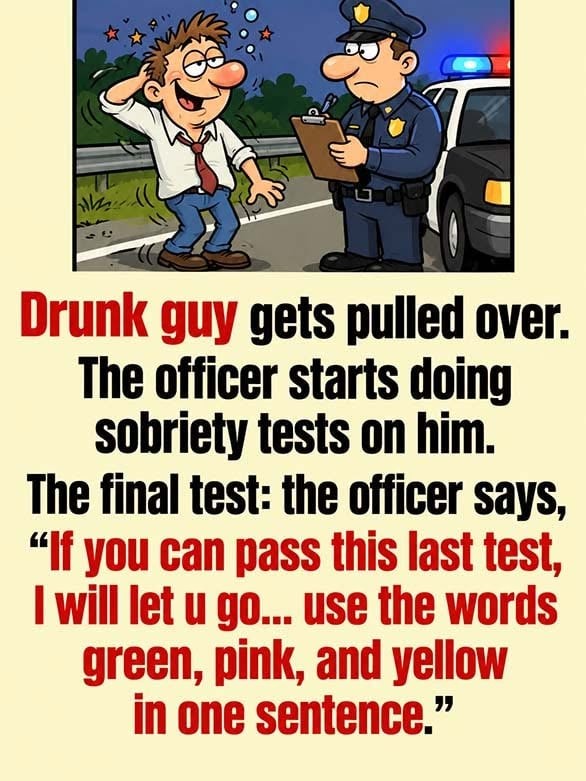
1. The Driver Who Used Green, Pink, and Yellow in One Sentence
A police officer stops a driver during a routine roadside check.
After completing the usual questions, the officer decides to give the motorist a small challenge.
“I want you to use three colors in one sentence,” he says. “The words are green, pink, and yellow.”
The driver pauses for a moment, apparently thinking carefully about his answer.
Then he smiles and says:
“My phone went green, and I pinked it up and said yellow. Have a nice day, officer!”
The officer looks at him for a moment.
Technically, the driver has managed to include all three requested words. But instead of using them to describe colors, he has turned them into a playful version of an everyday phone conversation.
The joke works because of the way the words sound.
“Green” becomes part of the phrase about a phone ringing, “pinked” sounds like “picked,” and “yellow” resembles a casual greeting such as “hello.”
The sentence is deliberately constructed to sound slightly unusual, which makes the final phrase even more amusing.
Why Is This Wordplay So Funny?
This joke relies on a technique known as a pun.
A pun uses words with similar sounds or multiple meanings to create humor. The listener initially expects the colors to appear in a conventional sentence, but the driver uses them as substitutes for familiar expressions.
The humor comes from the difference between what the officer expects and what the driver actually says.
It is also a reminder that language can be surprisingly flexible. A simple change in pronunciation can transform an ordinary sentence into something unexpected.
The driver may not have produced the most grammatically natural answer, but he certainly made the challenge memorable.
2. The Driver Who Had an Excuse for Everything
The second joke begins with another roadside conversation.
An officer approaches a driver and explains that several routine checks may be necessary.
The driver, however, seems prepared with an answer for every request.
“Could you take a breathalyzer test?” the officer asks.
“I’m afraid I can’t,” the driver replies. “I have asthma.”
The officer considers this response and moves to another option.
“Then perhaps we can take a blood sample.”
“Oh, that won’t work either,” the driver says. “I have hemophilia.”
The officer pauses before suggesting another test.
“All right. Would you be able to provide a urine sample?”
The driver shakes his head.
“I’m diabetic. That could complicate things.”
By this point, the officer has heard three different explanations.
He looks at the driver and finally offers one more simple request.
“Then would you mind walking along this white line?”
The driver looks down at the road, considers the suggestion, and answers:
“Because I’m too drunk!”
For a moment, the officer has no response.
After all the elaborate medical explanations, the driver has finally provided the simplest answer of the entire conversation.
The Unexpected Logic Behind the Punchline
The humor in this joke comes from the growing list of excuses.
Each answer appears to create another obstacle for the officer. The driver seems determined to avoid every possible test, and the explanations become increasingly elaborate.
The final request, however, changes the situation.
Walking along a line does not involve the same procedures as the earlier tests. The driver’s response accidentally reveals what he has been trying to avoid admitting.
That sudden change creates the punchline.
The joke also plays with a familiar comedy technique: building a pattern and then breaking it.
Readers quickly recognize that the driver is going to reject every suggestion. They begin anticipating another excuse. Instead, the final answer is unexpectedly direct.
It is important to remember that the medical conditions mentioned in the joke are part of its fictional humor. Real medical conditions should never be treated as automatic reasons to accept or reject a particular roadside procedure. Actual requirements depend on local laws and individual circumstances.
3. The Confident Man Who Accepted the Wrong Challenge
The third story moves away from wordplay and focuses on overconfidence.
A large, muscular man is sitting in a restaurant, speaking loudly about his strength.
He claims that he could easily defeat almost anyone who challenged him.
According to his own description, even a police officer or a world heavyweight boxing champion would struggle against him.
An officer nearby overhears the conversation and decides to test the man’s confidence.
Rather than starting an argument or challenging him to a physical contest, the officer offers a different kind of demonstration.
“Are you really as strong as you say?” he asks.
“Absolutely,” the man replies.
“Then let’s try something simple. I’ll put these handcuffs on you. If you can escape, I’ll admit you’re stronger than I expected.”
The man immediately agrees.
He believes this will be an easy opportunity to prove his point.
The officer calmly places the handcuffs around his wrists.
At first, the man smiles confidently. He pulls, twists, and tries several different movements.
But the cuffs remain in place.
A few minutes pass.
His confidence begins to fade. He tries again, putting even more effort into the challenge.
Eventually, he stops and admits that he cannot get free.
The officer looks at him and smiles.
“In that case, you’re under arrest.”
The man suddenly realizes that the challenge was never quite what he thought it was.
He had been so eager to demonstrate his strength that he had overlooked the officer’s real intention.
Why Overconfidence Makes a Great Comedy Setup
This joke uses a familiar theme: someone becomes so convinced of their own abilities that they fail to consider what is happening around them.
The man believes that strength is the only thing that matters. When the officer offers him a challenge, he accepts without thinking about the possible consequences.
The officer, meanwhile, does not need to match the man’s physical strength.
Instead, he uses the man’s confidence to create an unexpected situation.
The final sentence changes the meaning of everything that came before it.
What initially looked like a friendly demonstration becomes the beginning of an arrest.
This kind of humor is often called situational irony. The audience expects one outcome, but the characters end up in a completely different situation.
The joke is especially effective because the officer remains calm throughout the story. The man creates his own problem by accepting the challenge too quickly.
What Makes These Three Jokes Work?
Although the three stories have different characters and situations, they share several features that help make them entertaining.
Unexpected Answers
The first joke depends on words that sound like familiar expressions. The second uses a series of increasingly unusual excuses. The third turns a simple strength challenge into an unexpected legal situation.
In each case, the audience is encouraged to expect one response before receiving another.
Simple Situations
None of the jokes requires a complicated background story.
A police officer asks a question, a driver responds, or a confident man accepts a challenge.
These familiar situations allow readers to understand the setup quickly. The humor can then focus on the final twist rather than a long explanation.
Timing and Delivery
A good joke depends not only on the words but also on when the punchline appears.
If the ending is revealed too early, the surprise disappears.
The first story allows the unusual sentence to develop naturally. The second repeats a pattern of excuses before breaking it. The third lets the man demonstrate his confidence before revealing the officer’s real intention.
The timing makes each ending more effective.
Why Do People Enjoy Short Jokes?
Humor is an important part of everyday communication. Short jokes are especially appealing because they can provide a moment of entertainment without requiring a large investment of time.
A well-structured joke usually contains a setup, an expectation, and a surprising ending.
The setup gives readers enough information to understand the situation. The expectation encourages them to predict what might happen next. Finally, the punchline introduces a different interpretation.
Psychologists have studied humor through several theories, including incongruity theory. This approach suggests that humor often emerges when an event does not match what someone expects.
For example, the driver in the first joke is asked to use three colors. Most people would expect a sentence describing colorful objects. Instead, he creates a playful phone conversation.
The unexpected connection between the words produces the humorous effect.
Laughter can also help people connect socially. Sharing a joke creates a common experience, gives people something to discuss, and can make everyday interactions feel more relaxed.
Of course, not every joke makes everyone laugh. Humor depends on personal taste, language, culture, and the situation in which it is shared.
Some people enjoy clever wordplay, while others prefer physical comedy or stories built around unexpected situations.
The three jokes in this collection offer a little of each.
A Final Thought: Sometimes the Best Answer Is the One Nobody Expects
The driver who turned three colors into a phone conversation, the motorist who had an explanation for every test, and the confident man who accepted an unexpected challenge all demonstrate one simple principle of comedy.
The ending matters.
A joke can begin with an ordinary question and still lead somewhere nobody expects. Sometimes the funniest part is not the situation itself, but the moment when the characters realize what their own words or decisions have created.
Whether you prefer clever puns, unusual excuses, or humorous misunderstandings, these stories offer a simple reminder not to take every conversation too seriously.
After all, a little laughter can make even an ordinary day more enjoyable.
Sources
-
Attardo, Salvatore. Linguistic Theories of Humor. Mouton de Gruyter, 1994.
-
Raskin, Victor. Semantic Mechanisms of Humor. D. Reidel Publishing Company, 1985.
-
Martin, Rod A. The Psychology of Humor: An Integrative Approach. Elsevier Academic Press, 2007.
Editorial note: The three jokes are presented as humorous fictional anecdotes. The roadside testing and arrest situations should not be interpreted as legal or medical guidance.