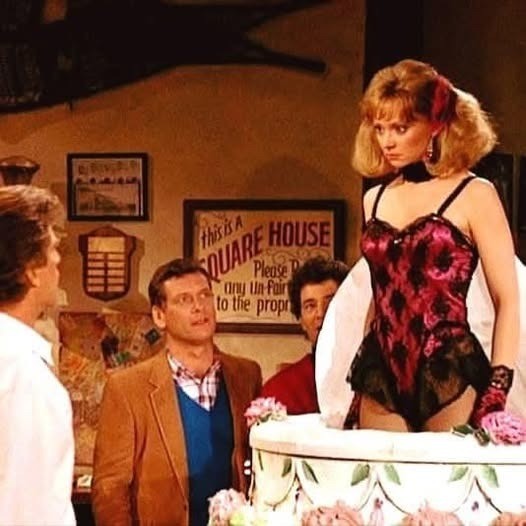
Cheers
Cheers remains one of the most influential and warmly remembered sitcoms in American television history. Set largely inside a Boston bar where regular customers and employees gather to talk, argue, celebrate, and seek companionship, the series turned a simple premise into an enduring cultural landmark. Its famous opening theme promised a place “where everybody knows your name,” and that idea became central to the show’s appeal: the bar was a fictional community where people with very different backgrounds could belong.
Created by Glen and Les Charles with James Burrows, Cheers premiered on NBC in September 1982 and concluded in May 1993 after 11 seasons and 275 episodes. The show followed former Boston Red Sox relief pitcher Sam Malone, played by Ted Danson, as he ran Cheers, a neighborhood bar in Boston’s Beacon Hill area. Around him was an exceptional ensemble that included Diane Chambers, Carla Tortelli, Norm Peterson, Cliff Clavin, Frasier Crane, Coach Ernie Pantusso, Woody Boyd, Rebecca Howe, and many other memorable characters.
Although its early ratings were modest, Cheers gradually became a major success. It earned critical praise, won numerous Primetime Emmy Awards, and helped define the modern ensemble sitcom. Its legacy extends beyond quotable lines and beloved characters. The series also offers a useful case study in television writing, long-running character development, workplace comedy, and the cultural role of familiar gathering places.
How Cheers Became a Television Classic
When Cheers debuted, its future was far from guaranteed. The first season finished near the bottom of the annual Nielsen ratings, a fact often cited as evidence of NBC’s patience with a program that had strong creative potential. Network executives kept the series on the air, and the show slowly built an audience through positive reviews, award recognition, and word-of-mouth support.
That decision proved consequential. By its ninth season, Cheers had become the most-watched program in the United States. The series finale in 1993 attracted tens of millions of viewers, reflecting the close relationship audiences had developed with the bar’s fictional community over more than a decade.
The show’s staying power came partly from its structure. A bar is naturally suited to an ensemble comedy: customers can enter with a problem, share a story, create conflict, or deliver a joke, while familiar regulars provide continuity. Unlike a series focused exclusively on a family home or office, Cheers could bring together people who might not otherwise socialize. This allowed its writers to explore friendship, ambition, romance, disappointment, class differences, and aging through humor rather than heavy-handed speeches.
James Burrows’ direction also became a defining part of the production. The series used a traditional multi-camera format and was generally filmed before a live studio audience. Its timing, performances, and staging created an atmosphere that felt theatrical while remaining accessible to television viewers. The bar itself became more than a set; it functioned as a familiar social space that viewers could return to every week.
The Ensemble Cast and the Power of Character Comedy
Cheers succeeded because it was not built around a single star alone. Ted Danson’s Sam Malone was charismatic, confident, and often emotionally avoidant, but the show gave its supporting characters rich comic identities and room to evolve. Shelley Long’s Diane Chambers brought intelligence, romantic idealism, and sharp verbal sparring to the series. The often turbulent relationship between Sam and Diane gave the early seasons an important narrative engine.
Rhea Perlman’s Carla Tortelli delivered some of the show’s most memorable sarcastic lines, while George Wendt’s Norm Peterson became synonymous with one of television’s best-known recurring gags: Norm entering the bar to a greeting from the other patrons. John Ratzenberger’s Cliff Clavin, the know-it-all postal worker, added a different kind of comic energy through improbable facts and overconfident observations.
Nicholas Colasanto played Coach, Sam’s loyal and good-natured colleague, until his death in 1985. The series handled the loss with restraint and affection. Woody Harrelson later joined the cast as Woody Boyd, a young bartender from Indiana whose innocence and sincerity created a new dynamic within the group. Harrelson’s arrival illustrates one of the show’s strengths: it could adapt to major changes without losing its identity.
Kelsey Grammer’s Frasier Crane began as Diane’s romantic partner but developed into one of the show’s most important characters. Frasier’s intelligence, insecurity, and occasional pomposity made him a natural fit for the ensemble. The character later led to the successful spin-off Frasier, demonstrating how deeply the original series had developed its supporting players.
After Shelley Long left the series, Kirstie Alley joined as Rebecca Howe, a business-minded manager whose ambitions and anxieties contrasted with Diane’s academic and romantic sensibility. The transition could have disrupted the program, but the writers used it to open a new chapter. The later seasons shifted some of the show’s focus toward workplace tensions, Sam’s changing role, and the evolving relationships among the regulars.
Cheers, Alcohol, and Responsible Storytelling
Because Cheers was set in a bar, alcohol was an unavoidable part of its environment. Yet the series is generally remembered less for celebrating drinking than for portraying the bar as a setting for conversation and connection. Characters came to Cheers to meet friends, share everyday frustrations, mark achievements, or find a sense of routine. The drinks were part of the setting, but the relationships were the story.
Over the years, some accounts have credited the show with contributing to public awareness about designated drivers and responsible choices around alcohol. It is important to approach broad claims about television’s direct effect on public behavior carefully. Public-health campaigns, policy changes, education programs, advocacy organizations, and community efforts all played significant roles in raising awareness about impaired driving in the United States.
Still, popular entertainment can contribute to wider conversations. Television shapes cultural expectations by showing which choices are treated as ordinary, humorous, risky, or socially responsible. A long-running program set in a bar had an opportunity to avoid presenting unsafe behavior as a consequence-free punchline. For modern viewers, this remains a relevant point: entertainment can reflect social norms while also helping audiences think about them.
Production stories have also noted that the beverages used on screen were not necessarily the alcoholic drinks they appeared to be. Television productions commonly use non-alcoholic substitutes or altered beverages so performers can work consistently through long filming sessions. This practical detail is a reminder that the apparent spontaneity of a sitcom scene is supported by careful planning, continuity work, prop preparation, and production safety.
Behind the Scenes: Success, Pressure, and Professionalism
The history of Cheers includes the challenges that can accompany a high-profile television production. Long-running network shows demand sustained creative work from writers, performers, crew members, and production staff. Cast changes, personal pressures, and the need to keep stories fresh are common realities in the industry.
Kelsey Grammer has spoken publicly over the years about substance-use problems and personal hardships during earlier periods of his life. Discussions of these experiences should be approached with care. His public career also reflects the importance of seeking support and the possibility of long-term professional recovery. Grammer went on to play Frasier across both Cheers and Frasier for decades, creating one of television’s longest-running character portrayals.
Ted Danson, meanwhile, became closely identified with Sam Malone, even though his career before and after the sitcom has included drama, comedy, and advocacy work. His performance was essential to the balance of Cheers: Sam could be self-assured and flawed, but Danson made him sympathetic enough for audiences to remain invested in him. The role earned Danson major industry recognition and established him as one of television’s defining performers of the era.
The cast’s continued public affection for the series has helped keep its legacy visible. Danson and Woody Harrelson later launched the podcast Where Everybody Knows Your Name with Ted Danson and Woody Harrelson (Sometimes), a title that directly acknowledges the bond audiences still associate with Cheers. Their collaboration reflects how the show’s central theme of friendship has endured beyond its original broadcast run.
The Cultural Legacy of Cheers
The impact of Cheers can be seen in the many sitcoms that followed it. Its combination of serialized relationships and self-contained weekly comedy influenced workplace comedies, ensemble series, and shows centered on “found family” communities. The program demonstrated that viewers could become deeply attached to characters who were not related by blood but were connected through a shared place and a set of recurring rituals.
The show also helped reinforce the importance of supporting characters. Norm, Cliff, Carla, Frasier, Coach, Woody, and Rebecca were never merely background figures. Each had recognizable motivations, comic patterns, and relationships that could carry an episode. This approach gave the writers flexibility and made the fictional world feel expansive despite the limited number of primary settings.
Its influence is particularly clear in the way later sitcoms use a central meeting point. Coffee shops, bars, offices, restaurants, apartment buildings, and community spaces have all served as hubs for ensemble storytelling. What Cheers illustrated so effectively was that a familiar location can become emotionally meaningful when audiences understand the people who return there.
For viewers revisiting the series today, some references and social attitudes reflect the era in which it was made. At the same time, much of its humor remains accessible because it is rooted in recognizable human experiences: wanting to be accepted, trying to improve one’s life, making mistakes, falling in love, and relying on friends during difficult moments.
Why Cheers Still Matters
More than three decades after its finale, Cheers remains a valuable example of enduring television craft. It combined strong writing, precise comic performance, character continuity, and a setting that felt welcoming without being simplistic. The show did not depend on elaborate special effects or rapidly changing trends. Instead, it trusted that viewers would return for the personalities behind the bar.
Its rise from weak early ratings to national success is also a reminder that influential programs do not always become immediate hits. Creative confidence, thoughtful network support, and time for an audience to grow can matter. In an era of fast judgments based on opening-week performance, the story of Cheers remains especially notable.
Ultimately, the series endures because it understood something fundamental about community. People may enter a familiar place carrying different worries, ambitions, and histories, but conversation and humor can create connection. That is the lasting appeal of Cheers: not simply a bar in Boston, but a carefully created world where viewers felt they knew the people waiting inside.
Sources
Disclaimer: This content is intended for entertainment purposes only and is not based on real events.