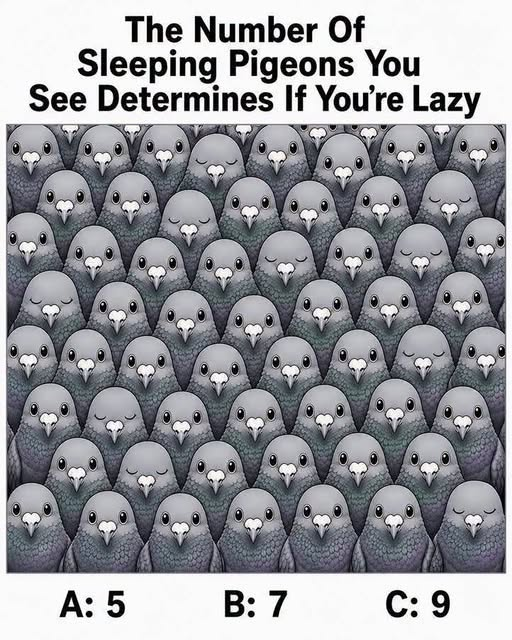
Pigeon-Counting Visual Test: Why People Notice Different Numbers First
Some visual puzzles take only a few seconds to try, yet they can lead to surprisingly interesting conversations. A pigeon-counting image is a simple example: viewers look at the same scene, try to count the birds, and often report different numbers at first glance. One person may immediately identify five pigeons, while another notices seven or nine after a quick scan.
The appeal is easy to understand. These puzzles invite people to slow down, look again, and compare what they noticed. They can also offer a practical reminder that visual attention is selective. Human eyes may receive a large amount of information at once, but the brain does not consciously process every detail equally or at the same speed.
It is important, however, to keep the result in perspective. A pigeon-counting puzzle is not a scientific personality test, an intelligence assessment, or a diagnostic tool. Seeing a particular number first does not reveal a fixed trait, predict future success, or measure cognitive ability. It is best understood as a light observation exercise that illustrates how people can approach the same image in different ways.
How the Pigeon-Counting Visual Test Works
The basic instruction is straightforward: look at the image and ask yourself how many pigeons you noticed first. The first number that comes to mind may reflect the most visually prominent birds, the general pattern of the scene, or the area where your attention landed first.
Some viewers count the most obvious figures and stop. Others naturally scan from left to right, top to bottom, or around the edges of the image. A person may also notice shapes that overlap, blend into a background, or appear less distinct because of scale, contrast, shadows, or the quality of the screen.
For that reason, a second look frequently produces a different answer. This does not mean that the first answer was wrong in a meaningful personal sense. It simply shows that attention can shift. Once viewers know they are expected to find more birds, they often search more systematically and become more likely to identify smaller or less prominent elements.
Several ordinary conditions can influence what someone sees first:
- Image size and resolution on a phone, tablet, or computer screen
- Brightness, contrast, and ambient lighting
- Viewing distance and visual comfort
- The amount of time spent looking at the image
- Whether the viewer is distracted, tired, or in a hurry
- Previous experience with “find the object” or counting puzzles
These factors make visual puzzles entertaining, but they also explain why they should not be treated as formal tests. A standardized psychological assessment requires carefully designed tasks, consistent conditions, validated scoring, and expert interpretation. A social-media-style image puzzle does not provide those safeguards.
Why People Can See Different Numbers in the Same Image
Visual perception is not simply a camera-like recording of the world. The brain actively organizes incoming visual information, identifies patterns, and decides which elements deserve attention. In everyday life, this process helps people navigate crowded places, read signs, recognize faces, and notice changes in their surroundings without consciously examining every object.
A pigeon-counting image can highlight the difference between broad attention and focused attention. Broad attention may help a viewer quickly understand the overall scene: birds are present, there is a central arrangement, and several shapes stand out. Focused attention can help with the next stage: separating individual birds, checking for overlaps, and looking for smaller figures near the edges or background.
Neither approach is inherently better. Both are useful in different circumstances. Seeing the larger pattern quickly can support efficient decision-making when time is limited. Careful scanning can be helpful when accuracy matters, such as proofreading information, reviewing a schedule, checking a form, or inspecting a detailed image.
Psychologists often describe attention as a limited resource. When people focus closely on one aspect of a scene, they may be less likely to notice another detail at the same moment. This is one reason why visual perception can vary from person to person. The first feature someone notices may guide the rest of their search.
If You Noticed 5 Pigeons First
If your first count was five pigeons, you may have noticed the most prominent birds or taken in the general structure of the scene before examining every small feature. In a casual puzzle, that can reflect an efficient first impression rather than a failure to observe.
Many people begin by identifying the clearest and largest objects. This is a practical way to process visual information. The brain often prioritizes elements that have stronger contrast, familiar shapes, central placement, or greater visual prominence. Once those objects are recognized, a more deliberate search may reveal additional details.
It can be tempting to attach a personality label to this response, such as saying that someone is always a “big-picture thinker.” That conclusion would go beyond the evidence. A single image cannot establish how a person thinks, works, learns, or makes decisions in daily life. Still, the puzzle may encourage a useful habit: after forming a quick impression, pause and check whether there is anything important outside the most obvious area.
That second look can be valuable in ordinary situations. When reading a message, evaluating a headline, planning a journey, or comparing products, a broad first impression is often helpful. A short review for overlooked details can make the final decision more informed.
If You Noticed 7 Pigeons First
Viewers who first notice seven pigeons may have quickly registered both the central arrangement and some of the less obvious birds. This could happen because they naturally scanned multiple areas of the image, because the display made certain details easier to see, or because they spent a little longer looking before choosing an answer.
Finding a middle number first does not prove that a person has a particular cognitive style. However, it can illustrate how visual search sometimes combines two steps: recognizing the main scene and then checking nearby areas for additional information. In many real-world tasks, this combination can be useful.
For example, someone reviewing a meeting agenda may first understand the overall purpose of the discussion and then look for timing, participants, and action items. A traveler may see the main departure board before searching for the correct platform number. A shopper may recognize the product category before comparing ingredients, sizes, or prices.
These examples show why flexible attention matters. People often need to move between the big picture and smaller details. A puzzle cannot measure that ability, but it can make the process easier to notice.
If You Noticed 9 Pigeons First
If nine pigeons stood out to you immediately, you may have scanned the image carefully, noticed more subtle shapes, or viewed the puzzle under conditions that made the smaller details easier to distinguish. It may also be that your attention was drawn to areas that other viewers initially skipped.
Detail-oriented observation can be useful in many settings. Editors, designers, researchers, accountants, technicians, and healthcare professionals may all need to identify small differences or verify information carefully. Yet attention to detail is not limited to any profession. Many people use it every day when cooking, organizing a home, following directions, or checking dates and appointments.
At the same time, a high first count in a visual puzzle should not be interpreted as proof of superior intelligence, stronger eyesight, or a more accurate personality type. The result may be influenced by the puzzle’s design, the device being used, and the time available to scan the picture. Accuracy also depends on whether the image itself clearly defines what should count as a separate pigeon.
The broader lesson is balance. Detailed review can prevent mistakes, but not every decision requires exhaustive analysis. In some situations, it is more useful to identify the main issue, make a reasonable choice, and move forward. Effective observation often involves knowing when to zoom in and when to step back.
What Visual Perception Research Can Tell Us
Research on perception and attention supports the general idea that people do not always notice the same things at the same time. Visual attention is shaped by both the features of an image and the viewer’s goals. Bright colors, movement, contrast, size, and central placement can draw attention automatically. Expectations also matter: if people are told to look for hidden objects, they are more likely to search methodically than if they are asked for a quick first impression.
Researchers also recognize that people can experience inattentional blindness, a phenomenon in which an unexpected but visible element may go unnoticed because attention is directed elsewhere. This does not mean that people are careless. Instead, it demonstrates the limits of conscious attention. The brain must prioritize information, especially when a scene contains multiple objects or competing details.
In a pigeon-counting puzzle, the viewer’s task is relatively simple, but the principle is similar. At first, attention may settle on the most noticeable birds. When the task becomes more specific—such as searching for every pigeon—attention may shift toward edges, overlaps, shadows, and background areas.
Visual perception is also influenced by context. If birds are grouped closely together, the brain may initially interpret them as a cluster rather than as separate individual objects. If one bird is partly obscured, viewers may need extra time to decide whether it should be included in the count. These are normal features of how people organize visual scenes.
Why These Puzzles Are Popular Online
Counting and “what did you see first?” puzzles are popular because they are accessible. They require no special equipment, are easy to share, and allow people to compare answers in a low-pressure way. They can also provide a short break from more demanding tasks.
Online discussions often add personality descriptions to different answers. Those descriptions can be amusing, but they should be read as entertainment rather than evidence-based conclusions. Credible psychological evaluation does not rely on one image, one answer, or a brief online quiz. Reliable assessment involves established methods and qualified professionals when needed.
A responsible way to enjoy these puzzles is to focus on the observation experience itself. Ask what you noticed first, what you missed, and what changed when you looked again. Compare scanning strategies with friends or family. You may find that one person starts in the center while another checks the corners, or that someone notices contrast while another tracks shapes.
Tips for Improving Observation Skills
Although a pigeon-counting image cannot measure intelligence or personality, it can be used as a simple prompt for practicing deliberate observation. The following strategies may help when accuracy is useful:
- Pause before answering: A quick response can be useful, but a brief second check may reveal overlooked details.
- Use a scanning pattern: Move across an image systematically, such as left to right and top to bottom.
- Check the edges: Smaller or partially hidden objects are often placed near borders or behind more prominent elements.
- Separate grouped objects: When shapes overlap, identify each object individually rather than counting the group as one.
- Reduce distractions: Better lighting, a larger screen, and a quiet moment can improve visual comfort and concentration.
- Review without overthinking: The goal is not endless analysis. A clear, structured second look is often enough.
Enjoy the Puzzle Without Overinterpreting the Result
Whether you noticed five, seven, nine, or another number of pigeons first, the most meaningful takeaway is simple: people can view the same image differently. Attention changes with context, expectations, visual conditions, and the amount of time spent searching.
These puzzles are most enjoyable when treated as a conversation starter rather than a verdict on personality. They can encourage curiosity about perception, remind people to check assumptions, and demonstrate that first impressions are not always complete.
Take another look at the image if you have it available. Does your count change when you slow down? Do you notice birds that were not obvious at first? The answer may say less about a fixed trait and more about the value of giving the details a second look.
Sources
Disclaimer: This content is intended for entertainment purposes only and is not based on real events.