Solve the Riddle: A Man Steals $100 From a Shop
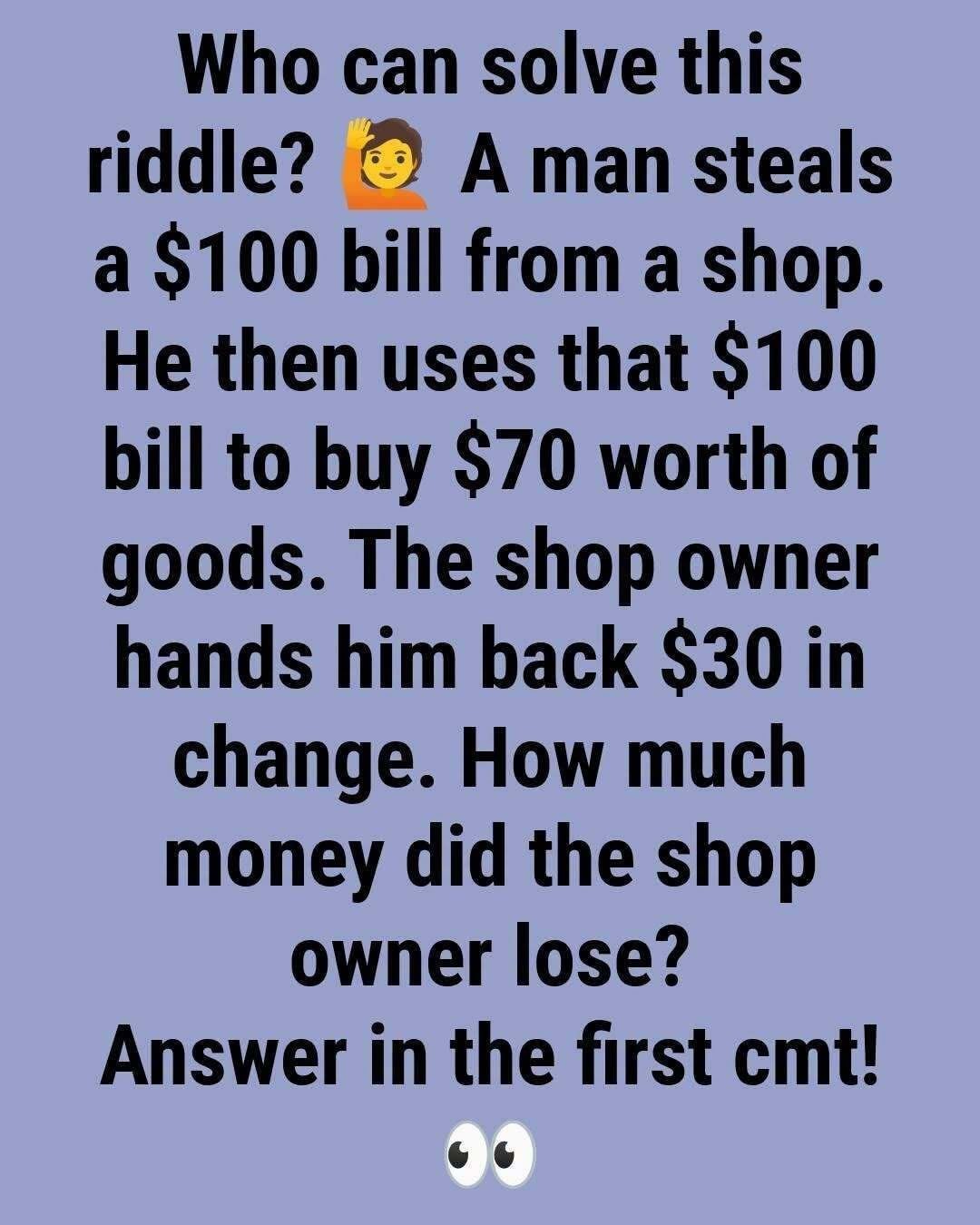
A man steals $100 from a shop. Later, he returns to the same store and uses the stolen $100 bill to buy $70 worth of goods. The shop owner gives him $30 in change. The question is simple but often leads to very different answers: how much money did the shop lose?
Many people quickly answer $200 or even $300. The confusion is understandable because the story includes a theft, a purchase, merchandise, and change. However, the correct answer is $100.
This classic logic riddle is useful because it shows how easily people can count the same money more than once. The key is to focus on the store’s final position after all transactions are complete, rather than adding every number mentioned in the scenario.
The Shop Theft Riddle Explained
At the beginning of the riddle, the shop has its normal amount of cash and inventory. The man takes $100 from the cash register or another place in the store.
At that moment, the shop is down $100 in cash. If the story ended there, the loss would clearly be $100.
But the man later comes back and spends the same stolen $100 bill in the shop. He selects $70 worth of goods and hands the $100 bill to the owner. The owner accepts the bill and gives him $30 in change.
Because the stolen bill has returned to the shop, the original missing $100 in cash is no longer missing. It is back in the register. What the shop has now lost is:
- $70 worth of merchandise
- $30 in cash given as change
When those two amounts are added together, the total is $100.
$70 in goods + $30 in change = $100 total loss.
Why the Answer Is Not $200
A common answer is $200. This usually comes from treating the original stolen $100 and the later $100 transaction as two separate losses. But they are not separate losses.
The man did initially take $100. However, he brought that exact $100 back when he used it to make a purchase. Once the shop receives the bill again, the original cash shortage is resolved. The store does not lose the same $100 twice.
Instead, the returned bill is exchanged for two things: $70 in goods and $30 in legitimate cash change. From the shop’s perspective, the $100 bill comes back in, then $100 in value goes out.
The amount that goes out is made up of merchandise and change. That is why the total loss remains $100.
Why the Answer Is Not $300
Another popular answer is $300. This result usually comes from adding together all three figures in the story:
- $100 initially stolen
- $70 worth of goods taken
- $30 in change
That calculation produces $200, not $300, unless the $100 bill used for the purchase is also counted as a separate loss after it has already been returned. In either case, the mistake is double-counting.
The $100 used in the purchase is not an additional loss. It is the same bill taken earlier. The store receives it back. Once it is returned, it cannot be counted as missing cash alongside the goods and change that the customer receives.
A sound accounting approach requires looking at net losses, not simply adding all the monetary amounts appearing in a story.
Following the Store’s Cash Step by Step
One of the easiest ways to solve the riddle is to track only the cash. Imagine the store begins with an unspecified amount of money in the register.
- The man steals $100. The register is down $100.
- He returns and hands over the same $100 bill. The register returns to its original cash position.
- The shop owner gives him $30 in change. The register is now down $30.
By the end of the story, the store has lost $30 in cash. It has also lost $70 in merchandise. Together, those losses equal $100.
This method helps separate the physical movement of money from the movement of goods. It also makes clear why the returned $100 bill should not remain in the final calculation as a separate loss.
Following the Store’s Inventory
Now consider the goods rather than the cash. The man receives $70 worth of merchandise from the shop. Those goods leave the business and do not return.
For the purpose of the riddle, the stated $70 value is treated as the value lost by the shop. In real business accounting, the retail price of an item and its cost to the business may differ. A shop may sell an item for more than it paid a supplier, so the exact accounting loss could depend on whether the question refers to retail value, inventory cost, revenue, or profit.
However, this riddle uses the stated value of the goods. Therefore, the inventory portion of the loss is $70, and the cash portion is $30.
The Correct Answer: The Store Loses $100
The store’s final loss is:
$70 in goods + $30 in cash = $100.
The original $100 bill does not increase the final loss because it returns to the shop before the transaction is completed. It is simply used as the payment method for the goods and the change.
The man ultimately leaves with $100 in total value: $70 worth of goods and $30 in cash. Since the store receives no genuine payment beyond the bill that was originally taken from it, the shop loses that same $100 in value.
A Simple Balance-Sheet View of the Riddle
Another way to understand the answer is through a simplified balance-sheet perspective. A business holds assets, including cash and inventory. In this scenario, the shop’s assets change in two ways.
Its cash falls by $30 because the owner gives the man $30 in change. Its inventory falls by $70 because the man leaves with products valued at $70. The combined reduction in assets is $100.
The temporary removal of the $100 bill matters only until the bill returns. Once it is handed back to the owner during the purchase, the cash register has recovered that amount. The store’s final asset reduction is therefore not the initial $100 theft plus the later transaction. It is only the value that remains gone at the end.
What This Riddle Teaches About Everyday Math
The shop theft puzzle is more than a quick brain teaser. It highlights an important habit in practical mathematics: identify what is being measured before performing calculations.
In this case, the question asks about the shop’s loss. It does not ask how much money changed hands, how much the man handled, or how many dollars are mentioned in the story. Those are different questions and can lead to different totals.
People often make mistakes when they add numbers without first considering whether those figures represent separate items. The same issue can arise in personal budgeting, business records, discounts, refunds, and bank transactions.
For example, if a customer returns a product and receives a refund, the original purchase amount and the refund should not automatically be treated as two independent expenses. The refund changes the net amount paid. Similarly, when money taken from a store is returned, it offsets the earlier cash loss.
Revenue, Profit, Cost, and Value Are Different
The riddle also offers a basic lesson in financial language. Revenue, profit, cost, cash flow, and asset value are related but different concepts.
Revenue generally refers to money a business earns from sales. Profit is what remains after expenses are deducted. Cash flow concerns money entering and leaving a business. Inventory is a business asset that can be sold to generate revenue.
In the shop riddle, the man appears to make a $100 purchase, but the store has not truly earned $100 in new revenue because the payment is made with money that already belonged to the shop. The key final outcome is that the shop no longer has $70 in goods and $30 in cash.
In a real retail setting, an accountant would likely examine the cost of the goods, the retail sale price, tax treatment, and inventory records. The puzzle intentionally removes those complications and asks readers to use the stated values.
How to Solve Similar Logic Questions
When facing a financial riddle, it can help to use a structured method instead of relying on intuition.
- Identify the starting point. Determine what the person or business has before any event occurs.
- Track each asset separately. Follow cash, goods, property, or other items independently.
- Look for returns or reversals. Money that comes back should offset money that previously left.
- Avoid double-counting. Ask whether two figures refer to the same bill, item, or transaction.
- Compare the beginning and ending positions. The difference between them is usually the real gain or loss.
Applying those steps to this riddle makes the result straightforward. The shop ends with $30 less cash and $70 less merchandise than it had at the beginning. Its total loss is $100.
Final Takeaway
The answer to the classic question, “A man steals $100 from a shop, then uses it to buy $70 in goods and receives $30 in change—how much did the shop lose?” is $100.
The store loses $70 in merchandise and $30 in cash. The stolen $100 bill is returned during the purchase, so it is not an additional final loss. The riddle is designed to test careful reasoning, especially the ability to distinguish between money temporarily removed and value permanently lost.
Once the transaction is viewed from the shop’s final position, the apparent complexity disappears. The man leaves with $100 in value, and the shop is down by $100 in value.
Sources
Disclaimer: This content is intended for entertainment purposes only and is not based on real events.