Your eyes may betray you before this puzzle gives up its secret
Introduction: The Allure of Visual Puzzles
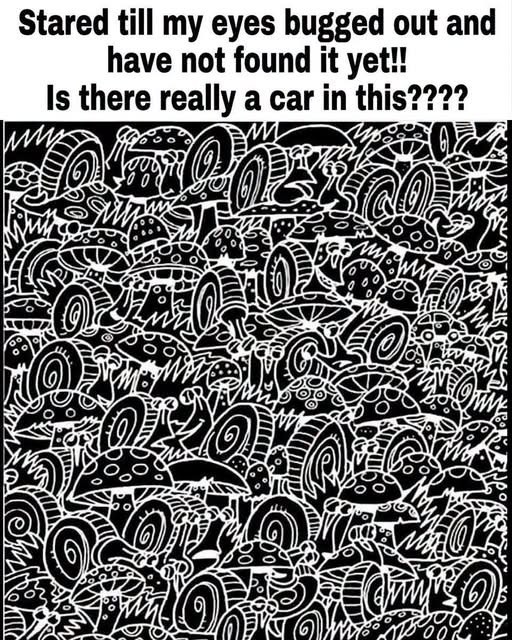
Visual puzzles have long captivated people of all ages, inviting us to challenge our observation skills and perseverance. Among the latest viral trends is a seemingly simple yet brilliantly deceptive test: spotting a tiny automobile cleverly tucked amongst an intricate illustration full of snails and mushrooms. To the casual eye, the puzzle may seem straightforward, but the complexity behind the artwork and the human visual system turns this challenge into a true test of patience and acuity.
Setting the Scene: The Puzzle’s Unique Appeal
The puzzle is set in a black-and-white woodland composition, populated densely with whorled snail shells, slender antennae, and an assortment of mushroom caps. Amidst this monochrome clutter, the shape of a car is hidden, waiting to be found by those bold enough to undertake the challenge. Unlike classic “spot the difference” or simple hidden-object games, this particular puzzle’s artistic design invites viewers to lose themselves in its fascinating detail, making the process both entertaining and demanding.
Those attempting the puzzle are encouraged to search within 30 seconds. While the time limit is playful, not strict, it is meant to add an element of excitement. The subtlety of the car’s silhouette, combined with the ambiguous shapes surrounding it, make for a uniquely engaging experience that tests not just eyesight but the mind’s ability to process visual information.
Techniques for Solving Visual Puzzles
Success in puzzles such as this often comes down to methodical searching and visual strategies. The human eye naturally seeks out patterns and familiar forms, but when faced with visual clutter, it is easy to become overwhelmed or distracted. Here are expert-backed techniques to improve the odds of success:
- Divide and Conquer: Instead of scanning the entire illustration quickly, break the image into smaller sections. Examine each segment for potential automotive clues — such as outlines of wheels, windows, or a roof.
- Pattern Recognition: The brain is adept at recognizing faces, objects, and symbols. Rely on this natural aptitude by focusing on details that distinguish a car from its surroundings, like straight lines or symmetrical shapes.
- Adjust Perspective: Sometimes a pause or a change in angle—such as zooming in or out—can help uncover hidden elements that were previously overlooked.
- Resist Distractions: The abundance of organic shapes in the illustration can lead to false positives. Remain mindful and deliberate so as not to confuse snail shells for wheel hubs or mushroom gills for windowpanes.
Why Visual Puzzles Matter: Cognitive Science Insights
Puzzles like this one provide much more than entertainment. According to cognitive scientists, hidden-object puzzles stimulate a variety of mental processes. These include visual discrimination, sustained attention, pattern recognition, and spatial reasoning.
For instance, Dr. Steven Pinker, a psychologist at Harvard University, notes that tasks involving visual search activate both the occipital lobe and prefrontal cortex, regions responsible for sight and decision-making. The challenge of distinguishing an automobile among similarly shaped snails and mushrooms enhances neural communication and can help sharpen perceptual skills.
Moreover, such puzzles can be used in educational settings, therapeutic interventions, and even occupational therapy, especially for patients needing to restore visual or cognitive function. As Dr. Linda Smith from Indiana University observes, “Activities that require sustained focus and detection of subtle differences promote brain health and encourage positive cognitive aging.”
Psychology Behind the Challenge: Why Our Eyes Often Miss the Obvious
Why is it so difficult to find the car? This question delves into the psychology of visual perception. When confronted with familiar but complex patterns, the brain tends to prioritize recognition of objects it expects—like snails and mushrooms—over unexpected intrusions like a car. This is known as selective attention. The brain filters out unlikely candidates, making the task harder but more rewarding once the “hidden” object is finally discovered.
Another relevant phenomenon is “inattentional blindness,” where individuals fail to notice obvious objects when their attention is absorbed by other aspects of the scene. This principle is often exploited in magic tricks and illusions, and is cleverly used by the puzzle’s artist to hide the car from immediate detection.
The Role of Art and Design in Visual Puzzles
The challenge is not just about cognitive skills, but also the aesthetics of visual design. Artists such as M.C. Escher and contemporary illustrators often use intricate linework and ambiguous forms to blur the boundaries between objects. In this puzzle, the woodland elements are drawn just similar enough to automobile features, making the distinction even more elusive.
Creators of such puzzles aim to evoke curiosity and engagement, encouraging viewers to spend more time analyzing every detail. This approach not only entertains but also stimulates the creative side of problem-solving, as the eye and mind must work together to decode the image.
The Social Side: Sharing and Competing
One of the reasons visual puzzles have become so popular on social media is their competitive yet collaborative nature. After finding the hidden car, participants are invited to share their success and timing without revealing the location, thus maintaining the challenge for others.
The puzzle fosters a sense of community, as people comment and compare their visual strategies. The speed at which the car is located becomes a playful badge of honor, and the collective experience ensures the puzzle’s popularity endures far beyond its first completion.

International and Societal Reactions
Visual puzzles like this have found audiences far beyond their country of origin. They are commonly shared globally, translated across languages, and featured in online publications from the United States to the United Kingdom, India, Japan, and beyond. Psychologists and educators in various countries have praised the role of such puzzles in early childhood development and lifelong learning.
Organizations that support cognitive health often recommend regular engagement with brain teasers, emphasizing their accessibility and universal appeal. In classrooms, puzzles provide a non-competitive way for children to practice focus and analytical thinking, especially in digital environments.
Online communities have even formed around these challenges, using platforms like Reddit, Instagram, and TikTok to compare puzzles, share solutions, and discuss visual tricks that stumped them. The participatory nature ensures the puzzles continue to inspire fresh engagement and innovative approaches.
Conclusion: The Enduring Value of Visual Challenges
Whether you are attempting to spot the hidden car quickly or savoring the process, this puzzle illustrates the enrichment visual challenges can bring. It is more than an optical experiment; it is a blend of cognitive science, art, and playful competition. By inviting us to look beyond the obvious, such challenges foster appreciation for both the complexity of visual perception and the power of methodical problem-solving. The reward is not just in finding the solution but in engaging with the puzzle and sharing it with the wider community.
Next time you view a busy illustration or seek a hidden object, remember the skills developed here—and that sometimes, your eyes may betray you before the secret is revealed.
Sources
Disclaimer: This content is intended for entertainment purposes only and is not based on real events.