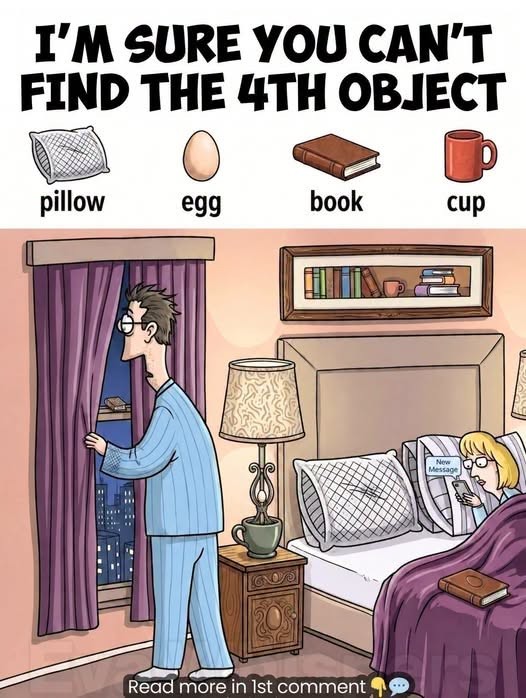
This innocent-looking bedroom puzzle can make you doubt your own eyes
Puzzles have long been recognized as an effective tool for stimulating cognitive abilities and encouraging creative thinking. One recent viral sensation—a seemingly simple bedroom visual puzzle—has captivated audiences online, with many viewers confessing that it made them doubt their own eyes. Although the task appears straightforward at first, the final object’s elusive nature sets this particular challenge apart, stirring debate and fascination in equal measure. In this article, we analyze the puzzle scene, examine why such visual challenges perplex so many, and draw on expert insights to explain what’s really happening when our brains struggle to spot what’s hidden in plain sight.
The Bedroom Puzzle: A Closer Look
The puzzle in question showcases a cozy bedroom scene. Participants are tasked with identifying four objects—a pillow, a book, a cup, and an egg—by matching items visible within the room to reference pictures or silhouettes provided alongside the main image. At a glance, these objects might seem easy to find, but closer inspection reveals layers of ambiguity that make the task more challenging than anticipated.
Breaking Down the Search
Let’s walk through the scene. Most puzzle solvers can readily locate several of the target items. Striped pillows are arranged comfortably on the bed—an unmistakable match to the reference. Books are even more abundant, visible not just on the purple blanket but scattered across a wall shelf and the windowsill as well. The hunt for the cup, however, invites more scrutiny: although a green mug sits beside the bed, its design does not precisely correspond to the clue. Instead, a red-brown, handled mug perched on a shelf overhead emerges as a stronger candidate.
The Egg: Master of Disguise
The most contentious search centers around the egg. Instead of a clear, familiar egg, the only possible options appear to be decorative: an elongated oval integrated into the lampstand and an oval-shaped ornament placed upon the bedside cabinet. Neither serves as an unambiguous answer, and this ambiguity gives rise to lively debate among solvers. The case of the missing (or disguised) egg reveals a broader principle about hidden object puzzles: often, the solution lies not in what meets the eye, but in how we interpret shapes and outlines instead of merely searching for literal representations.
Why Do Puzzles Like This Confound Us?
Puzzle designers routinely exploit the human tendency to focus on familiar patterns and overlook the unconventional. Cognitive psychologists explain that our perception is heavily influenced by what we expect to find; if we are searching for a classic egg shape, we may blindly pass over abstractions or designs that only loosely correspond to that idea. A study published in Frontiers in Human Neuroscience highlights that priming and expectation can narrow attention and make us less likely to spot items that defy prediction.
With the bedroom puzzle, successful solvers are often those who pause to reconsider their assumptions. Instead of hunting strictly for realistic objects, they adjust their search to include abstract representations—smooth ovals in unexpected places—which broadens their perspective. This is a classic example of the role that cognitive flexibility and “thinking outside the box” play in creative problem-solving.
The Psychology Behind Hidden Object Puzzles
One reason for the enduring popularity of hidden object puzzles is the complex interplay of visual perception, memory, and logic. Researchers at the American Psychological Association note that such puzzles engage the brain’s visual cortex and can improve attention to detail, pattern recognition, and even spatial awareness. By searching for both discrete objects and ambiguous shapes, solvers exercise a broad range of mental skills.
Another key factor is the human desire for resolution. As Psychology Today points out, uncertainty and unsolved mysteries can cause discomfort—prompting people to go over a puzzle repeatedly until they arrive at a satisfactory answer. This drive is compounded by social dynamics: when puzzles are shared in online communities, collective brainstorming can both heighten confusion and increase the likelihood of finding creative solutions.
Room for Interpretation: Multiple Solutions?
The ambiguity woven into the bedroom puzzle is not accidental. Puzzle creators often leave clues that accommodate more than one answer or invite interpretation. In this case, neither the lampstand oval nor the ornament egg may be a canonical solution; rather, the puzzle’s true purpose is to highlight the diverse ways attention can be directed and focus sharpened. Ultimately, the precise answer may matter less than the process by which participants learn to adjust their expectations and scrutinize every detail, including design flourishes that might initially appear to be mere decorations.
Expert Views: How to Improve at Visual Puzzles
Experts recommend several strategies for those keen to enhance their performance with visual puzzles:
- Scan with intention: Instead of scanning rapidly, adopt a systematic approach, covering each segment of the scene methodically.
- Challenge your expectations: If you cannot locate an object where you expect it, question whether your visual template might be too narrow.
- Look for outlines and abstract forms: Objects may not be depicted literally; sometimes a partial shape or a color cue is all you need.
- Take short breaks: A brief rest can refresh your eyes and help you return with a new perspective.
According to Dr. Emily Knight, a cognitive scientist at the University of Cambridge, “The most effective solvers are those who embrace ambiguity and persist even when initial answers seem out of reach. Puzzles like these reward not just sharp vision, but open-mindedness and adaptability.”
Online Reactions and Societal Impact
Online forums and social media platforms have amplified the reach and appeal of the bedroom puzzle, sparking widespread debate and collective problem-solving endeavors. Some viewers express frustration at the ambiguity, while others revel in the challenge. These differing reactions underscore the puzzle’s educational and entertainment value. Teachers and therapists have even begun to incorporate such visual puzzles into learning modules and therapy sessions, citing their capacity to foster patience, cooperative problem-solving, and cognitive flexibility.
Cultural Fascination with Visual Challenges
The popularity of hidden object puzzles is hardly a new phenomenon. From the “Where’s Waldo?” books to interactive online brain teasers and viral image illusions, people across cultures are drawn to tests of observation and deduction. These activities are not just exercises in fun; as highlighted by the Centers for Disease Control and Prevention (CDC), staying mentally engaged through puzzles can boost brain health and potentially delay cognitive decline.
Visual puzzles also encourage communal engagement. In multicultural classrooms or family gatherings, such activities bridge gaps in age, language, and background, enabling participants to bond over shared efforts to resolve a common conundrum.
The Takeaway: Beyond the Obvious
The innocent-looking bedroom puzzle may present itself as an easy observational challenge, but its true lesson lies in the way it forces us to question assumptions and seek new perspectives. Whether the elusive “egg” was hidden in the lampstand, on the cabinet, or nowhere at all, the value comes from the search: the act of looking beyond the obvious sharpens our mind and reminds us that not everything is as it first appears. The next time you encounter a persuasive puzzle, remember that sometimes the real solution is to look for possibilities, not just answers.

Sources
- BBC – The Cognitive Benefits of Doing Puzzles
- CDC – Cognitive Engagement and Brain Health
- Psychology Today – Why We Love Puzzles
- Frontiers in Human Neuroscience – Object Recognition and Attention
- American Psychological Association – Journal of Experimental Psychology
Disclaimer: This content is intended for entertainment purposes only and is not based on real events.