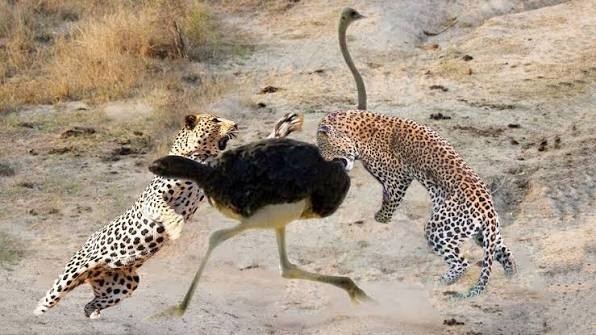
A quiet wildlife scene can change in only a few seconds.
A leopard appears near a parked vehicle. An ostrich is suddenly nearby, moving quickly as it tries to create distance. Then, just as the situation becomes more difficult to understand, a person appears to move toward the animals.
The unusual encounter, described in a recent online wildlife video, has attracted attention because it brings together two remarkably different animals in an unexpectedly close interaction.
The leopard is known for stealth, adaptability, and extraordinary athletic ability. The ostrich, meanwhile, is one of the largest living birds and is famous for its long legs, impressive speed, and distinctive appearance.
When these two species appear together in a confined space near a vehicle, the result can look almost unbelievable.
However, short wildlife videos rarely tell the entire story. Without information about what happened immediately before or after the recording, it is difficult to determine exactly why each animal behaved as it did.
Rather than assuming a dramatic explanation, the encounter offers an opportunity to explore leopard and ostrich behavior, their roles in African ecosystems, and why unexpected wildlife interactions can be so fascinating.
What Happened During the Leopard and Ostrich Encounter?
According to the online description accompanying the footage, a leopard appeared to follow an ostrich near a parked vehicle.
The ostrich moved around the vehicle while attempting to get away, while the leopard remained nearby. The scene became even more unusual when a man appeared to approach the animals.
The short recording provides only a limited view of the circumstances.
It does not establish the precise location, the reason the animals were so close to the vehicle, or the complete sequence of events. It is also difficult to determine the intentions of the person who approached from the footage alone.
This is an important consideration when watching viral wildlife videos.
A few seconds of footage can show what animals did, but not necessarily why they did it.
Nevertheless, the visible interaction highlights several fascinating characteristics of both species.
Why Leopards Are Such Adaptable Predators
Leopards are among the most adaptable large cats in Africa and Asia.
They can survive in a remarkable variety of habitats, including grasslands, woodland, forests, mountains, and areas with considerable human activity.
Their adaptability is partly connected to their ability to hunt different types of prey.
Unlike animals that depend heavily on one particular food source, leopards are opportunistic hunters. Their diet can vary depending on what is available in their environment.
They are also known for their ability to move quietly and remain difficult to detect.
This combination of adaptability and stealth makes the leopard one of the most successful big cats in many ecosystems.
The animal’s behavior in the video therefore needs to be considered within that broader ecological context.

The Ostrich Is Far More Capable Than It Looks
Ostriches are equally fascinating, although for very different reasons.
They are the world’s largest living birds and cannot fly. Instead, their long legs have evolved for efficient movement across open landscapes.
An ostrich can reach impressive running speeds and can maintain a rapid pace over considerable distances.
Its body is therefore adapted for life on the ground.
The ostrich’s long legs also provide a considerable advantage when moving across open terrain. Large eyes allow it to observe its surroundings, while its height gives it an elevated view over grasslands and savanna vegetation.
These adaptations make the ostrich a very different kind of survivor from the leopard.
Where the leopard relies heavily on stealth and carefully timed movement, the ostrich depends more on speed, awareness, and the ability to cover ground quickly.
Why Would a Leopard Approach an Ostrich?
The most obvious explanation is that the leopard may have been interested in the bird as potential prey.
However, that cannot be established with certainty from a short clip.
Predators constantly evaluate their surroundings. An animal may investigate another creature without every interaction developing into a feeding event.
The leopard may have been assessing the ostrich’s movement, reacting to the bird’s behavior, or simply responding to an opportunity in its surroundings.
Wild animals do not always follow a predictable sequence.
Even when a predator and potential prey appear close together, environmental conditions can influence what happens next.
The presence of a vehicle, people, unusual sounds, obstacles, or other animals may also alter the behavior of both species.
Why the Vehicle Made the Encounter Look So Unusual
The parked vehicle appears to play an important role in the visual drama of the footage.
Wild animals normally interact across much larger natural spaces. When an animal moves around a vehicle, the familiar shape of the car provides a striking contrast to the surrounding environment.
It may also create an unusual visual effect.
The ostrich appears to have fewer obvious directions in which to move, while the leopard remains close. This can make the interaction look more dramatic than a similar encounter in open terrain.
The vehicle may also have affected the animals’ movements.
Animals encountering unfamiliar objects may temporarily alter their normal behavior. The presence of people and vehicles is increasingly common in some wildlife areas, particularly locations where animals regularly encounter safari vehicles.
However, without information about the specific location and circumstances, it would be inappropriate to claim exactly how the vehicle influenced the encounter.
The Importance of Distance in Wildlife Encounters
One of the most important principles of wildlife observation is maintaining an appropriate distance.
Wild animals are unpredictable, particularly when they are startled, cornered, protecting young animals, or interacting with another species.
A person approaching a leopard and ostrich may therefore change the situation considerably.
Even if the intention is to help, human intervention can sometimes cause animals to behave differently.
Wildlife professionals generally rely on distance, controlled observation, and knowledge of animal behavior rather than approaching animals directly.
That is particularly important when large predators are involved.
Why the Ostrich May Have Been Difficult to Watch
Ostriches can appear awkward when they move through confined spaces.
Their long legs and large bodies are designed for open landscapes rather than navigating around vehicles and obstacles.
This may explain why the footage looks so chaotic.
The bird has a very different movement pattern from the leopard. Its long stride is effective when it has room to accelerate, but obstacles can change how efficiently it can move.
That contrast makes the encounter visually striking.
The leopard moves with a low, controlled posture, while the ostrich’s tall body and long legs make every movement highly visible.
The result is almost cinematic even though the underlying behavior may be completely natural.
What Makes Leopards and Ostriches Important to Their Ecosystems?
Both species play important roles in their environments.
Leopards are predators. Their presence contributes to the complex network of relationships between predators and other animals.
Ostriches, meanwhile, influence their environment in different ways. As large omnivorous birds, they interact with vegetation, insects, seeds, and other elements of their ecosystem.
Their eggs and young also form part of the wider food web.
The survival of both species depends on functioning ecosystems with adequate habitat and resources.
This is one reason wildlife encounters can be valuable educational opportunities.
A dramatic video may initially attract attention because it is unusual, but it can also encourage people to learn more about how animals coexist in natural environments.
Why Viral Wildlife Videos Are So Powerful
Humans are naturally attracted to unexpected events.
A leopard is already an impressive animal. An ostrich is visually distinctive. Seeing the two together immediately creates curiosity.
The appearance of a person near the animals adds another layer of uncertainty.
Viewers begin asking questions.
What happened before the camera started recording?
Why was the leopard following the ostrich?
Was the ostrich attempting to escape or simply moving away from the vehicle?
Why did the person approach?
What happened after the video ended?
These unanswered questions are one reason short wildlife clips can spread rapidly online.
But they also demonstrate why viewers should be cautious about accepting every caption as a complete explanation.
Separating What We See From What We Assume
There is an important difference between observation and interpretation.
We can observe that the leopard and ostrich were close together.
We can observe that the ostrich moved rapidly.
We can observe that the leopard remained nearby.
We can also observe a person approaching the animals.
But it is more difficult to establish the motivation behind those actions.
Was the leopard definitely hunting?
Was the ostrich definitely frightened?
Was the person definitely attempting a rescue?
Those interpretations may be plausible, but they require additional evidence.
Responsible wildlife storytelling should preserve that distinction.
The uncertainty does not make the footage less interesting. In many cases, it makes the story more scientifically interesting because it encourages viewers to consider several possible explanations.
The Science Behind Predator and Prey Encounters
Predator-prey relationships are among the most studied interactions in ecology.
Predators do not simply chase every potential prey animal they encounter. Hunting requires energy, and predators must constantly balance the potential benefit of obtaining food against the energy and risk involved.
Prey animals likewise make decisions about when to flee and when to remain still.
These interactions can therefore become complex.
Size, distance, terrain, visibility, fatigue, weather, and the presence of other animals can all influence what happens.
A leopard encountering an ostrich near a vehicle may therefore be responding to a combination of environmental circumstances rather than following a simple predetermined sequence.
A Reminder That Nature Does Not Follow a Script
The most remarkable aspect of the footage may simply be its unpredictability.
Wildlife documentaries often present nature through carefully selected scenes. Viewers see a predator moving through grasslands or a bird running across a savanna, usually with the benefit of narration and context.
Real encounters are much less orderly.
Animals can suddenly change direction. A potential chase may stop. An unexpected obstacle can alter movement. Another animal can appear and completely change the situation.
That unpredictability is part of what makes observing wildlife so fascinating.
Nature does not follow a script.
Final Reflection: Why We Cannot Look Away
The leopard and ostrich encounter is memorable because it brings together two animals with completely different physical abilities and survival strategies.
One is a stealthy big cat capable of moving almost invisibly through its environment. The other is a towering bird built for speed and life on the ground.
When they unexpectedly meet near a vehicle, the contrast is impossible to ignore.
Yet the deeper lesson is not necessarily about a dramatic chase or a mysterious intervention.
It is about how little we sometimes know from a few seconds of footage.
The natural world is full of behavior that can surprise us, but understanding it requires patience. A viral clip can show us a moment. Context helps us understand the moment.
Perhaps that is why encounters like this continue to capture human attention. We are fascinated not only by what we see, but by what remains unexplained.
The leopard, the ostrich, the vehicle, and the unexpected human presence create a scene that looks almost impossible to predict. And that unpredictability is precisely what reminds us that, despite everything we have learned about the natural world, there are still countless moments waiting to surprise us.
Sources
San Diego Zoo Wildlife Alliance — Educational information about leopards and ostriches, including their adaptations and natural behavior.
San Diego Zoo Wildlife Alliance
Smithsonian’s National Zoo and Conservation Biology Institute — Animal science, conservation, and educational resources.
Smithsonian’s National Zoo
International Union for Conservation of Nature (IUCN) — Conservation information and species assessments.
IUCN Red List of Threatened Species
National Geographic — Background information on leopards, ostriches, and African wildlife ecosystems.
National Geographic Animals
Source article provided for context: NewsPostTimes, “Leopard’s Unexpected Encounter With an Ostrich Leaves Everyone Stunned.” The exact circumstances and motivations of the animals should be treated cautiously because the supplied excerpt does not independently verify the full context of the footage.