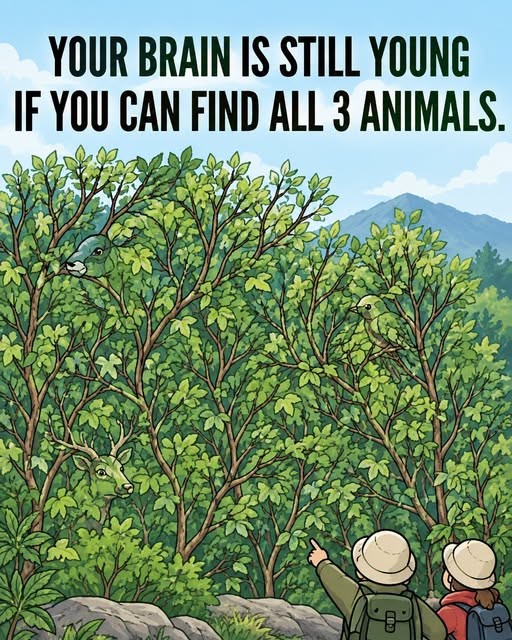
Three Animals Are Hiding in Plain Sight in a Mysterious Blue Forest
Introduction: The Fascination with Optical Illusions
Optical illusions have captivated humans for centuries, intriguing both children and adults alike. These visual puzzles leverage the complexities of human perception, often challenging us to see what lies beneath the surface. One such illusion, set in a mysterious blue forest, has gained widespread attention for its clever concealment of three animals—a moose, a squirrel, and a bear. Viewers are invited to search for these creatures among twisting branches and tangled lines, testing their observational skills and perception in a compelling way.
The Puzzle: Searching in the Blue Forest
At first glance, the scene appears to be little more than a dense collection of branches, rendered in shades of blue. However, hidden within this maze are three distinct animals. The moose, squirrel, and bear do not announce themselves with obvious shapes; instead, they are cleverly integrated into the artwork using curves, lines, and negative space. This method turns a simple search into a genuine test of perception and attention to detail.
Participants are encouraged to look beyond apparent shapes and focus on subtle cues. Sometimes, what appears to be a mere branch, upon closer inspection, is revealed as part of an animal’s anatomy. The challenge lies in shifting one’s focus from the foreground branches to the empty spaces. These spaces may provide clues, as they form outlines and contours that emerge only when viewed from particular angles.
The Psychology Behind Hidden Images
Optical illusions like this blue forest scene exploit the limits of our visual processing system. Our brains are wired to recognize patterns and familiar shapes; however, when those shapes are disguised by complex backgrounds, it becomes challenging to separate them from noise. This phenomenon is known as “figure-ground perception,” a concept studied extensively in the field of cognitive psychology.
Figure-ground perception refers to the ability of the brain to distinguish between foreground objects (figures) and background (ground). When the boundaries between figure and ground are subtle or ambiguous, it forces the observer to engage more deeply, sometimes changing their perspective or approach. This is why scanning the image slowly from top to bottom—rather than jumping around randomly—can be more effective at discerning hidden objects.
Strategies for Solving Visual Puzzles
For those attempting to solve this puzzle, several techniques can boost success:
- Slow Scanning: Methodically move your gaze across the image rather than skipping from one area to another.
- Focus on Negative Space: Often, the outlines of animals become clearer in the gaps between branches.
- Identify Unusual Patterns: Pay attention to curves, odd angles, and groupings of lines that may indicate a larger shape.
- Take Breaks: Returning to the image with fresh eyes can help reset your perception and reveal hidden details.
Many visual puzzle enthusiasts report that once the first hidden object is revealed, the remaining ones become easier to spot. This is due to priming: having recognized one pattern, the brain becomes more adept at seeking similar shapes.
Why Are Moose, Squirrel, and Bear Chosen?
The choice of animals is significant in such puzzles. Moose, squirrel, and bear have contrasting sizes and forms, making their concealment particularly challenging. The moose, with its large antlers, the bear’s robust shape, and the squirrel’s compact body each present unique difficulties for the artist and the viewer. Their familiar features, when disguised among twisting branches, encourage viewers to search for both large and small details in the artwork.
These animals are also iconic in many northern forests, giving the scene a naturalistic context. The presence of the blue hue introduces an element of mystique, setting an otherworldly atmosphere that adds to the challenge.
The Satisfaction of Discovery: Cognitive Rewards
One of the most rewarding aspects of optical illusions is the sudden moment of clarity. When a jumble of branches transforms into the recognizable shape of a creature, the sense of achievement is immediate. This process provides a cognitive reward, releasing dopamine, which is associated with pleasure and motivation.
The same mechanism is engaged when solving crosswords, sudoku puzzles, or riddles—activities known for supporting cognitive health. Optical illusions not only entertain but also exercise the brain’s ability to adapt and recognize novel patterns.
The Science of Visual Perception
The ability to identify hidden images is rooted in the science of visual perception. Studies by neurologists and vision scientists reveal that regions of the brain responsible for object recognition, such as the occipital lobe, work in tandem with the prefrontal cortex, which handles attention. When images are ambiguous or cluttered, these regions must collaborate intensively, engaging both logic and intuition.
Research has shown that exposure to visual puzzles enhances certain types of cognitive function, including attention to detail, memory retention, and creative problem-solving. This is particularly evident in studies examining how children and adults respond to puzzles in educational and therapeutic settings.
Global Appeal and Societal Reactions
Optical illusions are universally appealing, bridging cultural, linguistic, and age-based divides. The blue forest puzzle has sparked debates and conversations across social media platforms, as participants share their experiences, tips, and discoveries. Countries with traditions of visual art, such as Japan, France, and India, have seen optical illusions incorporated into school curricula and art therapy programs.
In addition, digital publishers and newspapers often feature such puzzles as a means of engaging their audiences. Teachers and parents report that puzzles like these foster collaborative learning and perseverance among students.
Expert Views on Optical Illusions and Learning
Experts in cognitive psychology and educational theory highlight the value of optical illusions for stimulating perceptual and associative learning. According to Dr. Richard Gregory, a renowned vision scientist, illusions reveal how our senses can be deceived and how adaptive our cognitive processes are. The skills required to solve visual puzzles—such as attention, pattern recognition, and spatial reasoning—translate well into real-world problem solving.
Educational leaders suggest introducing optical illusions into classrooms to nurture critical thinking and creativity. Therapists advocate for their use in rehabilitation programs for people recovering from neurological injuries, noting improvements in visual tracking and cognitive flexibility.
Beyond Entertainment: Optical Illusions in Science and Medicine
Optical illusions are not merely a source of entertainment; they serve practical purposes in scientific research and medical diagnostics. Vision researchers use illusions to understand how the human eye and brain cooperate to assemble visual information. In medicine, illusions can be used in diagnosis and treatment of certain vision disorders by assessing how patients interpret ambiguous images.
In art, illusion techniques have influenced painters and digital designers, resulting in works that challenge or enhance perception. The study of illusions also informs technology, such as virtual reality systems, where understanding perceptual limits is crucial for creating immersive experiences.
Tips for Enjoying Optical Puzzles
If you are inspired by the mysterious blue forest puzzle, there are several ways to enhance your experience with optical illusions:
- Share puzzles with friends and family to turn the challenge into a social activity.
- Experiment with different viewing angles and lighting conditions.
- Engage with online communities dedicated to visual puzzles to discover new tips and variations.
- Explore museum exhibits or online galleries featuring famous illusion artworks.
Conclusion: A Simple Branch or a Hidden Animal?
The journey through the mysterious blue forest is more than a search for hidden creatures—it is an exercise in observation, patience, and cognitive flexibility. The moose, squirrel, and bear hiding among the branches reward those who look beyond the obvious. These puzzles remind us of the intricate balance between perception and reality, and why the human mind is endlessly fascinated by the challenge of discerning what lies beneath the surface.
Whether you found all three animals or are still searching, the experience invigorates attention to detail and curiosity. Optical illusions, such as this one, remain a testament to the power and adaptability of the human mind.
Sources
- BBC: The Science of Optical Illusions
- Reuters: Visual Puzzles Engage Global Audiences
- The Guardian: Cognitive Neuroscience and Visual Perception
- Mayo Clinic: Vision Testing and Perception
- WHO: Vision and Cognitive Health
Disclaimer: This content is intended for entertainment purposes only and is not based on real events.