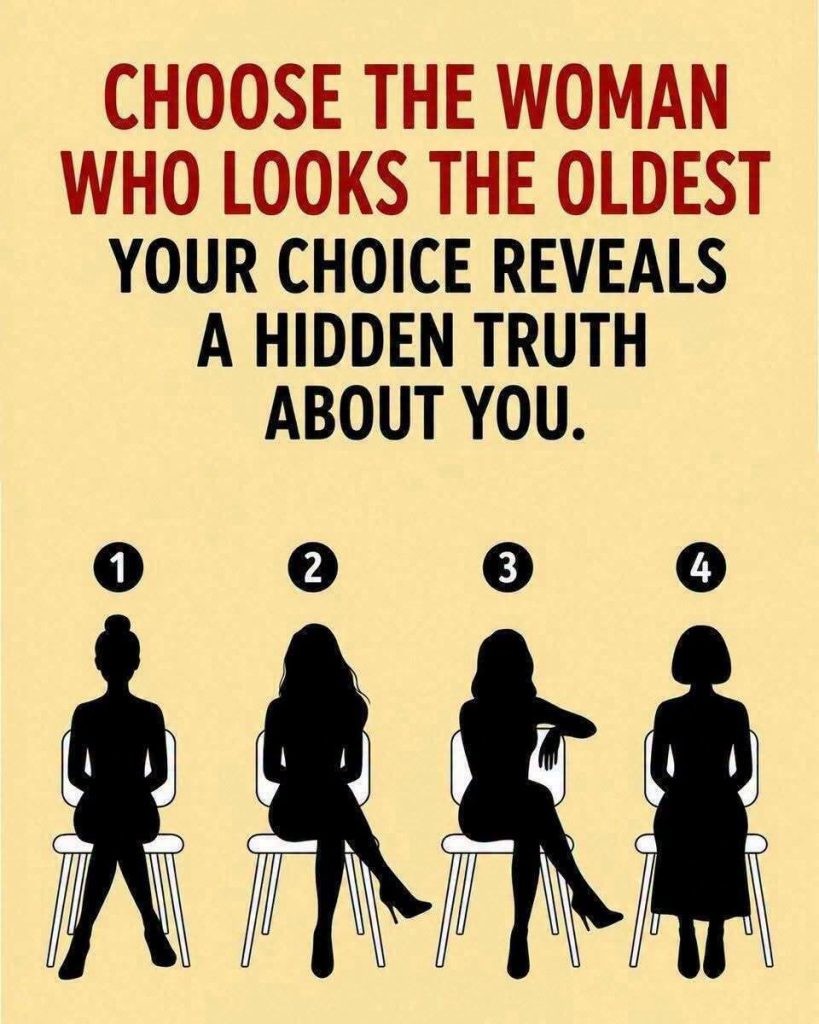
Which Woman Looks Oldest to You? What Your Choice Says About Your Perception
First impressions often shape the way we interpret the world around us, especially when making swift judgments about people and situations. A popular visual exercise asks viewers to quickly choose which of four silhouetted women appears “oldest” to them, then reflect on what this immediate decision might indicate about their perceptions and values. While the figures are mere outlines and contain no objective clues to age, the exercise provides an intriguing gateway for examining personal associations with traits such as maturity, confidence, empathy, and stability — all without scientific judgment.
Understanding the Exercise: The Power of First Impressions
The premise of this visual exercise is simple: observe an image containing four silhouetted women, then choose within seconds which figure you instinctively feel embodies the most age, experience, or maturity. The important instruction is not to overthink or analyze details, but to follow your first, automatic reaction. Because the silhouettes are ambiguous and devoid of facial features, expressions, or clothing details, your decision is guided almost entirely by subconscious cues and personal associations.
Psychologists refer to these immediate, intuitive reactions as “thin slicing” — a concept studied extensively for its role in social perception. According to research published in academic sources, thin slicing can yield surprisingly accurate judgments about emotional states and intentions, but is also colored by cultural, personal, and situational biases. In the context of this exercise, your selection is less a reflection of the women in the image, and more an insight into your own mindset, priorities, and value systems.
The Implications of Your Choice: Interpretations and Meaning
Below, we invite you to consider the interpretations commonly associated with picking each figure. None of these choices are diagnostic or psychological tests; rather, they offer a lens for self-reflection.
If You Chose Woman 1: The Value of Order and Responsibility
Choosing the first woman in the set may suggest an association between maturity and qualities like discipline, structure, and dependability. You might be the type who feels comfortable when there is a clear plan, preferring routine and responsibility over uncertainty. The upright, composed posture of Woman 1 could symbolize stability for you. People with this mindset are often seen as trustworthy in challenging situations, ready to take charge when necessary. However, a tendency to make rapid judgments based on immediate impressions can sometimes lead to overlooking nuance. Psychology experts like Dr. Malcolm Gladwell, who wrote extensively about thin slicing in his book Blink, warn about both the power and risk of quick assessments. Deliberately allowing more time for others to show their true character can sometimes yield deeper and more accurate understanding.
If You Chose Woman 2: Prioritizing Empathy and Emotional Connection
Your selection of the second silhouette might reveal a preference for warmth, openness, and emotional intelligence. You may focus on the atmosphere someone creates or the energy they give off, rather than surface-level characteristics such as appearances or status. Deep conversation and authenticity likely matter to you in forming connections. Emotional sensibility can foster strong, meaningful bonds with others, according to relationship psychologists, but it may also bring challenges — such as the risk of becoming overly invested in others’ emotions or problems. Social research consistently identifies empathy as a critical skill for community cohesion, leadership, and conflict resolution, but maintaining boundaries offers essential balance.
If You Chose Woman 3: Confidence and Independence
For many people, the idea of maturity is closely linked to self-assurance, decisiveness, and autonomy. If you find yourself drawn to Woman 3, you may respect those who seem comfortable in their identity and aren’t hesitant to act. This independent spirit is appreciated in diverse cultures as a trait of leadership and initiative. Studies on leadership, such as Zenger and Folkman’s research published in the Harvard Business Review, show that individuals who display confident, proactive behavior often succeed in motivating teams and handling adversity. However, true leadership also requires listening and openness to other ideas — traits that prevent strong will from hardening into inflexibility.
If You Chose Woman 4: Stability, Patience, and Comfort
Individuals who choose the fourth woman may associate wisdom and maturity with low-key confidence, patience, and an appreciation for the familiar. You might prefer deep but steady relationships, reliable routines, and environments that offer peace rather than excitement. This approach aligns with psychological theories on attachment and security, which highlight the value of stability for mental well-being. Experts like Dr. Sue Johnson emphasize that people with secure attachment styles benefit from predictability and trust in relationships. At the same time, occasional change can stimulate personal growth and resilience, suggesting balance between comfort and novelty is key.
The Science Behind Perception: Why We See What We See
Human perception is shaped by a complex mix of biology, culture, and life experience. Visual psychology studies suggest that when confronted with ambiguous images, people draw from patterns stored in memory. For example, posture might signal authority or resignation, while uprightness can hint at confidence or discipline. Cultural influences also play a significant role: what one society deems the mark of maturity — such as visible age, status, or parental qualities — may differ widely from another’s perspective. In research from the American Psychological Association, scholars have shown that even small cues can activate deep personal associations, which may not be consciously accessible without reflection.
The International Perspective: Universalities and Cultural Differences
Though the silhouettes offer no explicit markers like clothing or facial lines, the traits they evoke may be shaped by one’s cultural values. In collectivist societies, for instance, maturity is sometimes equated with deference and patience, while individualistic cultures may prize autonomy and confidence. Cross-cultural psychology finds both universal and culturally specific ideas of what makes a person seem “mature” or “wise.” For example, research in Reuters highlights the diversity of how age, respect, and status are interpreted around the world.
In practice, this exercise allows for a nonjudgmental way to explore your instinctive associations and stimulate conversations about what maturity and wisdom mean within different settings — at home, in workplaces, and across societies.
Mental Exercises and Personality: Entertainment, Not Diagnosis
It is important to emphasize that this type of image-based selection exercise does not offer a psychological diagnosis or scientific assessment of one’s personality. Psychological tools that claim to “reveal” your traits should always be approached with caution. The silhouettes provide a playful scenario for self-awareness, not authoritative insights. Serious personality evaluations are best conducted through validated methods under professional care, as recommended by organizations like the American Psychological Association.
This exercise encourages curiosity and personal reflection. Recognizing the diversity of how people interpret the world can foster empathy, reduce misunderstandings, and support open-mindedness in social interactions. Whether you see yourself as an organizer, empath, leader, or stabilizer, each perspective offers its strengths — and every perspective may shift according to situation, experience, or environment.
Expert Views: Insights from Psychology
Leading psychologists suggest that exercises like this tap into what is known as projective perception: when people interpret ambiguous stimuli based on their own feelings or subconscious associations. While fun and interesting, these exercises highlight more about the framework of our perception than offer factual information about our personalities. As Dr. Richard Wiseman notes, “Projective tests reveal the stories people tell themselves about the world — and sometimes, just sometimes, those stories are useful to examine.”
Self-reflection, initiated by neutral activities such as this, can help break automatic thinking patterns and promote more considered, empathetic responses. According to mental health experts at the Mayo Clinic, understanding why we react instinctively in social scenarios supports emotional intelligence and greater satisfaction in relationships.
Societal Reactions and Applications
In popular culture and digital media, visual exercises like choosing the “oldest” silhouette are widely used for entertainment and as icebreakers in group settings. While not scientifically rigorous, they can facilitate open conversation — about values, about what different cultures find admirable, and about the importance of challenging first impressions before drawing conclusions. Social scientists advocate using these moments to foster diversity and critical thinking skills, both essential for healthy communities in a globalized world.
Ultimately, these visual impression exercises foster moments for dialogue, recognition of unconscious bias, and appreciation of the richness of human judgment. They remind us that even simple, consequence-free choices can serve as tools for understanding ourselves and others more deeply.
Conclusion: Embracing Diversity in Perception
Whether your instant choice reflects a preference for order, warmth, confidence, or stability, remember that there is no “correct” or “incorrect” answer. Your decision is entirely personal, shaped by a lifetime of experiences and influences. The real value lies in self-awareness and in opening conversations about the roots of human perception. By understanding how we see the world, we are better able to appreciate its complexity — and our own place within it.
Sources
Disclaimer: This content is intended for entertainment purposes only and is not based on real events.