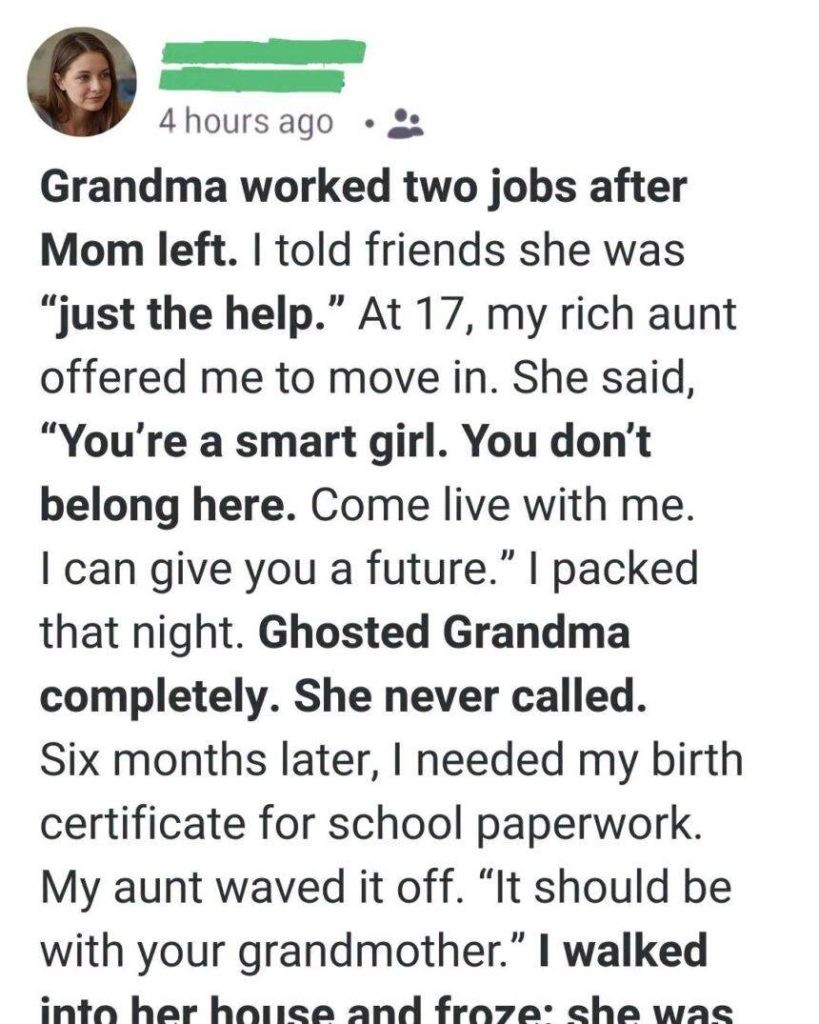
Grandma Worked Two Jobs After Mom Left
The Unspoken Sacrifices of a Grandmother
When families experience sudden change or hardship, the roles of parental figures can shift dramatically. In such moments, everyday heroes often emerge, stepping forward to fill gaps left by circumstances beyond anyone’s control. For many, grandparents become the silent pillars who sustain their grandchildren, offering care, structure, and emotional support, even at great personal cost. This is the story of one such grandmother, whose enduring love and hard work shaped her granddaughter’s life in ways that only became clear over time.
A Childhood Marked by Absence
The narrative begins with a void—an absent mother who left with no warning, leaving her child behind. For the young girl at the center of this story, the sudden disappearance brought confusion, pain, and the need to adapt quickly. However, it also forged a remarkable relationship with her grandmother, who quietly assumed the responsibility of a parent.
Growing up, the granddaughter chose not to share the full truth about her upbringing with peers. When friends asked who raised her, she often responded with detached humor, claiming her grandmother was “just the help.” This deflection concealed the more complicated reality of her home life and the quiet sacrifices made by the woman who had become her primary guardian.
For many children raised in unconventional families, maintaining social acceptance and hiding perceived differences can be a daily struggle. The granddaughter’s reluctance to reveal the truth reflected not only teenage awkwardness but also a deeper need to belong.
Grandmother’s Daily Struggle and Resilience
After the mother’s departure, the grandmother’s role expanded dramatically. She began working two jobs—cleaning offices at dawn and stocking shelves overnight—to provide for her granddaughter. Despite her own exhaustion, she still found the strength to braid her granddaughter’s hair before school and painstakingly launder her one good dress by hand.
The granddaughter’s embarrassment over her grandmother’s appearance at school events—the tired eyes, the old car, the lingering scent of cleaning solution—was unmistakably human. Social pressures often cause children to feel uncomfortable about circumstances beyond their control. The contrast between her grandmother and other girls’ mothers, who arrived at school in stylish clothes and perfume, was sharply felt.
Sociologists note that children living with kin, rather than biological parents, often experience shame or guilt, particularly in environments where family norms revolve around the nuclear structure. However, these same children frequently develop resilience and empathy, drawing on the example set by their guardians.
The Allure of a Different Life
At seventeen, a new opportunity arrived in the form of her aunt—her mother’s older sister—who offered comfort, wealth, and the promise of a different life. With her appearance and affluence, the aunt suggested that moving in with her would open doors to a brighter future. The granddaughter’s grandmother, in a remarkable act of selflessness, did not object; she simply continued her nurturing rituals, choosing only to ask what her granddaughter would like for dinner.
Many young adults who are given the chance at new beginnings may choose to leave behind those who have supported them the most—a complex decision rooted in the desire for acceptance, success, or simply escape. The granddaughter, too, left calmly without elaborate goodbyes or promises to keep in touch.
Emotional Distance and Lingering Guilt
Despite leaving, the granddaughter found it easier to rationalize her absence by telling herself that her grandmother no longer needed her. This was a protective narrative, shaped by the guilt of leaving the only parent she had known. It is common for estranged family members to justify distance with stories of mutual independence.
Yet life has a way of reopening old doors. When the granddaughter needed her birth certificate for school, her aunt reminded her that it was still with her grandmother. Returning to her old home, she found her grandmother asleep on the couch in her work uniform, evidence of exhausting labor. The simplicity of the moment—the familiar photo, the familiar drawer—prompted a cascade of memories and unspoken emotion.
Quiet Generosity and Mutual Understanding
Though she left with the paperwork, the granddaughter could not ignore her feelings of regret and concern. She began sending her grandmother money each month, a modest gesture for groceries or necessities, always without note or explanation. The grandmother accepted these contributions silently, without acknowledgement, allowing her granddaughter to atone in her own way.
The silent exchange became a ritual, a communication between two generations defined not by words but by consistent, caring action. Financial support is a meaningful way families continue to care for one another, reinforcing bonds even across emotional or physical distance. Research in family psychology finds that gestures—however small—can sustain connections when words fail.
Years passed in this unspoken understanding. The granddaughter completed her education, built a career, and created a new life, all while allowing her aunt the public credit for her success. In many families, attributions of support and sacrifice are often simplified for social ease, but the deeper truth lies in everyday acts often unseen by outsiders.
An Unexpected Reunion
The balance shifted when a call came from a neighbor: the grandmother had experienced a minor fall at work but was recovering at home. Without hesitation, the granddaughter visited. Their reunion was understated but deeply meaningful. The grandmother’s first words were practical, caring—asking if her granddaughter was eating well, rather than confronting her with past absences or guilt.
The conversation turned to the years of silent financial support. The grandmother acknowledged her awareness, but emphasized the importance of allowing her granddaughter to give quietly. Her reaction was compassionate, devoid of reproach. This mature approach reveals an understanding that love and forgiveness are best given freely, not demanded.
Studies have shown that family relationships characterized by unconditional acceptance, rather than judgment, foster the mental and emotional resilience of children and young adults. The acceptance displayed by the grandmother provided the granddaughter with the space to confront her own feelings and seek reconciliation.
Building a Shared Future
The story comes full circle as the grandmother moves in with the granddaughter, marking a new chapter shaped by companionship, gratitude, and care. With the years of hard labor behind her, the grandmother still clings to her routines—rising early and tending to housework. The granddaughter, though sometimes reminded of her grandmother’s past exhaustion, now finds peace in watching her rest.
Today, when people ask about the older woman who shares her home, the granddaughter proudly introduces her as the grandmother who raised her. This simple act of recognition has come to mean everything to them both—a public acknowledgment of love, sacrifice, and the irreplaceable role of kinship in personal development.
Researchers in sociology and child development have long highlighted the profound impact kin caregivers have on grandchildren’s outcomes. Beyond meeting material needs, these caregivers instill values, resilience, and a sense of belonging that last a lifetime.
Reflections on Gratitude and Reconciliation
This story exemplifies the quietly heroic sacrifices often made by grandparents and other kin caregivers worldwide. In the United States and beyond, millions of children are raised by relatives who step in during times of crisis. According to the U.S. Census Bureau, millions of grandparents are householders responsible for their grandchildren. Their efforts are often underappreciated, despite their vital importance to family and social stability.
At the heart of the story is not only gratitude, but also the journey toward maturity and self-acceptance. Many people come to understand and appreciate their familial bonds only after gaining perspective from distance or adversity. The granddaughter’s evolution from embarrassment, to guilt, to pride in her grandmother’s care, mirrors a universal process of growth and reconciliation.
The story also reminds us that reconciliation does not require grand gestures. Sometimes, quiet acknowledgment and shared understanding are enough to rebuild even the most complex relationships.
The Wider Societal Impact of Kin Caregiving
The trend of grandparents as primary caregivers is not limited to individual families—it has emerged as a significant social phenomenon in many societies, influenced by economic hardship, health crises, and shifting family structures. Organizations such as Generations United in the U.S., and numerous studies in child welfare, recognize the increased reliance on intergenerational support.
Kin caregivers often experience significant financial, emotional, and physical challenges as they provide for grandchildren. Support systems, whether from government, community organizations, or extended family, play a critical role in relieving some of these burdens.
Internationally, societies are gradually recognizing the contributions of grandparents through social programs, legal protections, and public advocacy. Increased awareness of their role is essential for ensuring policies are in place to stabilize families and offer children the supportive environments they need to thrive.
Conclusion
The story of a grandmother quietly working two jobs to care for her granddaughter is one of resilience, love, and the transformative power of family. While unspoken sacrifices can go unnoticed in day-to-day life, their impact endures across generations. Recognizing and appreciating the unsung heroes within families helps foster stronger, healthier communities for all.
In every society, countless grandmothers, grandfathers, aunts, and uncles step forward when needed most. Their contributions deserve recognition and support, not only from those they nurture but from the wider world as well.
Sources
- U.S. Census Bureau – Facts on Grandparents as Caregivers
- BBC News – Family and Society
- The Guardian – Family Support
- Generations United
Disclaimer: This content is intended for entertainment purposes only and is not based on real events.