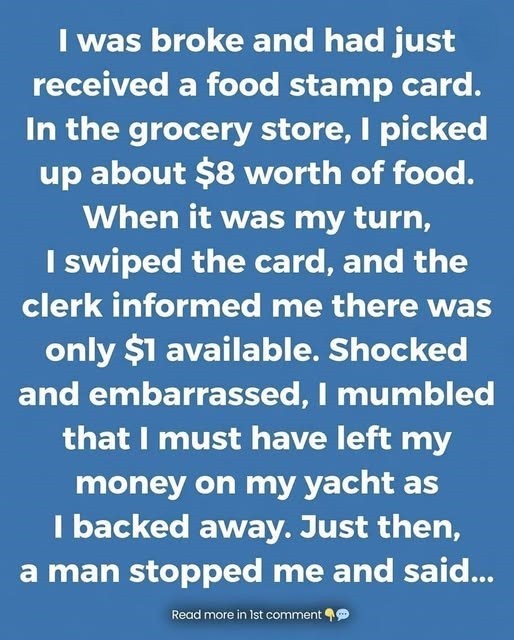
I walked toward the exit with my head down, hoping nobody would look at me.
My cheeks were burning with embarrassment, and I could still feel the uncomfortable knot in my throat. Just moments earlier, my debit card had supposedly been declined at the checkout.
It was only a small moment.
But when you are standing in front of other people, holding a basket of groceries and suddenly unable to complete a simple purchase, embarrassment can feel much bigger than the situation itself.
I did not want anyone to notice.
I did not want questions.
Most of all, I did not want anyone to feel sorry for me.
So I decided to leave.
I had barely reached the door when a man I had never seen before stepped toward me.
He held out a twenty-dollar bill.
“I think you dropped this,” he said with a calm smile.
I looked at the money, then at him.
For a second, I was confused.
Then relief washed over me.
I must have dropped it, I thought.
Perhaps it had slipped out of my wallet when I was searching for my card.
I thanked him and accepted the bill.
I did not think much more about it.
At that moment, I was simply grateful that I could return to the checkout and buy the groceries I needed.
I had no idea that the stranger had given me something much more valuable than twenty dollars.
He had given me a way to accept help without feeling exposed.
The Embarrassing Moment at the Checkout

Financial difficulties can be deeply personal.
Even when someone is experiencing a temporary problem, standing in a public place and realizing that a payment is not going through can create an uncomfortable feeling of vulnerability.
People around you may not know your circumstances.
They may not know whether the problem is technical, temporary, or financial.
But when something goes wrong in front of others, the mind can quickly imagine that everyone is watching.
That was how I felt.
I had already planned what I needed to buy.
Nothing extravagant.
Just ordinary groceries for home.
When the card did not work, my first reaction was confusion.
I checked the card.
I tried again.
Still nothing.
Eventually, I decided that leaving would be easier than continuing to stand there.
I lowered my head and started walking toward the exit.
Then the stranger approached me.
“I Think You Dropped This”
His words were simple.
There was no dramatic speech.
No long explanation.
He did not ask why my card had been declined.
He did not ask whether I needed help.
He simply held out a twenty-dollar bill and said he thought I had dropped it.
I believed him.
Why wouldn’t I?
People return things they find all the time.
I looked at the bill and tried to remember whether I had taken it out earlier.
Maybe I had accidentally dropped it.
Maybe I had forgotten that I was carrying it.
The explanation seemed perfectly reasonable.
More importantly, it allowed me to accept the money without feeling embarrassed.
I thanked him.
He smiled.
Then he walked away.
There was no expectation that I would remember his name.
No request for recognition.
No attempt to make the moment about himself.
He simply helped and left.
The $20 That Changed the Situation

I returned to the checkout and was able to purchase the groceries I needed.
The entire situation suddenly felt much smaller.
The embarrassment began to fade.
I left the store and went home.
For the rest of the afternoon, I thought very little about the stranger.
I assumed he had simply been a kind person who had noticed that I had accidentally dropped some money.
It was a nice thing to happen.
But I did not yet understand what had actually happened.
That realization came later.
The Moment I Discovered the Truth
Later that day, I stopped at another store.
I reached for my debit card as usual.
I expected the same problem.
Instead, the transaction went through without difficulty.
I stood there for a moment, confused.
If the card was working now, what had happened earlier?
When I returned home, I checked my bank account.
There was nothing unusual.
My account had sufficient funds.
There had apparently never been a problem with the balance itself.
Then another thought occurred to me.
I opened my wallet.
And there it was.
My original twenty-dollar bill.
Exactly where I had left it.
I stared at it for a moment.
Then everything suddenly made sense.
The stranger had not returned my money.
He had given me his.
He Had Protected My Dignity

The realization affected me more than I expected.
The stranger could have simply handed me twenty dollars and told me to use it.
But that might have made me feel uncomfortable.
I might have refused.
I might have felt embarrassed.
I might have wondered whether people nearby were watching.
Instead, he created a small story that allowed me to accept his kindness while keeping my dignity intact.
He did not make me feel like someone receiving charity.
He made me feel like someone who had simply been reunited with something that belonged to her.
That difference may seem small.
It wasn’t.
There is a special kind of kindness in helping someone without making them feel smaller.
Why Dignity Matters When Offering Help
Helping someone is not only about what you give.
It can also be about how you give it.
Imagine someone struggling to carry several bags.
You could loudly announce that they need help.
Or you could quietly take one bag and walk beside them.
The practical result may be similar.
But the emotional experience can be very different.
People generally want to maintain a sense of independence and dignity.
When someone is already feeling vulnerable, unwanted attention can make the situation more uncomfortable.
The stranger seemed to understand this instinctively.
He did not turn my difficult moment into a public lesson.
He simply made it easier.
Kindness Without Recognition

One of the most memorable parts of the experience was that the stranger received nothing in return.
He did not know me.
He did not know my circumstances.
He did not know whether I would remember him.
He did not ask for anything.
He simply saw a person having a difficult moment and decided to help.
There is something powerful about that kind of generosity.
Modern life often places considerable attention on public acts of kindness.
People share charitable efforts online.
Organizations celebrate generous donations.
Individuals tell stories about helping others.
There is nothing inherently wrong with recognition.
But quiet kindness has its own beauty.
Sometimes the person who helps you may never know how deeply their action affected you.
They may forget the encounter entirely.
Meanwhile, the person receiving the kindness may remember it for years.
Small Acts Can Have a Lasting Effect
Twenty dollars may not sound like a life-changing amount of money.
In the context of that particular day, however, it mattered.
It allowed me to purchase the groceries I needed.
More importantly, it changed how I felt during a moment when I had been struggling with embarrassment.
The emotional value of the gesture was much greater than the amount itself.
This is an important reminder about everyday kindness.
A kind action does not have to be expensive.
It might be holding a door open.
Offering directions.
Checking on a neighbor.
Listening to someone who needs to talk.
Letting another driver merge.
Sharing a meal.
Giving someone encouragement.
These actions may take only a few seconds.
Yet they can influence someone’s entire day.
Why We Often Remember Kindness
Human beings tend to remember emotionally meaningful experiences.
A brief interaction can stay with someone when it occurs at exactly the right moment.
The stranger’s gesture came when I was feeling particularly vulnerable.
That may be why it became so memorable.
He did not solve every problem in my life.
He did not know anything about my future.
He simply changed one difficult moment.
But sometimes that is enough.
When someone feels overwhelmed, a small reminder that another person cares can make the world feel a little less lonely.
The Difference Between Charity and Compassion
Charity often involves giving resources to someone who needs them.
Compassion goes a step further by recognizing the person’s emotional experience.
The stranger’s action contained both.
He gave money, but he also considered how I might feel accepting it.
That second part is what made the gesture especially thoughtful.
He understood, perhaps instinctively, that people do not only need practical assistance.
Sometimes they need to feel respected while receiving it.
This is a valuable lesson for anyone who wants to help others.
Ask not only, “What can I give?”
Also consider, “How can I give it in a way that respects this person’s dignity?”
Kindness Does Not Always Look Dramatic
Stories about generosity often focus on extraordinary gestures.
Someone pays a large bill.
A stranger changes someone’s future.
A community comes together after a major challenge.
Those stories can certainly be inspiring.
But kindness does not have to be dramatic.
Sometimes it is almost invisible.
A person notices someone having a difficult moment.
They quietly step forward.
They make things easier.
Then they move on.
No audience is required.
No applause is necessary.
The simplicity may actually be what makes the action so meaningful.
What the Stranger Taught Me
I never learned much about that man.
I do not know where he came from.
I do not know what he was thinking when he saw me walking toward the exit.
I do not know whether he regularly helps strangers or whether that moment was simply an impulse.
And perhaps I do not need to know.
What matters is what he chose to do.
He could have walked past.
Instead, he stopped.
He could have made me feel embarrassed.
Instead, he protected my dignity.
He could have demanded gratitude.
Instead, he quietly disappeared.
That small encounter changed how I think about helping people.
We Never Know What Someone Else Is Carrying
One reason kindness matters is that we rarely know what another person is experiencing.
Someone who appears distracted may be worried about something at home.
Someone who seems quiet may simply be having a difficult day.
Someone who makes a mistake may already feel embarrassed.
Someone who appears perfectly fine may be dealing with private concerns that nobody else can see.
We cannot know every person’s circumstances.
But we can choose how we respond to them.
A little patience costs very little.
A little understanding can mean much more than we realize.
The Twenty Dollars Became a Memory
Eventually, the money was spent.
The groceries were eaten.
The day continued.
But the memory remained.
Whenever I think about that moment, I no longer remember the embarrassment as strongly as I remember the stranger’s smile.
That is perhaps the most remarkable part.
He transformed what could have remained an uncomfortable memory into a reminder of human generosity.
The problem with my card was temporary.
The twenty dollars was temporary.
But the lesson stayed.
Kindness does not always require knowing someone’s story.
It does not always require a large sacrifice.
Sometimes it simply requires noticing.
A Quiet Reminder That Compassion Still Matters
We often hear about how disconnected modern life can feel.
People rush through stores.
They look at their phones.
They move from one responsibility to another.
It can be easy to assume that everyone is focused only on themselves.
Then a moment like this happens.
A stranger notices.
A stranger stops.
A stranger chooses to help.
And suddenly the world feels a little different.
That is why small acts of kindness matter.
They remind us that compassion does not have to be complicated.
It can happen between two strangers who never meet again.
It can take less than a minute.
It can cost very little.
And it can still become a memory that someone carries for years.
I never expected a twenty-dollar bill to teach me such a powerful lesson.
The stranger did more than help me buy groceries.
He reminded me that kindness can be thoughtful, quiet, and respectful.
He showed me that helping someone does not have to come with embarrassment or attention.
Sometimes the most generous thing a person can give is not simply money or assistance.
It is the chance to accept that kindness while still feeling like yourself.
And perhaps that is what makes compassion so meaningful.
We may never know exactly what another person is going through.
But we can choose to make their day a little easier.
Sometimes, that small choice is enough to restore someone’s faith in people.
Sources
Greater Good Science Center at the University of California, Berkeley, research and resources on kindness, compassion, gratitude, and social connection. Greater Good Science Center
American Psychological Association, resources on relationships, well-being, and human behavior. American Psychological Association
National Institutes of Health, research and information concerning social connection, psychological well-being, and healthy relationships. National Institutes of Health
Encyclopaedia Britannica, background resources on altruism, generosity, and human social behavior. Encyclopaedia Britannica