
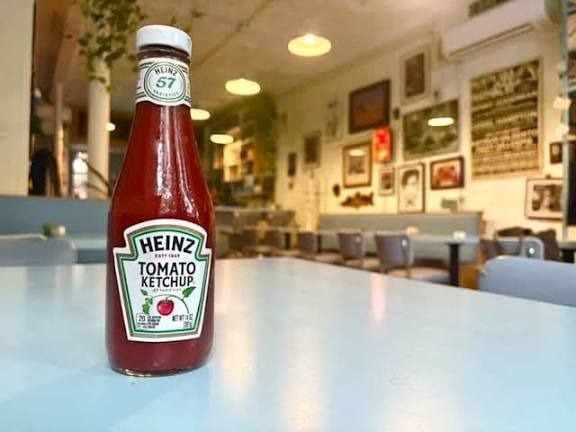
Have you ever sat down at a restaurant, reached for a ketchup bottle, and noticed the small “57” printed on the glass?
Most people probably have.
You may even have used the familiar trick of tapping the bottle around that number to encourage the ketchup to come out. But have you ever wondered why the number is there in the first place?
The answer is surprisingly simple, yet it reveals something fascinating about branding, psychology, and everyday traditions.
The famous number belongs to Heinz, and its origins go back more than a century. What began as a marketing idea eventually became one of the most recognizable details on a food package.
But the story of the “57” is not really about mathematics. It is about how a memorable idea can become part of everyday culture.
Where Did the Heinz “57” Come From?

The “57” is associated with the famous Heinz slogan “57 Varieties.”
The idea dates back to the late 1800s, when Henry J. Heinz was building the company that would eventually become famous around the world for ketchup and other food products.
According to the Heinz story, Heinz was inspired by a slogan he encountered while traveling. He reportedly saw an advertisement promoting a shoe company with a large number of styles and realized that numbers could make a marketing message more memorable.
At the time, Heinz was already producing a wide range of food products.
Rather than simply describing the company as having many varieties, he chose the number 57.
There was just one important detail: the number did not represent an exact count of everything Heinz produced.
That is what makes the story so interesting.
The “57” was essentially a branding decision. It sounded distinctive and gave the company a memorable identity.
In other words, 57 was chosen because it worked as a slogan, not because it was a precise inventory figure.
That simple decision would eventually become deeply connected with one of the world’s most recognizable food brands.
Why Was 57 Chosen?
The exact reasoning behind the number has been told in slightly different ways over the years, but the central idea remains the same.
Henry Heinz believed that a specific number could make a marketing message more memorable.
Instead of saying something generic such as “many varieties,” the phrase “57 Varieties” gave customers something concrete to remember.
This was an effective branding technique long before modern advertising became dominated by television, social media, and digital marketing.
Numbers can be surprisingly powerful in advertising.
A phrase such as “57 Varieties” feels more specific than “many varieties,” even when the number itself is not meant to provide a literal measurement.
That specificity can make a slogan easier to recognize and repeat.
Over time, the phrase became closely associated with Heinz itself.
The number was no longer simply part of an advertisement. It became part of the company’s identity.
The Number Wasn’t Really About 57 Products
One of the most common misconceptions is that Heinz literally had exactly 57 varieties of food.
That isn’t the point of the slogan.
Heinz had already developed a large selection of products, and the number was chosen as a memorable marketing device.
This is an important distinction because modern consumers often assume that numbers appearing in advertisements must represent precise statistics.
But advertising has always used numbers symbolically.
A memorable number can communicate ideas such as variety, choice, quality, or tradition without functioning as a literal measurement.
The “57” became effective precisely because people remembered it.
And once a slogan becomes recognizable enough, it can take on a life of its own.
How Did 57 End Up on the Ketchup Bottle?
Eventually, the number moved from advertising into the physical design of Heinz ketchup bottles.
This was a clever branding decision.
Instead of seeing “57 Varieties” only in advertisements, customers could see the number directly on the bottle sitting on their kitchen table or restaurant table.
That gave the number a practical and visual role.
The familiar glass ketchup bottle features the number near the neck, creating an easily recognizable detail that generations of customers have encountered.
But this is where another popular piece of ketchup folklore enters the story.
Many people have heard that tapping the “57” helps ketchup come out of the bottle.
And that belief has become almost as famous as the number itself.
Does Tapping the 57 Really Help?
There is a practical reason why ketchup can sometimes be difficult to pour.
Ketchup is a thick, slow-moving fluid. Its texture means that it does not always behave like water or other liquids.
The familiar advice to tap the area around the “57” has therefore become part of ketchup culture.
However, it is worth separating the marketing story from the physics of ketchup.
The number itself does not possess a special property that magically makes ketchup flow.
The tapping can help disturb the ketchup inside the bottle and encourage movement, but the effect depends on factors such as the bottle design, the ketchup’s consistency, and how much product remains inside.
So if someone tells you that the “57” is a secret mechanical button, that is better understood as a fun piece of popular tradition rather than a scientific fact.
Still, the tradition is fascinating.
A Small Detail Becomes a Family Tradition
Perhaps the most interesting part of the “57” story isn’t the marketing strategy at all.
It is what happened afterward.
Generations of people learned that when ketchup wasn’t coming out easily, they should tap the bottle around the familiar number.
Parents showed children how to do it.
Children eventually showed the next generation.
Something that began as a branding element became part of the experience of using the product.
This is how ordinary objects can acquire cultural meaning.
A number printed on glass may seem insignificant when viewed in isolation. But after people repeatedly interact with it, tell stories about it, and pass traditions along, it can become surprisingly memorable.
The same thing happens with many everyday objects.
A particular sound, package design, logo, phrase, or button can become connected with childhood memories, family meals, restaurants, and familiar routines.
The object itself may be ordinary.
The memories attached to it are not.
Why Numbers Work So Well in Branding
The success of “57” also illustrates an interesting principle in advertising psychology.
People tend to remember distinctive information more easily than vague descriptions.
Compare:
“Heinz offers many varieties.”
with:
“57 Varieties.”
The second phrase has a rhythm and specificity that makes it easier to remember.
It is short.
It is unusual.
And it creates curiosity.
Why 57?
Why not 50?
Why not 100?
That small question can make people pay attention.
From a modern marketing perspective, this is a useful lesson: sometimes the most memorable branding does not require a complicated explanation.
A simple, distinctive idea can be more powerful than a long description.
The Cultural Meaning of the Heinz Bottle

The Heinz ketchup bottle has become more than just packaging.
For many people, it represents familiar meals and everyday experiences.
It can bring to mind hamburgers, French fries, family dinners, barbecues, restaurants, and childhood memories.
That doesn’t mean every person has the same emotional connection to it.
Cultural associations vary between individuals and generations.
But the persistence of the design demonstrates how branding can become intertwined with ordinary life.
When a product remains recognizable for decades, its visual elements can become part of popular culture.
The “57” is a perfect example.
You don’t necessarily need to know its history to recognize it.
You simply see the number and immediately associate it with ketchup.
The Difference Between Marketing and Myth
Stories surrounding familiar products often become embellished over time.
People enjoy discovering hidden meanings behind ordinary objects, and that curiosity can sometimes turn a simple fact into a larger legend.
The story of Heinz’s “57” is a good example of why it is useful to distinguish between documented history and popular interpretation.
The number was created as part of the “57 Varieties” branding concept.
Its continued appearance on ketchup bottles helped turn it into a recognizable symbol.
The idea that tapping precisely on the number is a special ketchup-dispensing secret is better treated as a popular tradition than as evidence that the number itself has a unique physical function.
That doesn’t make the tradition less enjoyable.
If anything, understanding the difference between fact and folklore makes the story more interesting.
Why This Tiny Number Still Gets Attention
In today’s world, consumers are surrounded by logos, advertisements, notifications, labels, and digital content.
Yet tiny details can still capture our attention.
The “57” is a reminder that effective branding doesn’t always need to be loud.
Sometimes a small visual element is enough.
People notice it.
They remember it.
They talk about it.
Eventually, they may even teach someone else what it supposedly means.
That is a remarkable journey for two digits printed on a bottle.
The Enduring Legacy of “57”
The story of the Heinz “57” demonstrates how a simple marketing decision can become part of everyday culture.
It wasn’t necessarily created because Heinz had exactly 57 products. Instead, the number helped communicate variety while giving the brand a memorable identity.
Its appearance on ketchup bottles gave the slogan a physical presence.
And the familiar tapping tradition added another layer to its cultural identity.
Today, someone seeing “57” on a ketchup bottle may barely think about it.
But behind that tiny number is a story about advertising, memory, family traditions, and the surprising ways ordinary objects become meaningful.
Perhaps that’s why these small details are so enjoyable to discover.
We walk past them every day without asking questions.
Then one day, curiosity makes us stop and wonder:
Why is that number there?
And sometimes, the answer is much more interesting than we expected.
Sources
For further reading and verification, reputable references include:
Heinz — official company history and brand information.
Smithsonian Institution — historical perspectives on American food culture and branding.
Library of Congress — historical collections and materials relating to American advertising and consumer culture.
Encyclopaedia Britannica — background information on Henry J. Heinz and the development of the Heinz company.
Harvard Business Review — research and discussion concerning branding, consumer memory, and marketing psychology.
Final Thought
The “57” on a ketchup bottle may seem like an insignificant detail, but its story reminds us how human curiosity works.
We are naturally drawn to patterns, symbols, numbers, and unexplained details. A tiny mark on an everyday object can make us wonder about its origin, and that question can lead us into a much larger story about history and culture.
Perhaps that is the real magic of familiar objects.
Sometimes, the smallest details are the ones hiding the biggest stories.