When children are young, adulthood can look deceptively simple.
There is a home, food in the refrigerator, electricity when a light is switched on, internet access, clean clothes and many other everyday comforts. What children do not always see is the work, planning and money required to provide those things.
In 2015, one mother decided to make those hidden responsibilities visible after her 13-year-old son argued that earning his own money meant he should have more independence.
Her response became a widely discussed example of unconventional parenting and “tough love.”
A 13-Year-Old Wanted More Independence
The mother was Heidi Johnson, and her son was Aaron.
At the time, Aaron was 13 and earning a small amount of money through YouTube. According to Johnson’s later explanation, he had been pushing boundaries and challenging some of the rules at home.
One disagreement involved homework and screen time.
Johnson expected her son to complete his schoolwork and household responsibilities before spending time on electronics. Aaron reportedly felt that because he was making some money himself, he deserved greater freedom.
Rather than continuing the argument, Johnson decided to approach the situation from a completely different direction.
She wrote him a letter.
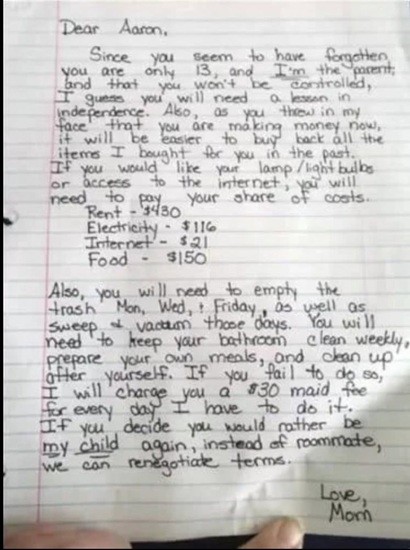
Instead of sounding like a traditional parental warning, the letter was structured almost like an agreement between roommates.
The $717 Monthly Bill
Johnson began by reminding Aaron that he was still 13 and that she remained his parent.

But because he wanted to be treated more like an independent adult, she decided to show him what that would actually involve.
The letter listed several monthly household expenses.
According to Johnson, Aaron’s fictional share included:
- $430 for rent
- $116 for electricity
- $21 for internet
- $150 for food
Together, those expenses came to $717 per month.
For a teenager earning a small amount from YouTube, the figure was obviously unrealistic.
That was precisely the point.
Johnson wanted Aaron to understand that having some personal income was very different from being financially independent.
Earning money can provide spending freedom, but genuine independence also requires being able to cover housing, food, utilities and other necessities.
The Lesson Was About More Than Money
The proposed arrangement did not stop with monthly expenses.
Johnson also gave Aaron household responsibilities.
He was expected to handle tasks such as taking out the trash, sweeping, vacuuming, cleaning his bathroom and preparing his own meals.
She even included a fictional $30 “maid fee” for days when she had to complete chores that he was supposed to handle himself.
The message was straightforward: if someone wants to be treated like an independent roommate, independence comes with responsibilities.
However, Johnson later clarified an important detail.
She never actually intended to make her 13-year-old son pay $717 a month or force him to leave the family home.
The bill was a teaching exercise.
Her goal was to help him recognize the effort behind the comforts he already enjoyed.
Aaron Was Not Immediately Impressed
According to Johnson’s later account, Aaron’s first reaction was not positive.
When he saw the letter, he became angry and crumpled it up.
He eventually left the apartment while upset.
Johnson had previously encouraged him to take a walk when emotions became intense, believing that stepping away could give both of them time to calm down.
When Aaron returned, however, the disagreement had not completely disappeared.
Johnson said she asked him to leave her room until they could have a respectful conversation.
Rather than continuing the confrontation, they gave each other more time.
Then something changed.
The Teenager Began to Reconsider
About an hour later, Aaron apparently began thinking differently about the situation.

Johnson later said he removed some electronics and other belongings from his room that he believed he should have to earn back.
He apologized and asked what he could do to improve the situation.
Some privileges were restored relatively quickly, while others were earned back over time.
For Johnson, that was an important part of the lesson.
The purpose was not to permanently punish her son.
It was to connect responsibility with privileges.
Aaron also began to understand the financial side of the argument.
The amount of money he was earning was nowhere near enough to cover the fictional household expenses his mother had listed.
How a Private Family Lesson Became a Viral Story
The situation might have remained a private disagreement between a mother and her teenage son.
Instead, Johnson’s Facebook post spread far beyond her original audience.
She later explained that she had intended to share the letter with friends, but the post was accidentally made public.
Once people discovered it, the story spread rapidly.
Thousands of people began discussing whether Johnson’s approach was appropriate.
Some praised her creativity.
Others strongly criticized the method.
The debate quickly became much larger than the original family disagreement.
Supporters Saw a Lesson in Financial Responsibility
Many people who supported Johnson believed the letter offered a useful lesson about adulthood.
Teenagers may understand that parents pay bills, but they do not always understand how quickly ordinary expenses can add up.
Rent, food, electricity and internet service are only some of the recurring costs adults have to consider.
Supporters argued that Johnson’s exaggerated bill helped make those invisible expenses easier for her son to understand.
They also pointed out that household responsibility is not limited to money.
Cooking, cleaning, taking out trash and maintaining a living space all require time and effort.
From that perspective, the letter was less about collecting money and more about explaining the responsibilities that come with independence.
Critics Had Different Concerns
Not everyone agreed with Johnson.
Some critics argued that children should not be made to feel as though they owe their parents money for necessities such as food and housing.
Others questioned whether presenting basic needs as a financial obligation could send the wrong message.
There were also concerns about privacy.
Because the dispute involved a 13-year-old, some people felt that making the conflict public on social media was inappropriate, regardless of the mother’s intentions.
Those concerns became an important part of the larger discussion surrounding the story.
Johnson Explained What She Was Actually Trying to Teach
After the story attracted widespread attention, Johnson repeatedly clarified her position.
She said she was not going to put her son out of the home if he could not pay the fictional bill.
He would continue to have food, shelter and other basic necessities.
Her intention was to encourage gratitude and responsibility.
She wanted Aaron to understand that the comforts of childhood do not appear automatically.
Someone works to provide them.
Someone pays the bills.
Someone buys groceries.
Someone cleans the house.
Someone makes sure there is a safe place to live.
For Johnson, recognizing that effort was an important part of growing up.
Aaron Already Had Household Responsibilities
Johnson also explained that the viral letter did not suddenly introduce responsibility into her son’s life.
Aaron already had ordinary household chores.
These included tasks such as:
- Taking out the trash
- Unloading the dishwasher
- Cleaning up after himself
- Making his bed
- Keeping his bedroom organized
- Cleaning his bathroom
- Helping with household cleaning
She also expected him to take school seriously, ask for help when necessary and complete homework before recreational screen time.
The issue was therefore not simply about chores.
It was about a teenager beginning to question why those expectations existed.
The Difference Between Earning Money and Being Independent
One of the most interesting parts of the story is the distinction between having income and being financially independent.
A teenager might earn money from a job, YouTube channel or another activity.
That does not necessarily mean the person can support an independent household.
Adults have to consider many expenses, including housing, food, utilities, transportation, clothing and unexpected costs.
They also have to manage schedules, responsibilities and long-term financial decisions.
Johnson’s fictional $717 bill was an exaggerated way of making that difference visible.
Her son could earn money.
But earning some money was not the same thing as being able to pay for an entire household.
Growing Up Naturally Brings More Responsibility
The conflict also reflects a familiar part of adolescence.
Teenagers naturally begin wanting more control over their lives.
They want to make their own decisions, stay up later, choose how they spend their time and have more privacy.
Parents, meanwhile, remain responsible for helping them develop the judgment and skills necessary for adulthood.
That can create tension.
A teenager may feel ready for independence before fully understanding what independence requires.
Parents have to find ways to gradually increase freedom while also teaching responsibility.
There is no single method that works for every family.
The Viral Letter Was Only One Moment
One problem with viral stories is that they often preserve only the most dramatic moment.
In this case, people saw the strict letter and formed opinions about the mother and son.
But the complete story included what happened afterward.
Johnson said Aaron eventually apologized.
They talked.
Some privileges were restored.
And the relationship continued.
Years later, Aaron also pushed back against suggestions that the incident had permanently damaged his relationship with his mother.
That later context is important because the viral letter represented one difficult moment rather than the entirety of their family life.
What Happened to the Relationship?
According to later coverage and statements attributed to Aaron, he and his mother remained close.
He also acknowledged that his behavior at 13 was not necessarily his proudest moment.
The conflict ultimately became something they could look back on rather than a permanent break in their relationship.
That does not prove that every aspect of Johnson’s parenting approach was ideal.
It simply shows that the story had a more complicated ending than the original viral post suggested.
The Social Media Debate Remains Relevant
The story also raises a question that has become increasingly important: Should parents share their children’s difficult moments online?
Johnson said the original post was not intended to become a worldwide story.
But once the letter became public, the family no longer controlled how it was discussed.
The incident demonstrates how quickly a private family disagreement can become public when shared online.
Today, parents have even more opportunities to document their children’s lives through social media.
That makes questions about consent, privacy and context increasingly important.
What Parents Can Take From the Story
Regardless of whether someone agrees with Johnson’s particular method, the underlying lesson is relatively straightforward.
Children benefit from gradually learning about:
- Money and budgeting
- Household responsibilities
- Saving and spending
- The value of work
- Respectful communication
- The consequences of choices
- The responsibilities that accompany greater freedom
Those lessons do not necessarily require a dramatic $717 bill.
They can be taught through age-appropriate chores, allowance management, savings goals and conversations about household expenses.
The important part is helping young people understand that independence involves both freedom and responsibility.
A Lesson That Became Much Bigger Than One Family
Heidi Johnson’s unusual letter was never really about collecting rent from a 13-year-old.
It was about making invisible responsibilities visible.
Aaron wanted the freedom associated with adulthood.
His mother wanted him to understand the other side of that equation.
Adults can make more decisions for themselves, but they also have bills to pay, work to complete, homes to maintain and responsibilities to manage.
The story became controversial because people disagreed about whether Johnson’s method was appropriate.
But the larger conversation it created is one many families eventually face.
Growing up is not simply about gaining more freedom.
It is also about learning how to handle the responsibilities that come with it.
For Johnson and Aaron, a difficult argument eventually became a lesson about money, household work, respect and independence.
And years after the original letter went viral, that distinction remains at the heart of why the story continues to attract attention.