Some puzzles are difficult because they require complicated calculations. Others are challenging for a much simpler reason: they make us look in the wrong direction.
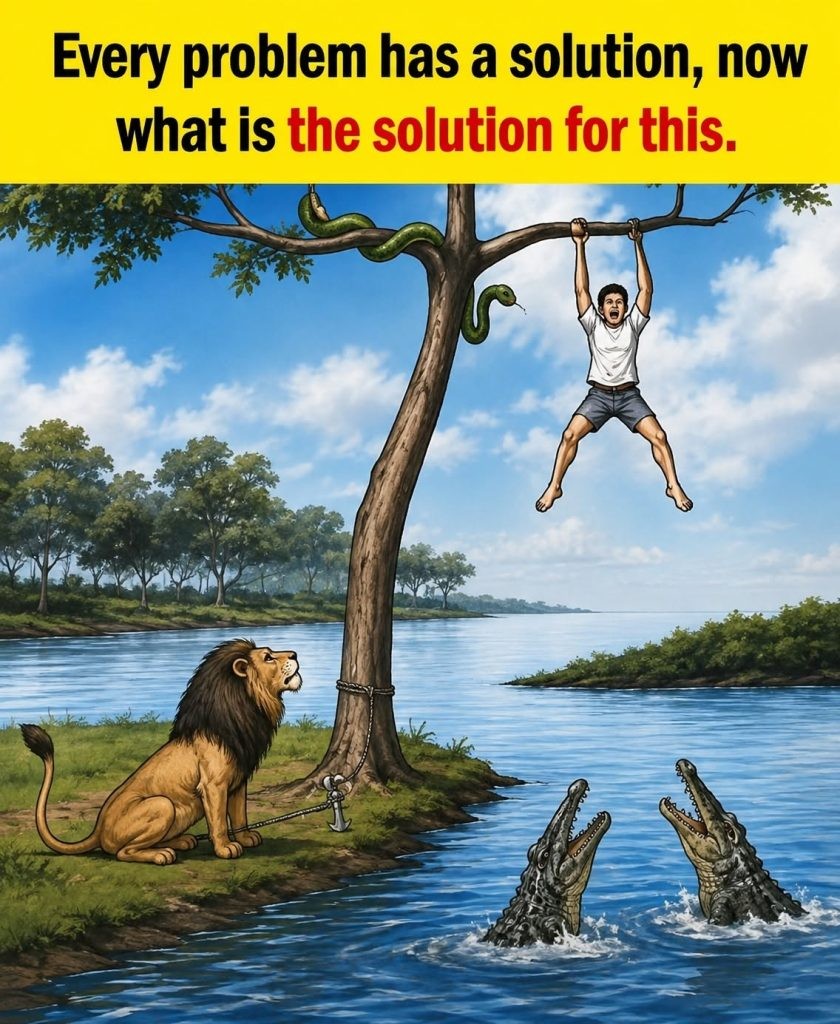
A seemingly impossible survival puzzle has been making people stop, stare, and reconsider their first assumptions. At first glance, a man appears to be surrounded by dangerous animals with nowhere safe to go. A snake is nearby. A lake contains crocodiles. A lion is roaming in the area.
It seems as though every possible escape route leads to trouble.
But there may be another answer.
The trick is not necessarily about finding the fastest way out. Instead, it is about noticing how the situation changes when the man simply waits and observes.
The Man Surrounded by Danger
Picture the scene carefully.
A man is standing in an area where several hazards appear to surround him.
On one side, there is a snake.
Nearby is a tree beside a lake where crocodiles are present.
Then there is a lion moving through the area.
If you were placed in this situation, what would you do first?
Your instinct might be to run.
That is exactly what makes the puzzle interesting.
The obvious paths all seem blocked. Moving toward the snake would be risky. Going toward the lake would create another problem. Heading in the direction of the lion doesn’t appear to be a sensible option either.
The more you look at the scene, the more impossible it seems.
But puzzles like this often depend on one important principle:
The situation may not remain exactly as it is.
The First Mistake People Make
When people see an image filled with threats, they often focus on the objects themselves rather than their behavior.
The snake is dangerous.
The crocodiles are dangerous.
The lion is dangerous.
But simply identifying those dangers doesn’t solve the puzzle.
The better question is:
What are the animals going to do next?
That small change in perspective completely alters the problem.
Instead of asking, “Which direction can the man run?” we can ask, “Will one of these obstacles move?”
This is where observation becomes more important than speed.
The Lion Changes Everything
According to the intended logic of the puzzle, the lion eventually becomes thirsty and approaches the lake.
That creates a new situation.
The lion is no longer positioned exactly where it was before.
At the same time, the crocodiles have something else to react to.
The arrangement of the animals changes, creating a possible opening for the man.
The important point isn’t necessarily that the lion and crocodiles would behave exactly this way in real life. Rather, this is the puzzle’s intended twist: the apparent barriers are not static.
Once one element moves, the entire problem has to be reconsidered.
That is a common technique in visual riddles.
The answer is sometimes hidden not in an object but in an event that has not happened yet.
Patience Becomes the Real Solution

The man doesn’t necessarily need extraordinary strength.
He doesn’t need to outrun the animals.
He doesn’t need to fight his way through the scene.
He simply needs to recognize that waiting may create a better opportunity.
This is what makes the puzzle more interesting than it initially appears.
Our first instinct in a threatening situation is often to react immediately.
But immediate action isn’t always the smartest action.
Sometimes observation provides more useful information than movement.
The man watches the environment.
The animals move.
The circumstances change.
And suddenly, a route that didn’t appear available before may become possible.
Why This Puzzle Tricks Our Brains
There is a psychological reason puzzles like this can feel surprisingly difficult.
When we see a dramatic image, our brains naturally prioritize the most obvious information.
A snake catches our attention.
A lion catches our attention.
Crocodiles catch our attention.
Because these objects appear threatening, we immediately begin searching for a physical escape route.
We rarely stop to ask whether the scene itself might change.
This is an example of how framing can influence problem solving.
The puzzle presents the situation as though the man must choose between several dangerous options.
But that may be the wrong question.
Instead of choosing one of the existing options, the man can wait for a new option to appear.
The Importance of Looking Beyond the Obvious
Many classic riddles work in a similar way.
They provide enough information to make one answer seem obvious, then hide a small detail that changes the entire interpretation.
The solution isn’t necessarily about knowing more facts.
It is about questioning the assumptions you made during the first few seconds.
For example, we might assume that every animal will remain exactly where it is.
But why?
We might assume the man has to move immediately.
But does he?
We might assume every visible object represents a permanent obstacle.
Again, does it?
Once those assumptions are removed, the puzzle becomes much more flexible.
Could It Work This Way in Real Life?
This is where it is important to separate puzzle logic from real-world animal behavior.
In a fictional or illustrative riddle, animals are often given predictable actions so that the puzzle has a clear solution.
Real animals are considerably less predictable.
A lion might approach water for many reasons, but its exact behavior cannot be guaranteed. Crocodiles may respond to movement in different ways. A snake’s behavior can also vary depending on its species, surroundings, temperature, and perceived threat.
So the puzzle should be viewed primarily as a logic exercise, rather than a realistic guide to dealing with wild animals.
Its purpose is to challenge observation and reasoning.
The Hidden Lesson About Problem Solving
Perhaps the most useful part of the puzzle has nothing to do with the animals.
It is about how we respond when every option appears bad.
Imagine facing a problem at work, in a relationship, or during an important decision.
You might see only three choices.
Option A doesn’t work.
Option B seems worse.
Option C feels impossible.
It can be tempting to conclude that there is no solution.
But sometimes the real answer is to pause.
The circumstances may change.
New information may appear.
Someone may offer an unexpected opportunity.
A problem that seemed impossible in the morning may look completely different by the afternoon.
The puzzle captures that idea in a simple visual story.
Why Timing Matters
Timing is another important part of the riddle.
The man doesn’t necessarily solve the situation by doing something extraordinary.
He benefits from recognizing the right moment.
That distinction is important.
Good decision making isn’t always about acting first.
Sometimes it is about knowing when to act.
In chess, players often wait for an opponent to create an opening.
In business, people may wait for better information before making a decision.
In everyday life, taking a few minutes to think can prevent an unnecessary mistake.
The puzzle turns that general principle into a dramatic scenario.
What Is the Intended Answer?
The intended solution is that the man waits for the situation to change.
When the lion heads toward the lake, the animals’ positions and attention shift. This creates an opportunity for the man to move away from the immediate danger rather than rushing directly toward one of the obstacles.
The deeper answer, however, is not simply “wait for the lion.”
It is:
Don’t assume the situation will remain unchanged.
That is the detail many people overlook.
Why People Enjoy Puzzles Like This
Logic puzzles remain popular because they offer a small challenge with an immediate reward.
You look at the problem.
You make an assumption.
You get stuck.
Then suddenly, one small detail changes everything.
That moment of realization is satisfying because it reveals something about how our own thinking works.
We aren’t simply solving the puzzle.
We’re discovering how easily our minds can become attached to the first interpretation we create.
And that is precisely why these images can be so perplexing.
A Final Thought
At first glance, the man appears trapped.
Every direction seems to contain another obstacle.
But the solution isn’t necessarily hidden in a secret path.
It is hidden in the passage of time.
The animals can move.
The circumstances can change.
And a situation that looks impossible at one moment may become manageable at another.
That is the simple lesson behind this puzzle: when you can’t see a solution, don’t always assume there isn’t one. Sometimes you simply haven’t waited long enough to see it.
Perhaps that is why riddles continue to fascinate us. They remind us that curiosity begins with a willingness to look again, question our assumptions, and consider that the obvious answer may not be the right one.