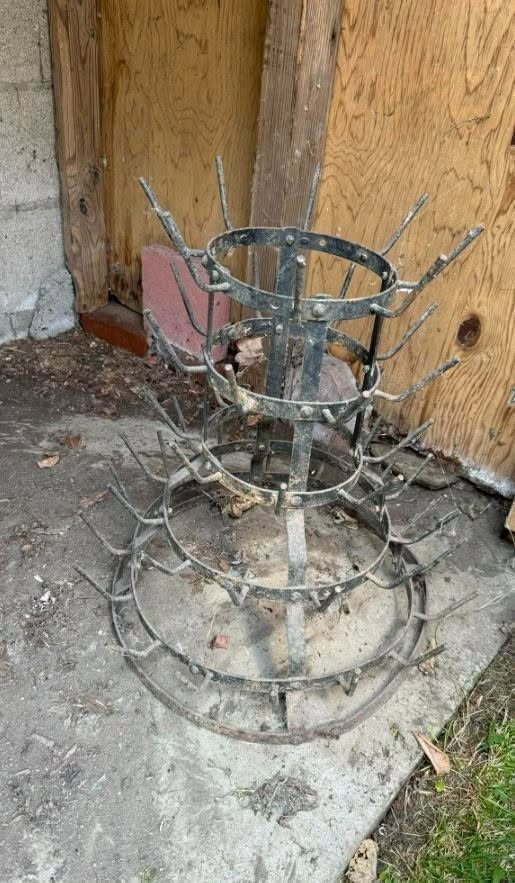
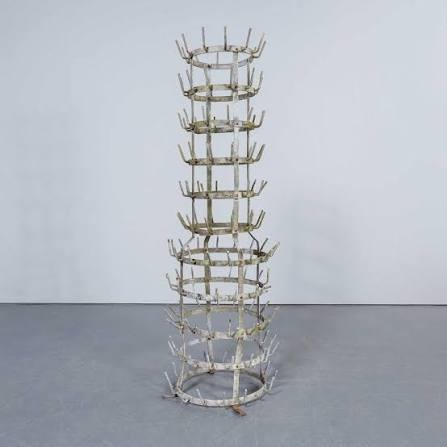
At first glance, the old metal object looks almost mysterious.
With its circular tiers, unusual shape, and dozens of thin metal points reaching outward, it could easily be mistaken for a piece of antique machinery or even some kind of decorative sculpture. To modern eyes, its purpose is not immediately obvious.
But this strange-looking object has a much simpler story.
It was designed to solve an everyday household problem: drying glass bottles.
Known in French as a porte-bouteilles, séchoir à bouteilles, or hérisson, this type of metal bottle-drying rack was a practical household item. Its distinctive structure allowed washed bottles to be placed upside down so that water could drain away and the inside could dry naturally.
Today, objects like this can feel almost like artifacts from another world. Yet they reveal something fascinating about earlier domestic life: before modern appliances became commonplace, people often solved ordinary problems with remarkably simple mechanical designs.
And this particular object has an even more surprising connection to modern art.
A Simple Tool Hidden in Plain Sight
Imagine a household in France more than a century ago.
Glass bottles were valuable objects that could be washed and reused rather than immediately discarded. After cleaning, however, getting the inside of a narrow bottle completely dry was not always easy.
Simply placing the bottle upright could leave moisture trapped inside.
The bottle-drying rack offered a straightforward solution.
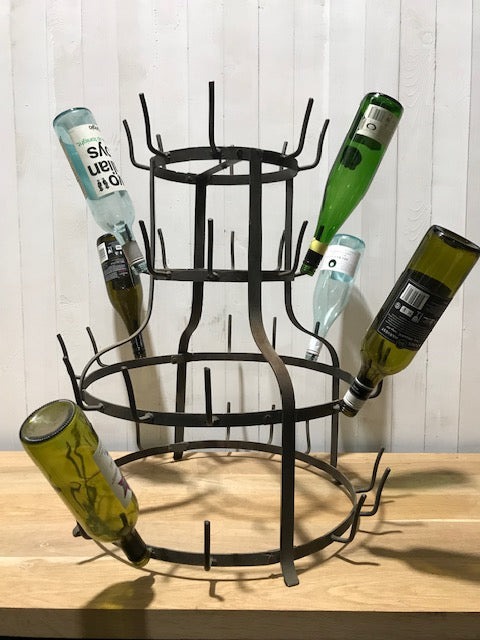
Its metal frame was designed with multiple levels and projecting supports. Bottles could be placed upside down over the metal points, allowing air to circulate while remaining water drained away.
The design was simple, but effective.
Historical sources describe these racks as ordinary household objects, with some French families reusing their glass bottles and placing them on the rack to dry before taking them to a wine merchant for refilling.
What looks strange today was once a practical part of everyday life.
Why Does It Look Like a Metal Hedgehog?
One of the most interesting details is its French nickname: hérisson, meaning “hedgehog.”
The reason is easy to understand.
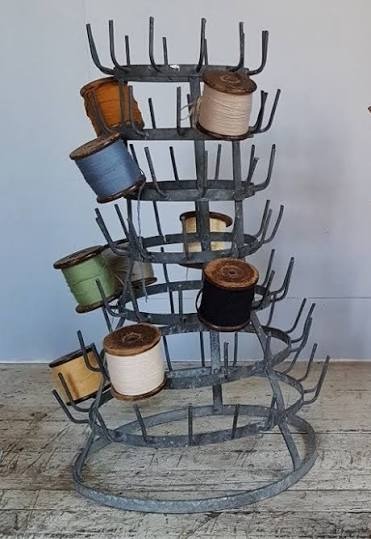
The many upward-pointing metal supports give the object a spiky appearance. From a distance, the rack can resemble a large metal creature covered in quills.
That unusual appearance eventually became an important part of its cultural identity.
The name hérisson was not necessarily a statement about symbolism or superstition. It was simply an evocative way to describe an object whose shape immediately reminded people of a hedgehog.
This is a good example of how ordinary objects can acquire memorable names simply because of their appearance.
The Science Behind the Design
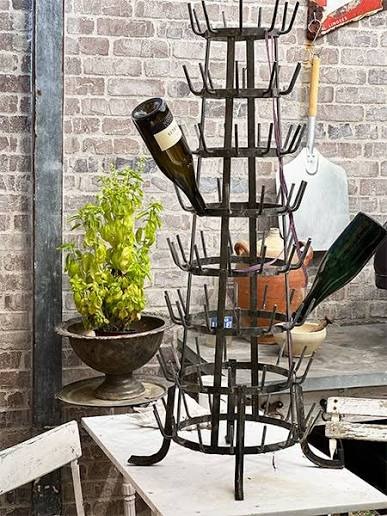
Although the rack was created for practical household use, its effectiveness can be explained through basic physical principles.
When a wet bottle is turned upside down, gravity encourages water to move toward the opening. At the same time, the open position allows air to circulate through the bottle.
The rack keeps the bottle elevated rather than allowing its opening to sit against a flat surface.
That small detail matters.
If the opening were blocked, moisture could remain trapped inside for longer. By supporting the bottle above the surrounding surface, the rack creates more opportunity for water to drain and for air to reach the interior.
The design therefore combines several simple principles:
Gravity helps drainage.
Air circulation encourages drying.
Elevated supports prevent the bottle opening from being sealed against a surface.
There is nothing mysterious about the process. The remarkable part is how efficiently a relatively simple metal structure could address an everyday problem.
A World Before Modern Kitchen Appliances
It is easy to look backward and imagine that people in the past had fewer practical solutions.
In reality, many historical household objects were highly specialized.
People simply did not have the same electrical appliances, automated dishwashers, or compact drying systems available today. As a result, household tools were often designed around direct mechanical solutions.
The bottle rack is a perfect example.
It does not require electricity.
It does not require complicated controls.
It does not need a motor.
It simply uses gravity, airflow, and a carefully designed structure.
That simplicity is part of what makes antique household equipment so interesting to collectors today.
From Household Object to Art History
The story becomes much more surprising when the name Marcel Duchamp enters the picture.
In 1914, French-American artist Marcel Duchamp purchased a mass-produced bottle rack at a Paris department store. Instead of treating it as merely a household tool, he selected it as an artwork.
The object became known as Bottle Rack, or Porte-Bouteilles.
The Art Institute of Chicago explains that Duchamp’s approach transformed ordinary manufactured objects through the simple act of selecting and presenting them as art.
This idea became associated with Duchamp’s famous concept of the readymade.
The basic question was revolutionary:
What happens when an ordinary manufactured object is removed from its normal environment and presented as art?
Suddenly, the viewer is forced to reconsider the object.
A bottle rack is no longer simply a bottle rack.
It becomes an opportunity to think about art, creativity, authorship, and meaning.
Why Duchamp’s Choice Was So Important
Duchamp’s selection of the bottle rack was significant partly because he did not need to transform the object into something visually elaborate.
He did not need to paint it.
He did not need to carve it.
He did not need to construct a complicated sculpture from scratch.
Instead, the object itself became the center of the discussion.
The Art Institute of Chicago describes this transformation as one that challenged traditional ideas about what an artwork actually is and what an artist contributes to it.
That makes the humble bottle rack an unexpected bridge between household technology and modern art.
A tool that once helped people dry bottles eventually became part of a much larger conversation about creativity.
Was There a Hidden Meaning?
This is where interpretation becomes more complicated.
Because the bottle rack has an unusual shape, some viewers have attempted to find deeper symbolic meanings in it.
That is understandable.
Humans naturally search for patterns and meanings, especially when an ordinary object is placed inside an art museum.
However, it is important to separate documented history from later interpretation.
Duchamp’s bottle rack is well documented as a manufactured household object that he selected and presented in the context of his developing ideas about readymade art.
Beyond that, interpretations can vary considerably.
Some viewers may see humor.
Others may see social commentary.
Others may simply appreciate the strange visual appearance.
There is no need to assume that every possible interpretation was part of Duchamp’s original intention.
Sometimes an object’s ability to generate questions is more important than having one definitive answer.
Why the Original Object Is No Longer With Us
There is another fascinating detail surrounding Duchamp’s bottle rack.
The original object he purchased in Paris is no longer preserved.
According to museum documentation, Duchamp left the piece in his Paris studio when he moved to New York. His sister Suzanne, who was looking after the studio, eventually discarded it.
That means the examples displayed in museums today are later versions or replicas rather than the original household object Duchamp purchased in 1914.
This may sound like a small historical detail, but it adds another layer to the story.
An everyday object that was once easily replaceable eventually became important enough that museums produced and preserved authorized versions.
The ordinary became extraordinary.
What the Object Tells Us About Earlier Generations
Beyond its connection to art, the bottle rack offers a glimpse into everyday habits from another era.
It reminds us that glass containers were often treated as reusable resources.
A bottle was not necessarily something to use once and discard. It could be cleaned, dried, returned, and used again.
The drying rack therefore belonged to a broader culture of reuse and practical household management.
Its design also reflects a particular philosophy of manufacturing.
The object was created to perform one specific task repeatedly.
There was little need for electronic features or complicated technology.
Its usefulness came from its physical structure.
That philosophy can feel surprisingly modern today, especially at a time when people are once again interested in reducing waste, repairing household objects, and finding simple solutions to everyday problems.
Why Vintage Objects Fascinate Us
Perhaps the biggest reason objects like this continue to attract attention is that they challenge our assumptions.
When we encounter an unfamiliar antique tool, we often try to guess its purpose.
Is it agricultural equipment?
A piece of industrial machinery?
A decorative object?
Something connected to a forgotten tradition?
That moment of uncertainty is part of the fun.
Once we discover the answer, we experience a small connection with the past.
The object suddenly makes sense.
The strange metal structure becomes a practical household tool. The unusual nickname becomes understandable. And the connection to Duchamp adds another unexpected chapter to its history.
The Difference Between Myth and History
Stories surrounding old objects can easily become exaggerated over time.
An unusual shape may lead to speculation about hidden meanings. A rare surviving example may inspire elaborate stories about its origins. A familiar household tool may eventually acquire an almost legendary reputation.
But history is often more interesting when we separate documented facts from speculation.
In this case, the basic story is already fascinating.
The object was a bottle-drying rack.
It was designed for a practical household purpose.
Duchamp encountered one in Paris in 1914.
He selected it as a readymade and helped transform the way many people thought about the relationship between ordinary objects and art.
No extraordinary explanation is necessary.
The real story is remarkable enough.
A Small Object With a Much Bigger Story
Today, a modern viewer might walk past a vintage bottle rack without giving it much thought.
It is easy to assume that an object with such an unusual appearance must have had some mysterious purpose.
But sometimes history hides in plain sight.
The strange metal structure was created for something remarkably ordinary: helping people dry reusable glass bottles.
Then, through an unexpected encounter with Marcel Duchamp, that ordinary household object became connected to one of the most influential ideas in modern art.
That journey is what makes it memorable.
It moved from the kitchen to the studio, from practical equipment to an object of artistic discussion, and eventually into museums and art history.
The Curiosity That Keeps Old Objects Alive
Perhaps that is why forgotten household objects continue to fascinate us.
They are physical reminders that everyday life has changed dramatically over time. They show us how previous generations solved problems, reused materials, and designed tools around the resources available to them.
But they also remind us that meaning is not always fixed.
A bottle rack can be a household tool.
It can become a collector’s item.
It can become a museum object.
Or it can simply become a conversation starter for someone who sees it for the first time and wonders, “What on earth was this used for?”
That question is perhaps the most valuable part of all.
Human curiosity encourages us to look closer, investigate unfamiliar objects, and search for the stories hidden behind them. And sometimes, the answer is even more interesting than the mystery.
A simple metal rack once designed to dry bottles became part of a much larger story about technology, everyday life, art, and human imagination.
Sometimes, the most fascinating objects are not the ones created to be extraordinary. They are the ordinary objects that history teaches us to see differently.