Chapter 1: The Bill That Made No Sense
Eleanor had always been careful with money.
She lived alone in a quiet suburban neighborhood where nothing much ever happened. Her daily routine was simple, predictable, and peaceful.
That was why she immediately noticed something was wrong when her electricity bill arrived.
It was nearly twice what she normally paid.
At first, Eleanor assumed it was a mistake.
She checked the previous month’s bill. Then she checked the meter. She walked around the house, making sure she hadn’t accidentally left an appliance running.
Everything seemed normal.
The lights were off when she wasn’t using them. The air conditioner was running as usual. Nothing had changed.
Yet the bill kept climbing.
For the next several weeks, Eleanor tried to ignore it.
Until one night, she looked out of her bedroom window.
And saw something that made her stop breathing for a moment.
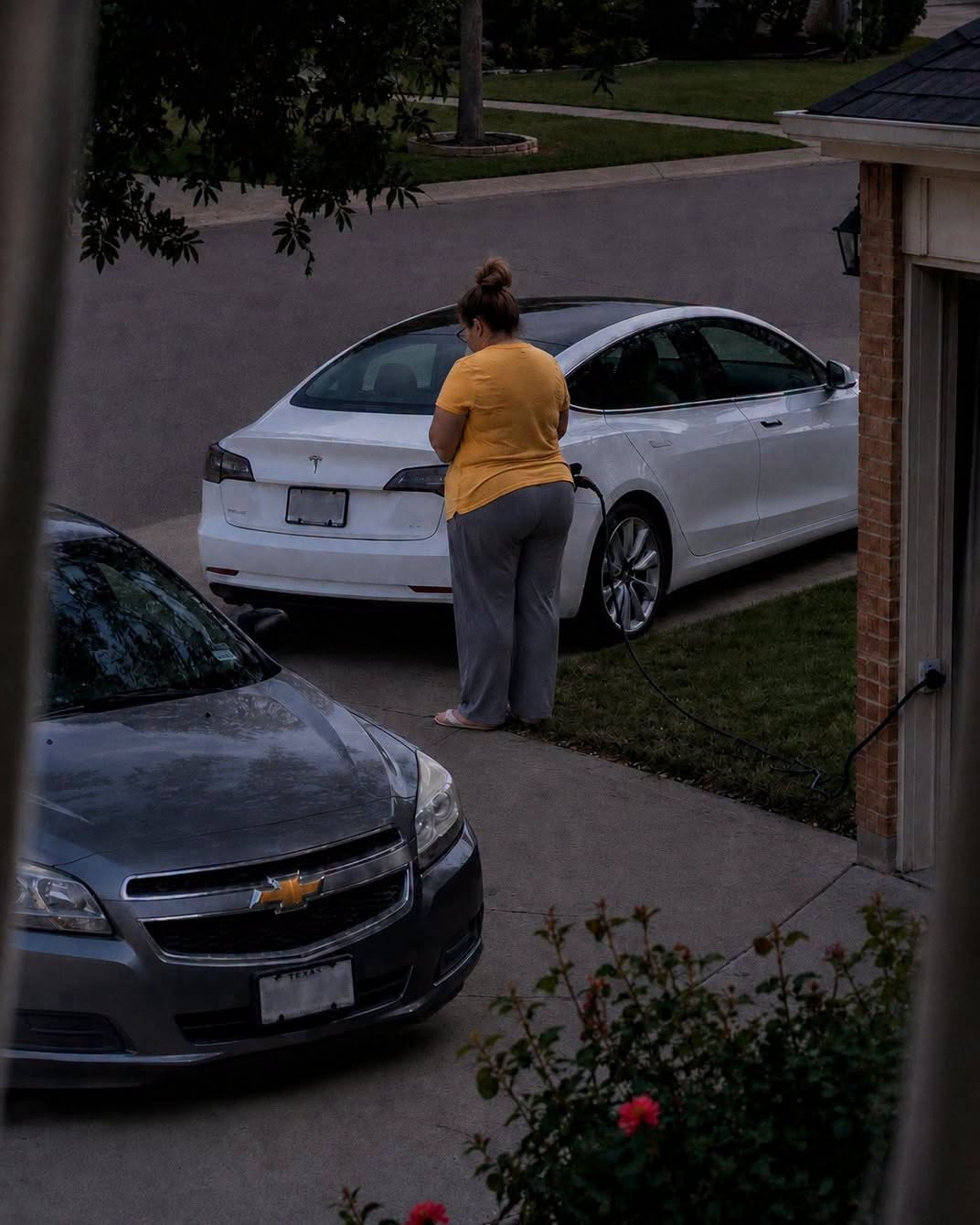
There was an electric car parked beside her house.
And a charging cable was connected to one of Eleanor’s outdoor outlets.
But Eleanor didn’t own an electric car.
Chapter 2: The Neighbor’s Secret
Eleanor quietly stepped outside.
She recognized the vehicle immediately.
It belonged to Monica, the woman who lived next door.
For a moment, Eleanor simply stood there, staring.
She couldn’t understand what she was seeing.
Why would Monica plug her car into Eleanor’s outlet?
More importantly…
How long had she been doing it?
The next morning, Eleanor checked the outlet.
There were no signs that it had been damaged.
Everything looked perfectly normal.
That somehow made the situation even stranger.
She decided not to confront Monica immediately.
Instead, Eleanor waited.
That evening, she watched from behind her curtains.
Around 10 p.m., Monica’s car appeared again.
She parked in almost exactly the same spot.
Then she connected the charging cable.
Eleanor couldn’t believe it.
This wasn’t a one-time mistake.
Monica had apparently been doing this repeatedly.
Chapter 3: It Wasn’t Just the Electricity
The following morning, Eleanor finally remembered something.
A few months earlier, Monica had asked if she could temporarily use an outdoor outlet because she was having electrical work done at her house.
Eleanor had agreed.
“Just for a few days,” Monica had promised.
But apparently, those few days had quietly turned into something much longer.
Then Eleanor started remembering other things.
The garden hose Monica had borrowed.
The tools that had never been returned.
The packages that occasionally disappeared from Eleanor’s porch before she could collect them.
Even the parking space Monica sometimes used without asking.
Individually, none of these things seemed important.
Together, they revealed a pattern.
Eleanor had been allowing small boundaries to disappear one by one.
And Monica had apparently learned that Eleanor rarely complained.
But this time was different.
Because now Eleanor was paying for it.
Literally.
Chapter 4: The Confrontation
The next afternoon, Eleanor walked over to Monica’s house.
She knocked on the door.
Monica opened it with a smile.
“Hey, Eleanor!”
Eleanor smiled back.
But this time, she didn’t pretend everything was fine.
“I noticed your car has been charging from my outlet.”
Monica paused.
Then she laughed.
“Oh, that?”
She acted as though Eleanor had mentioned something completely ordinary.
“I figured you wouldn’t mind.”
Those six words stayed in Eleanor’s mind.
I figured you wouldn’t mind.
That was the real problem.
Monica hadn’t asked.
She had simply assumed.
Eleanor calmly explained that her electricity bill had increased dramatically and that she couldn’t continue allowing the car to charge from her property.
Monica looked surprised.
“But it’s just a little electricity.”
Eleanor didn’t argue.
She simply said:
“Maybe. But it’s my electricity.”
Then she walked home.
For the first time in months, she felt strangely relieved.
But she wasn’t finished.
Chapter 5: The Simple Solution
That evening, Eleanor didn’t confront Monica again.
Instead, she came up with a simple solution.
She installed a small motion sensor near the outlet and placed a clearly visible sign beside it.
The message was short:
PRIVATE PROPERTY. PLEASE ASK BEFORE USING THIS OUTLET.
There was no insult.
No threat.
No argument.
Just a boundary.
Eleanor went to bed feeling satisfied.
The next night, she heard a car pull into the driveway.
She looked through the window.
Monica was there.
She stepped out of her car and walked toward the outlet.
Then she noticed the sign.
She stopped.
For several seconds, she simply stared at it.
Then she looked toward Eleanor’s house.
And something unexpected happened.
Monica didn’t plug in the car.
Chapter 6: The Conversation Nobody Expected
The following morning, Monica knocked on Eleanor’s door.
Eleanor opened it.
“I saw your sign,” Monica said.
“I understand.”
There was an awkward silence.
Then Monica surprised her.
“I guess I got too comfortable.”
Eleanor hadn’t expected that answer.
Monica admitted that she had gradually started treating Eleanor’s kindness as something she could rely on without asking.
The charging outlet had simply become the latest example.
Eleanor listened.
She didn’t yell.
She didn’t demand an apology.
She simply explained that being a good neighbor didn’t mean she had to say yes to everything.
Monica nodded.
And for the first time, the two women had an honest conversation about boundaries.
Chapter 7: What Eleanor Learned
A few days later, Eleanor’s electricity bill returned to normal.
But the experience had changed something far more important.
She realized that setting boundaries didn’t necessarily make someone unfriendly.
Sometimes, it simply meant being clear about what belonged to you.
The garden hose.
The tools.
The driveway.
The electricity.
Even your time.
Eleanor had spent months worrying about whether saying “no” would make her a bad neighbor.
Instead, she discovered something else.
A healthy neighborhood isn’t built by people who never say no.
It’s built by people who respect each other’s boundaries.
And sometimes, the smallest “no” can prevent a much bigger problem later.
The End
Have you ever had a neighbor cross a boundary and pretend it wasn’t a big deal? What would you have done in Eleanor’s situation?